Singapore VCC insights
VCC for family office investment vehicles — Step-by-step walkthrough
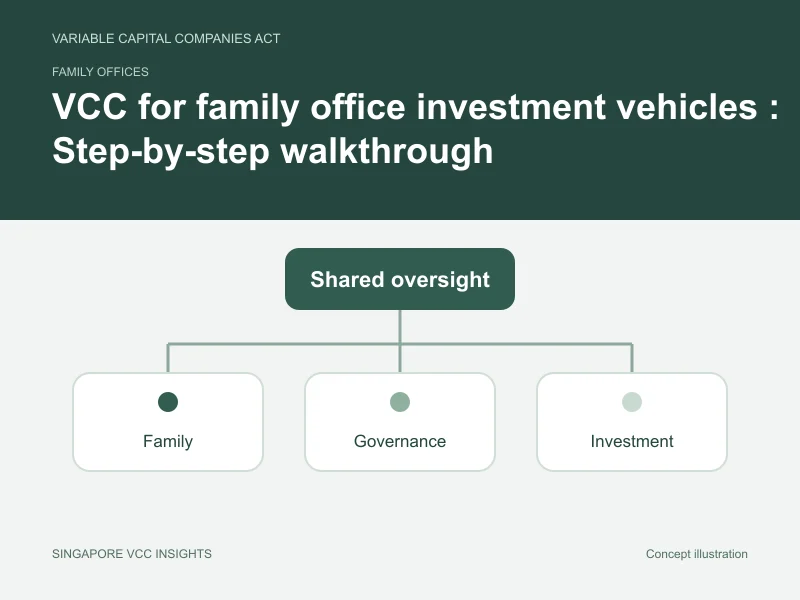
A VCC for family office investment vehicles is a Variable Capital Company used by a single family to hold and manage its investment portfolio under one corporate roof in Singapore, paired with a Singapore-based fund manager and, in most cases, a Section 13O or 13U tax incentive. It combines flexible capital, ring-fenced sub-funds and a recognised fund structure.
Raffles Corporate Services works with a panel of corporate and employment law firms; this article is general information, not legal advice.
What a family office VCC actually is
The Variable Capital Company is a corporate fund vehicle introduced under the Variable Capital Companies Act 2018. For wealthy families, it sits at the centre of the single family office (SFO) structure: the family’s capital is contributed as shares in the VCC, the portfolio is held inside the VCC, and a related fund management entity directs the investments. Unlike an ordinary private limited company, a VCC can freely issue and redeem shares at net asset value without the capital maintenance restrictions that constrain a Companies Act 1967 company, which makes contributions and distributions far simpler to administer.
A VCC may be set up as a standalone (single) fund or as an umbrella with multiple sub-funds. The umbrella form is the reason families gravitate to the structure: each sub-fund can hold a distinct strategy, for example a liquid equities sleeve, a private equity sleeve and a real estate sleeve, while the assets and liabilities of each sub-fund are legally segregated from the others. One umbrella VCC therefore replaces what might otherwise be three or four separate companies, with one board, one auditor and one annual compliance cycle.
For the wider context on how the family office sits around the fund, our complete guide to setting up a family office in Singapore for 2026 walks through the operating entity, the headcount expectations and the assets-under-management thresholds that frame the whole exercise.
Who the structure is for
This structure suits a family that has accumulated investable assets, typically from S$20,000,000 upwards, and wants a single, professionally governed home for that capital rather than a scatter of personal accounts and holding companies across jurisdictions. It is well matched to families seeking a tax incentive on fund income, families who want clean segregation between investment strategies, and families planning multi-generational succession where shares in the VCC can be allotted and redeemed as members of the family come and go.
It is less suitable where the pool is small, where the family is unwilling to appoint or engage a Singapore-based fund manager, or where the only objective is to hold a single operating business rather than a diversified investment portfolio. In those cases an ordinary holding company is usually cheaper and simpler.
In practice, families also reach for the VCC when they want privacy and consolidation. A VCC’s register of members is not made public in the same way as an ordinary company’s shareholding, and an umbrella VCC lets a family present a single consolidated structure to bankers and custodians rather than a fragmented set of entities. For families relocating wealth into Singapore as part of a broader move, the VCC is frequently paired with the operating family office company that employs the investment professionals and runs day-to-day affairs, with the VCC sitting beneath it as the actual asset-holding vehicle.
Eligibility and requirements for a family office VCC
A VCC for family office investment vehicles carries the same statutory baseline as any other VCC, plus the practical requirements of the tax incentive the family is targeting. The core requirements are these. The VCC must have at least one director who is ordinarily resident in Singapore. It commonly has at least three directors where it intends to apply for tax incentives, in line with usual practice for incentivised funds. At least one director must also be a director or qualified representative of the fund manager, or be the fund manager itself, reflecting the requirement under the Variable Capital Companies Act 2018 that the VCC be tied to its manager at board level.
Critically, every VCC must appoint a permissible fund manager. The Variable Capital Companies Act 2018 requires a VCC to be managed by a fund manager that is regulated by the Monetary Authority of Singapore, whether a licensed fund management company, a registered fund management company or an entity otherwise exempt under the framework administered by the Monetary Authority of Singapore. A purely self-directed family with no regulated manager cannot run a VCC on its own. The VCC must also keep a registered office in Singapore and appoint a Singapore-based company secretary and an auditor.
Where the family is pursuing the Section 13O or Section 13U exemptions under the Income Tax Act 1947, additional conditions apply, including minimum fund size, minimum local business spending and minimum investment-professional headcount. The differences between the two schemes, including the assets-under-management floor and the spending tiers, are set out in our partner explainer on Section 13O versus Section 13U family office tax incentives.
Cost and timeline
The hard registration cost is modest; the surrounding professional and fund-manager costs are where the real budget sits. The ACRA name application fee for a VCC is S$15. The VCC incorporation fee payable to the Accounting and Corporate Regulatory Authority is S$8,000, and registering each additional sub-fund within an umbrella VCC costs S$400 per sub-fund. These statutory figures are published by the Accounting and Corporate Regulatory Authority and should always be checked against the live fee schedule before filing.
On top of the ACRA fees, a family should budget for professional set-up work, which commonly ranges from S$15,000 to S$40,000 depending on complexity, covering constitution drafting, fund-manager arrangements, the MAS notification or licensing pathway and the tax incentive application. Recurring annual costs, covering the company secretary, accounting, audit, fund administration and the resident director, typically run from S$30,000 a year upwards.
On timeline, the VCC itself can be incorporated quickly once documents are ready, often within one to two weeks of name reservation. The longer pole is the tax incentive: a Section 13O or 13U application reviewed by MAS commonly takes around three to six months from submission, so families targeting an incentive should plan the calendar around that window rather than the incorporation date.
Step-by-step setup process
The walkthrough below reflects the usual sequence for a single family office VCC seeking a tax incentive.
Step 1: Settle the structure. Decide between a standalone VCC and an umbrella with sub-funds, and confirm which tax incentive, if any, the family is targeting. This decision drives almost everything downstream, including headcount and spending commitments.
Step 2: Establish the fund manager. Set up or appoint the Singapore fund management entity and confirm its regulatory status with MAS. For many SFOs this is a related entity that relies on an exemption, but the regulatory pathway should be confirmed early.
Step 3: Reserve the name. Apply through ACRA’s BizFile portal to reserve the VCC name, paying the S$15 fee. A VCC name must end with the words “VCC” or “Variable Capital Company”.
Step 4: Prepare the constitution and appointments. Draft the VCC constitution, appoint the directors (including the resident director and the manager-linked director), the company secretary and the auditor, and fix the registered office.
Step 5: Incorporate. File the incorporation application with ACRA and pay the S$8,000 fee, adding S$400 for each sub-fund being registered at the outset.
Step 6: Open banking and fund the vehicle. Open the corporate and custody accounts and arrange the family’s capital contribution as subscriptions for shares in the VCC or its sub-funds.
Step 7: Apply for the tax incentive. Submit the Section 13O or 13U application to MAS, then maintain the committed headcount and local spending throughout the incentive period.
A realistic calendar for a family targeting an incentive therefore runs something like this. Weeks one and two cover structuring decisions and the fund-manager pathway. Weeks two and three cover name reservation and drafting. The incorporation itself can complete within a few business days of a clean filing. Banking and custody onboarding can take several weeks in its own right, depending on the institution and the source-of-wealth review. The MAS incentive review then runs in parallel or after, commonly three to six months. Families who treat the incorporation date as the finish line are often surprised by the banking and incentive timelines, so the prudent approach is to start the manager and incentive workstreams as early as the structuring decision allows.
Governance, compliance and tax residency
A VCC is a company, so it carries continuing obligations: maintaining statutory registers, holding the requisite meetings, keeping accounting records, preparing financial statements and filing an annual return with ACRA. Sub-fund segregation must be respected in practice as well as on paper, with separate records and clear allocation of assets and liabilities to each sub-fund.
Where the family is relying on a Singapore tax incentive, the VCC’s tax residency matters, and residency turns on where the central management and control of the company is exercised, which is why board composition and where directors actually meet are not mere formalities. Families running cross-border structures should read our guide on the Singapore tax residency control and management test before fixing board arrangements. The fund manager relationship is also a live compliance item, since the requirement to be managed by a permissible fund manager continues for the life of the VCC, not just at incorporation.
The family should also note the VCC-specific reporting touches. A VCC files its annual return and financial statements with ACRA, and where an incentive applies, the conditions attached by MAS are tested on an ongoing basis, so the family office needs a calendar that captures both the corporate filing deadlines and the incentive review points. The annual independent audit is not optional for a VCC, and the auditor will expect clean sub-fund records, which reinforces why segregation should be built into the bookkeeping from the first contribution rather than retro-fitted later. Records relevant to the incentive, such as evidence of local business spending and the headcount of investment professionals, are best maintained contemporaneously so they can be produced if the authorities request them.
Common mistakes and gotchas
Several avoidable errors recur. The first is treating the VCC as a do-it-yourself holding company and overlooking the mandatory regulated fund manager; without that relationship the structure is not viable. The second is under-budgeting for the tax incentive’s ongoing commitments, then failing the headcount or local-spend tests in a later year. The third is mixing sub-fund assets or sharing bank accounts across sub-funds, which undermines the very segregation that justifies the umbrella. The fourth is assuming the incentive is automatic; it is granted by MAS on application and on continuing conditions, not on incorporation. The fifth is fixing a board that meets and decides outside Singapore, which can put the intended tax residency at risk.
Related guides
Families comparing fund strategies often look beyond the SFO use case. The same VCC engine can be deployed for pooled and feeder structures, and our walkthrough on the VCC for accredited-investor-only feeder funds is a useful companion read where the family expects to admit a small number of external investors alongside its own capital. Read it together with the family office and tax-residency guides linked above to map the full picture.
FAQs
Does a family office VCC need a regulated fund manager? Yes. A VCC must be managed by a permissible fund manager that is licensed, registered or exempt under the MAS framework. A family cannot operate a VCC purely on a self-directed basis with no regulated manager.
How many directors does a family office VCC need? A VCC needs at least one director ordinarily resident in Singapore, and at least one director who is also tied to the fund manager. Funds applying for tax incentives commonly appoint at least three directors in line with the incentive conditions.
What does it cost to register a VCC? The ACRA incorporation fee is S$8,000, plus S$15 for the name application and S$400 for each additional sub-fund. Professional set-up and the tax incentive application are separate and usually run from S$15,000 upwards.
How long does the whole process take? The VCC can usually be incorporated within one to two weeks once documents are ready, but a Section 13O or 13U tax incentive application reviewed by MAS commonly takes around three to six months.
Can one VCC hold several investment strategies? Yes. An umbrella VCC can hold multiple sub-funds, each with a distinct strategy and with assets and liabilities legally segregated from the other sub-funds, under a single board and a single annual compliance cycle.
Need help with this? Call, SMS or WhatsApp +65 8501 7133, or email hello@rafflescorporateservices.com. Raffles Corporate Services works with a panel of corporate and employment law firms; this article is general information, not legal advice.