Independent Singapore VCC guidance
Direct answer
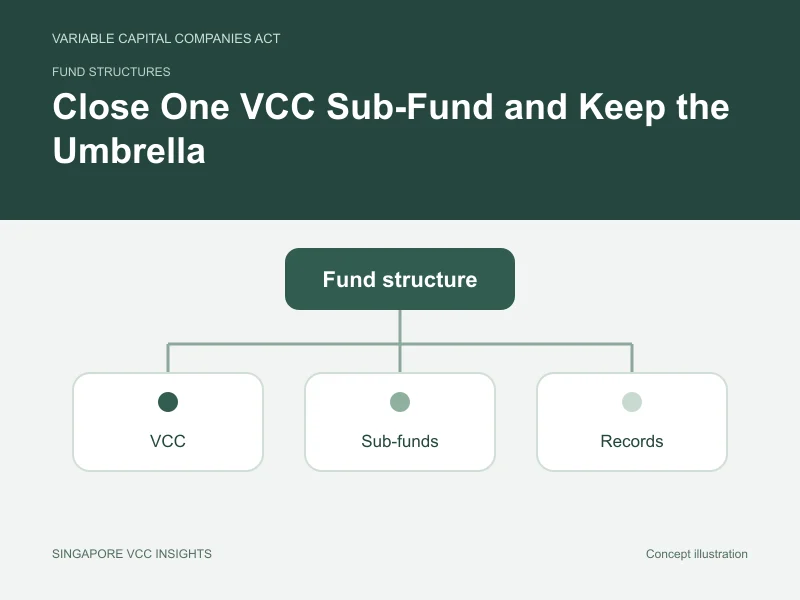
An umbrella VCC can apply to dissolve one inactive sub-fund while the umbrella and its other sub-funds continue. The board should first stop new activity, settle or transfer every asset and liability through properly documented transactions, complete investor and provider close-out, obtain the required tax clearance, and confirm that no proceeding or regulatory action prevents the route. Only then should the directors approve the ACRA application and update every shared umbrella record that still refers to the sub-fund.
At a glance
- Closing one sub-fund is different from closing the umbrella VCC.
- Administrative dissolution is a clean-state route, not a shortcut around unresolved assets or liabilities.
- Tax clearance and final sub-fund records belong before completion, not after deletion from the register.
- The umbrella's shared contracts, policies and reports must be revised without disturbing continuing sub-funds.
Who this is for
- Directors and operations teams closing an inactive sub-fund within a continuing Singapore umbrella VCC.
Important exclusions
- A sub-fund with unresolved solvency, creditor, litigation, regulatory or complex distribution issues that may require a formal winding-up route.
Choose dissolution only for a clean sub-fund
ACRA provides an application route to dissolve a sub-fund that has not begun operating or is no longer active. The current subsidiary legislation adds the clean-state conditions: no asset or contingent asset, no liability or contingent liability, no relevant court proceeding and no ongoing or pending regulatory action on account of the sub-fund. The board should test those conditions before selecting the route. If an item cannot be settled, transferred or resolved lawfully, stop the application and assess the appropriate winding-up process with advisers.
Sources: ACRA · Singapore Statutes OnlineSelect the closure route
- Never launchedUse the dissolution assessment if the sub-fund never began business and every clean-state condition can be evidenced.
- Inactive and clearedUse the same assessment after operations cease, investors exit and assets, liabilities, proceedings and regulatory matters are fully resolved.
- Assets or liabilities remainDo not file a clean-state application while property, debt, accruals, guarantees, claims or contingent exposures remain unexplained.
- Dispute or regulatory actionPause and obtain case-specific advice where litigation, investigation, direction, approval condition or objection may affect closure.
- Umbrella also endingTreat closure of the entire VCC as a separate lifecycle project rather than presenting it as a single-sub-fund housekeeping task.
Related guidance: umbrella VCC and sub-fund guide
Build the pre-application close-out ledger
Create a ledger that starts with the final trial balance and extends beyond accounting balances. Include investments, cash, receivables, payables, accrued fees, tax, unsettled trades, guarantees, indemnities, claims, side letters, subscriptions, redemptions, distributions, unclaimed money, data obligations and provider termination rights. For each line, record the legal owner, counterparty, amount or exposure, settlement method, approval, evidence and completion date. A zero accounting balance is not enough if a contract, claim or contingent exposure survives.
Sources: Singapore Statutes Online · IRASClean-state evidence
- Board-approved cessation date and instruction preventing new subscriptions, investments and avoidable expenses for the closing sub-fund.
- Final portfolio and cash reconciliation showing how every asset, receivable and unsettled item was realised, distributed or otherwise resolved.
- Creditor and expense schedule showing payment, release or documented treatment of every liability and contingent liability.
- Investor register reconciliation showing final holdings, redemption or distribution evidence, notices and any unclaimed amount treatment.
- Legal and compliance confirmation covering proceedings, complaints, investigations, directions, approval conditions and outstanding regulatory actions.
- Provider termination file covering administrator, custodian, bank, auditor, manager, data, technology and delegated arrangements.
- Archive map proving that books, contracts, approvals, investor files and correspondence remain accessible after the operational systems are closed.
Related guidance: VCC sub-fund contract controls
Complete tax clearance and final accounts
IRAS states that tax clearance must be obtained before completion of a sub-fund winding-up process. The umbrella should provide the relevant financial statements and tax computation up to the sub-fund's cessation date and settle outstanding tax matters, including outstanding taxes and penalties relating to that sub-fund. Build the tax work into the critical path. The finance team should reconcile cessation dates, realised transactions, expense allocations and final balances to the corporate close-out ledger before requesting clearance.
Sources: IRASTax and accounts workstream
- Fix cessationApprove and document the date on which the sub-fund ceased business, then use it consistently across ledgers, contracts and correspondence.
- Close transactionsReconcile disposals, distributions, expenses, accruals and any cross-sub-fund or umbrella allocations through the cessation date.
- Prepare statementsProduce the relevant sub-fund financial information and supporting tax computation in a form that reconciles to the umbrella records.
- Resolve liabilitiesSettle outstanding tax, penalty and filing matters and retain payment, submission and correspondence evidence in the closure file.
- Obtain clearanceDo not treat the corporate application as the final step while the required IRAS clearance remains incomplete or conditional.
Related guidance: VCC compliance checklist
Approve and submit the ACRA application
The current Act provides that an application to dissolve a sub-fund is made on the umbrella VCC's behalf by its directors or a majority of them. ACRA's public guide directs users to VCC eServices, the Close a VCC area and the Application to Dissolve a Sub-Fund transaction. The board paper should attach the clean-state ledger, tax clearance, investor and provider completion evidence, conflict declarations and the exact sub-fund identifier. The resolution should authorise a named lodger and require later notices or objections to return to the board.
Sources: Singapore Statutes Online · ACRABoard and filing pack
- Correct umbrella VCC legal name, unique identifier and exact sub-fund name and number.
- Directors' paper explaining the selected route and confirming the evidence reviewed for every statutory condition.
- Signed resolution approving the application, naming the lodger and assigning responsibility for notices, objections and follow-up.
- Final asset, liability, investor, tax, proceeding and regulatory-action schedules with supporting links.
- Copy of the submitted VCC eServices data and acknowledgement retained with the controlled board record.
- Monitoring entry for official correspondence and any show-cause, objection or additional-information process before dissolution becomes final.
Related guidance: guide to closing an entire VCC
Keep the umbrella and other sub-funds clean
The closure project ends only when the continuing platform no longer depends on the dissolved sub-fund. Review the constitution, offering documents, umbrella policies, provider agreements, bank and custody mandates, expense allocations, data feeds, website and investor reports for references that require amendment. Preserve the historical sub-fund record while removing it from live dealing, valuation and payment workflows. Shared providers should confirm that the change does not alter permissions, access or allocation logic for continuing sub-funds.
Sources: ACRA · IRAS · ACRA| Area | Required update | Continuity test |
|---|---|---|
| Corporate record | Remove live references while preserving the historical board and filing trail | Continuing sub-funds retain correct names, officers and authorities |
| Provider systems | Disable the closed sub-fund in dealing, NAV, custody, banking and reporting workflows | No instruction can post accidentally to its old account or ledger |
| Shared expenses | End or revise allocations and settle final provider charges | Continuing funds do not inherit unsupported closing costs |
| Investor reporting | Issue accurate final and continuing-platform communications | Reports do not imply that the umbrella or other sub-funds have closed |
| Tax and accounting | Retain final statements, computation, clearance and reconciliations | Umbrella records preserve the sub-fund history and remaining balances agree |
| Archive | Store accessible contracts, books, approvals and correspondence under a retention owner | Records can be produced without reopening retired provider systems |
Related guidance: standalone versus umbrella VCC guide
Frequently asked questions
Can one sub-fund close while others keep trading?
Yes, an umbrella VCC can apply to dissolve an inactive sub-fund while continuing its other sub-funds. The board must keep the closure workstream isolated, update shared systems and documents carefully, and avoid communications that suggest the umbrella or continuing strategies are also closing.
Is a zero bank balance enough for dissolution?
No. The clean-state assessment extends beyond cash. The board should verify investments, receivables, payables, accrued fees, tax, unsettled trades, guarantees, claims, proceedings, regulatory action and contingent exposures. A zero cash balance can coexist with unresolved rights or obligations.
What if a creditor or investor claim appears during the process?
Pause the clean-state conclusion and assess the claim with advisers. Preserve all notices and correspondence, update the board and do not submit or continue on assumptions that are no longer true. The correct route depends on the nature, amount and legal status of the claim.
Does ACRA filing replace IRAS tax clearance?
No. The corporate and tax workstreams are distinct. IRAS guidance calls for tax clearance and settlement of outstanding sub-fund tax matters before completion. Keep the tax computation, financial statements, correspondence and payment evidence in the same indexed closure file.
What should happen to the old sub-fund records?
Archive them under a named retention owner in a format that remains searchable and reproducible. Remove the sub-fund from live dealing and payment systems, but preserve contracts, investor records, books, approvals, filings, tax evidence and correspondence for future audit, dispute or authority requests.
Official sources and further reading
- Closing a variable capital company sub-fund (ACRA)
- Closing a variable capital company (ACRA)
- Variable Capital Companies (Dissolution of Sub-funds and Striking Off of VCCs' Names) Regulations 2020 (Singapore Statutes Online)
- Variable Capital Companies Act 2018 , Dissolution of sub-fund on application by umbrella VCC (Singapore Statutes Online)
- Tax Framework for Variable Capital Companies (IRAS)
- Overview of managing a variable capital company (ACRA)
Discuss a Singapore VCC structure
For help coordinating a Singapore VCC setup or corporate administration, contact Raffles Corporate Services.
General information only. This article is not legal, tax, regulatory or investment advice and does not imply affiliation with or endorsement by ACRA, MAS or IRAS.