Singapore VCC insights
VCC Act 2018 — Section 32-33 distribution out of capital — Timeline and processing benchmarks
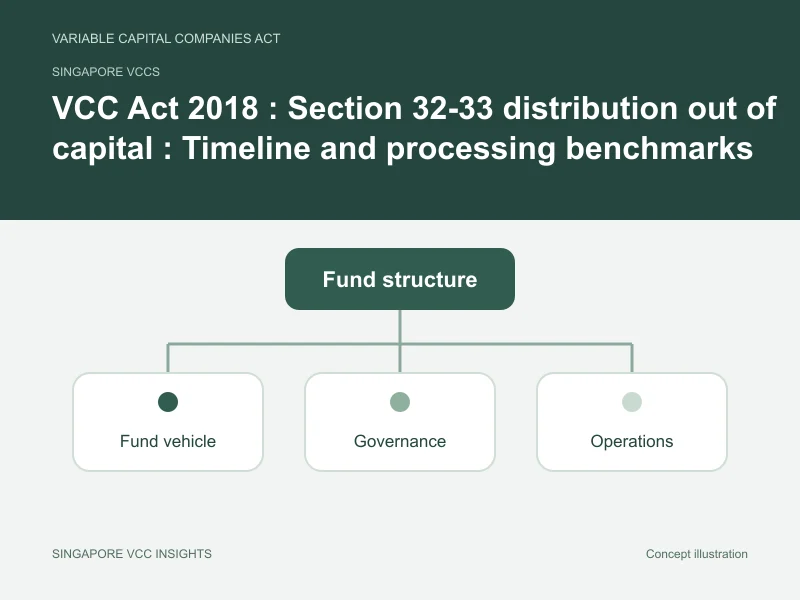
The VCC Act 2018 makes one of its sharpest departures from ordinary company law in the sections dealing with distributions: a Variable Capital Company may pay dividends out of capital, not only out of profits, provided a solvency test is met. Sections 32 and 33 of the Variable Capital Companies Act 2018 frame how that works and why it matters for investment funds.
Raffles Corporate Services works with a panel of corporate and employment law firms; this article is general information, not legal advice.
What the VCC Act 2018 permits on distributions
A conventional company incorporated under the Companies Act 1967 may generally only pay dividends out of profits. A Variable Capital Company is different. Because a VCC’s shares are issued and redeemed at net asset value and its capital is designed to vary with subscriptions and redemptions, the Variable Capital Companies Act 2018 permits a VCC to pay dividends out of its capital. This aligns the corporate form with how open-ended investment funds actually distribute returns to investors.
The full text is available from the Singapore Statutes Online publication of the VCC Act 2018, and the MAS explainer on the VCC sets out the policy intent behind the flexibility.
Who this affects
The capital-distribution rule is central for fund managers, VCC directors and their advisers structuring income-paying funds , property, credit and dividend strategies in particular , where paying out of capital is a normal feature. For the tax treatment that sits alongside these distributions, see Private banking onboarding for newly licensed CMS holders , Timeline and processing benchmarks, and for banking arrangements that support redemptions and payouts, Singapore bank account opening , DBS, OCBC, UOB, Wise, Aspire , Timeline and processing benchmarks.
The solvency condition
The flexibility is not unconditional. Distributions out of capital are permitted only where the directors are satisfied, on reasonable grounds, that the VCC will be able to pay its debts as they fall due and that the distribution does not render the VCC insolvent. The solvency judgement rests with the board, which must apply it at the level of the relevant sub-fund in an umbrella VCC, since each sub-fund’s assets and liabilities are segregated.
Directors typically document the solvency assessment in board minutes and rely on the VCC’s net asset value computation and the fund administrator’s records to support it.
Sub-fund segregation and distributions
In an umbrella VCC, sections dealing with segregation mean the assets of one sub-fund cannot be used to meet the liabilities of another. A distribution by a sub-fund must therefore be made only from that sub-fund’s own assets, and the solvency test is applied to that sub-fund. This ring-fencing is one of the principal reasons managers choose the umbrella VCC over multiple standalone entities.
The interaction between segregation, variable capital and redemptions is examined in VCC Act 2018 , Section 24 variable capital and share redemption , Timeline and processing benchmarks.
Practical cost and timeline
There is no separate filing fee for a distribution itself; the cost is the governance and administration around it. Expect fund administration to compute the distributable amount from net asset value, the auditor to test it at year end, and the board to minute the solvency decision. A VCC’s ongoing running cost , administration, audit, secretary and MAS-related compliance , commonly runs from about S$25,000 to S$60,000 a year depending on the number of sub-funds.
Distributions themselves are processed on the fund’s dealing calendar, so the timeline follows the fund’s subscription and redemption cycle rather than a statutory clock.
Common mistakes and gotchas
The recurring errors are: treating a VCC like an ordinary company and assuming dividends can only come from profits, thereby under-distributing; making a distribution without a documented solvency assessment; and, in an umbrella VCC, paying a distribution that draws, even indirectly, on another sub-fund’s assets in breach of the segregation principle.
Directors also sometimes overlook that the constitution of the VCC and the offering documents may impose distribution mechanics that are stricter than the Act. The registrar of VCCs is ACRA, and filings must remain consistent with those documents.
Step-by-step: making a compliant distribution
First, compute the distributable amount from the relevant sub-fund’s net asset value. Second, confirm the constitution and offering documents permit the distribution. Third, have the board assess and minute solvency at the sub-fund level. Fourth, ensure the payment draws only on that sub-fund’s assets. Fifth, record the distribution in the fund’s books and reconcile it at audit. The statutory text is on Singapore Statutes Online.
VCC Act 2018: reading Sections 32-33 alongside the rest of the statute
The VCC Act 2018 is best read as a purpose-built framework, and the distribution provisions in Sections 32-33 only make sense in that context. The Act was enacted so that open-ended investment funds could use a corporate form whose capital naturally rises and falls with subscriptions and redemptions. Paying dividends out of capital is a logical consequence: if capital is designed to vary, restricting distributions to accounting profits would defeat the purpose.
The Companies Act 1967 applies to VCCs with modifications set out in the VCC Act and its regulations, so a VCC director must read the two together. Where the VCC Act is silent, the modified Companies Act provisions fill the gap; where the VCC Act speaks, as it does on distributions and capital, it prevails.
Net asset value, redemptions and the payout mechanics
A VCC issues and redeems shares at a price based on net asset value, and distributions are computed from the same net asset value framework. When investors redeem, the VCC pays out of the relevant sub-fund’s assets; when it distributes income or capital, it does the same. The fund administrator calculates the net asset value on the dealing calendar, and the directors’ solvency assessment is made against that calculation.
This is why robust fund administration is not optional for a VCC. The register of members, the net asset value computation and the sub-fund ledgers must all reconcile, because they jointly support every subscription, redemption and distribution the VCC makes.
Directors’ liability where a distribution is wrongly made
The flexibility to distribute out of capital comes with director accountability. If a distribution is made when the solvency test is not met, the directors who authorised it may be exposed, and the recipients may in certain circumstances be required to repay. This mirrors the protective logic of company law: creditors are shielded by the solvency judgement, and the judgement carries personal responsibility.
Directors protect themselves by grounding the solvency assessment in the administrator’s figures, minuting the decision and the basis for it, and confirming that the distribution draws only on the relevant sub-fund. Casual or undocumented distributions are the exposure to avoid.
FAQs
Can a VCC pay dividends out of capital? Yes. The Variable Capital Companies Act 2018 permits a VCC to pay dividends out of capital, not only profits, provided a solvency test is met , a key departure from the Companies Act 1967.
What is the solvency test? The directors must be satisfied on reasonable grounds that the VCC can pay its debts as they fall due and will not be rendered insolvent by the distribution.
How does segregation affect distributions in an umbrella VCC? Each sub-fund’s assets are ring-fenced, so a distribution must be made only from that sub-fund’s assets and the solvency test is applied at sub-fund level.
Is there a filing fee for a distribution? No separate fee for the distribution itself; costs arise from administration, audit and board governance.
Where is the VCC Act published? On Singapore Statutes Online, with policy background in the MAS explainer on the VCC.
Related guides
Read more: VCC Act 2018 , Section 24 variable capital and share redemption , Timeline and processing benchmarks, Private banking onboarding for newly licensed CMS holders , Timeline and processing benchmarks and Singapore bank account opening , DBS, OCBC, UOB, Wise, Aspire , Timeline and processing benchmarks.
Need help with this? Call, SMS or WhatsApp +65 8501 7133, or email hello@rafflescorporateservices.com. Raffles Corporate Services works with a panel of corporate and employment law firms; this article is general information, not legal advice.