Independent Singapore VCC guidance
Direct answer
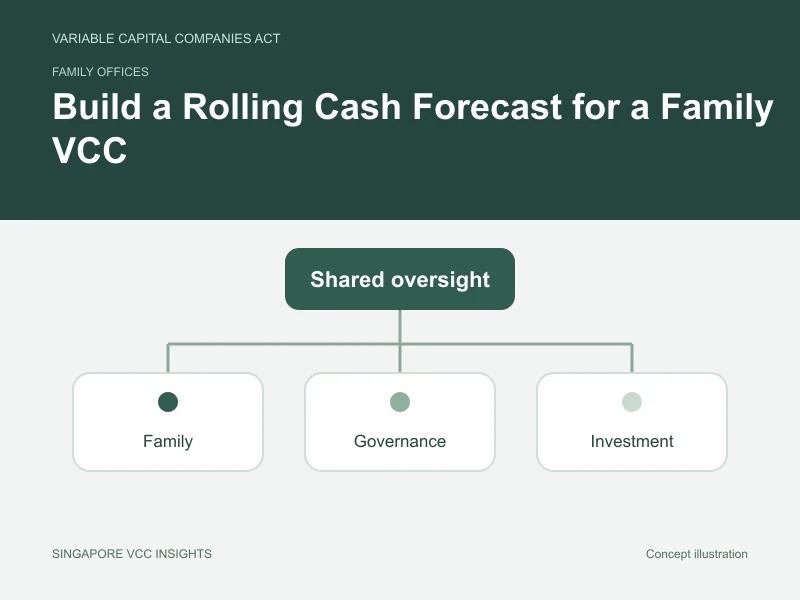
Build the forecast from bank, custody, administrator and approved commitment data, with a separate view for each sub-fund and for any umbrella-level operating items. Split cash into available, restricted and pending amounts; classify flows as committed, expected or contingent; and show the earliest decision date rather than only the payment date. Reconcile the opening position to source records, assign an owner to every forecast line and define which shortfall, concentration or timing conflict requires management or board escalation.
At a glance
- Keep family household cash outside the VCC forecast unless a documented transaction connects it.
- Separate sub-fund cash and obligations before producing an umbrella summary.
- Use confidence and decision dates so uncertain inflows do not fund committed outflows.
- Reconcile every forecast cycle and explain movements, overrides and misses.
Who this is for
- Family-office finance teams managing a standalone or umbrella VCC cash operating view.
Important exclusions
- A promise that redemptions, asset sales, credit facilities or family funding will be available.
Define the cash perimeter
Begin with accounts and assets legally attributable to the VCC. Do not blend a principal's personal reserve, family-office company cash or another holding vehicle into the fund view. For an umbrella VCC, preserve the separation of sub-fund positions and obligations even when providers supply a consolidated report. The top-level dashboard can aggregate for visibility, but it should never imply that one sub-fund's available cash is automatically usable for another.
Sources: Accounting and Corporate Regulatory Authority · Inland Revenue Authority of Singapore| Bucket | Include as | Example | Control |
|---|---|---|---|
| Available VCC cash | Usable balance subject to mandate and account controls | Settled bank or custody cash attributed to the VCC or relevant sub-fund | Reconcile to source statement and account owner. |
| Restricted or reserved cash | Visible but not freely allocable | Margin, collateral, distribution reserve or approved operating buffer | Name the restriction and release authority. |
| Pending cash | Separate from settled availability | Unsettled sale, expected subscription or approved tax recovery | Show confidence, dependencies and expected date. |
| External family cash | Excluded until a documented transaction exists | Personal liquidity or family-office operating account | Keep outside the fund forecast and label any proposed transfer. |
Related guidance: standalone and umbrella VCC decision guide
Build the line-item forecast
Use one row per cash event rather than netting unrelated items. Capture the sub-fund, currency, account, counterparty, purpose, expected date, latest decision date, amount or range, confidence, source and owner. Portfolio trades, capital activity, management fees, administration, audit, tax, custody, insurance and other approved expenses should enter from their authoritative schedules. The model should expose timing mismatches and data gaps; it should not make them disappear through optimistic netting.
Sources: Inland Revenue Authority of Singapore · Monetary Authority of SingaporeRequired forecast fields
- Legal owner, sub-fund, account and currency for the opening cash position.
- Cash-flow type, counterparty, purpose, amount or range and authoritative source record.
- Expected payment or receipt date plus the earlier date when a decision or instruction is needed.
- Status as committed, expected or contingent, with assumptions and dependencies stated.
- Named preparer, reviewer and decision owner for exceptions or funding actions.
- Actual cash date and amount so forecast accuracy and recurring misses can be reviewed.
Related guidance: VCC annual operating-cost stack · family-office annual budget evidence
Worked scenario for an umbrella VCC
Consider a hypothetical umbrella VCC with a liquid-strategy sub-fund and a private-markets sub-fund. The liquid strategy expects a security sale to settle before an administrator invoice and a planned investor redemption. The private-markets strategy has an approved investment closing, but its incoming subscription remains conditional. The correct forecast does not offset the two sub-funds or treat either expected receipt as settled cash. It highlights both decision dates and asks each sub-fund owner for an evidence-backed action.
Sources: Inland Revenue Authority of Singapore · Accounting and Corporate Regulatory Authority| Sub-fund | Flow | Status | Decision implication |
|---|---|---|---|
| Liquid strategy | Security-sale proceeds | Expected, settlement not complete | Do not count as available until settlement evidence appears. |
| Liquid strategy | Investor redemption | Committed under approved dealing records | Preserve the payment path and escalate any settlement mismatch. |
| Private markets | New investment closing | Committed after investment approval | Confirm funding readiness before the instruction cut-off. |
| Private markets | Incoming subscription | Contingent on onboarding and cleared cash | Do not use it to close the funding gap until conditions are complete. |
| Umbrella operations | Shared provider invoice | Expected pending allocation review | Allocate under the approved policy before cash instruction and posting. |
Related guidance: shared VCC sub-fund cost allocation controls
Turn forecast gaps into decisions
Each gap should produce a decision ticket, not an informal request to make the numbers work. Options may include changing settlement instructions, postponing an uncommitted investment, obtaining evidence for an expected receipt, reviewing an available facility, seeking a properly documented subscription or escalating a redemption constraint under the fund documents. The forecast owner should state the choice, deadline, authority, affected investors, conflicts and records required. Any action remains subject to the VCC's documents and applicable duties.
Sources: Monetary Authority of Singapore · Accounting and Corporate Regulatory AuthorityShortfall response
- Data gapObtain the missing statement, invoice, settlement record or provider confirmation before changing the cash conclusion.
- Timing gapTest whether an instruction, settlement or payment can move without breaching documents or creating unfair treatment.
- Funding gapEscalate a documented funding decision rather than assuming family cash, another sub-fund or contingent proceeds are available.
- Control gapPause the affected instruction when ownership, authority, bank access or allocation cannot be demonstrated.
Govern updates and forecast accuracy
Set a cadence that reflects the portfolio and transaction calendar, with more frequent updates around closings, subscriptions, redemptions and material invoices. Reconcile the prior forecast to actual cash before rolling the view forward. Categorise misses as timing, amount, omitted item, duplicate, wrong entity or failed assumption. Repeated misses should change the input process, provider service level or approval workflow. Preserve versions and overrides so reviewers can see what changed and why.
Sources: Inland Revenue Authority of Singapore · Monetary Authority of SingaporeForecast control cycle
- ReconcileMatch opening cash and prior-period movements to bank, custody and administrator records for each legal owner.
- RefreshUpdate committed, expected and contingent flows from named source owners without erasing prior assumptions.
- ChallengeTest settlement, approval, allocation and funding dependencies before treating a flow as decision-ready.
- DecideRoute gaps and conflicts to the authority defined in the governance and banking mandate.
- LearnCompare actual outcomes with forecast assumptions and fix recurring data or provider-control failures.
Frequently asked questions
Should personal family cash appear in the VCC forecast?
No, unless a specific documented transaction connects it to the VCC. Personal or family-office company liquidity should remain outside the fund perimeter so the forecast does not imply availability, authority or investor treatment that has not been established.
Can an umbrella forecast net cash across sub-funds?
A dashboard may aggregate for visibility, but the underlying forecast should preserve each sub-fund's cash, obligations and attribution. Do not use one sub-fund's surplus to conceal another's shortfall or assume transferability without a valid documented basis.
How should uncertain subscriptions be shown?
Show them as expected or contingent, with dependencies such as completed onboarding, signed documents and cleared cash. They should not fund a committed outflow in the decision view until the stated conditions have actually been met.
Who should own the forecast?
Name one finance or operations owner who consolidates authoritative inputs, plus source owners for banking, custody, administration, tax and investments. Material decisions and overrides should go to the authority defined in the VCC's governance framework.
What makes a forecast useful to directors?
It should show legal ownership, confidence, timing, decision deadlines, assumptions and unresolved conflicts, not only a net cash number. Directors need to see which action is requested, who can approve it and what evidence supports the recommendation.
Official sources and further reading
- Understanding VCC Features, Eligibility and Requirements (Accounting and Corporate Regulatory Authority)
- Legal Obligations of a VCC Director (Accounting and Corporate Regulatory Authority)
- Governance and Management of Variable Capital Companies (Monetary Authority of Singapore)
- Tax Framework for Variable Capital Companies (Inland Revenue Authority of Singapore)
- Record Keeping Requirements (Inland Revenue Authority of Singapore)
Discuss a Singapore VCC structure
For help coordinating a Singapore VCC setup or corporate administration, contact Raffles Corporate Services.
General information only. This article is not legal, tax, regulatory or investment advice and does not imply affiliation with or endorsement by ACRA, MAS or IRAS.