Singapore VCC insights
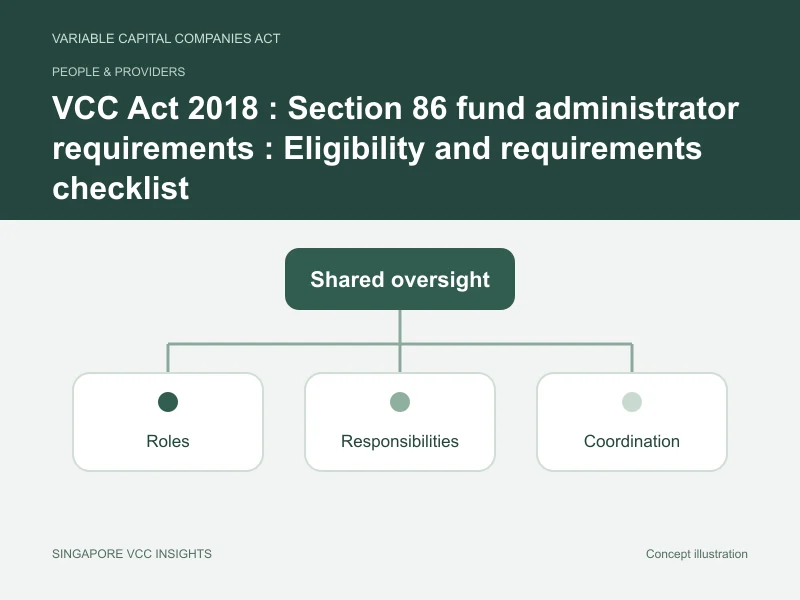
VCC Act 2018 — Section 86 fund administrator requirements — Eligibility and requirements checklist
Raffles Corporate Services works with a panel of corporate and employment law firms; this article is general information, not legal advice.
The VCC Act 2018 does not let a variable capital company self-administer without controls; it requires proper books, a registered office and, in practice, a competent fund administrator to maintain records and registers. Under the VCC Act 2018, fund administration underpins the register of members, NAV records and regulatory filings for each sub-fund.
What the VCC Act 2018 says about administration
Section 86 of the Variable Capital Companies Act 2018 establishes record-keeping obligations, requiring a VCC to keep accounting and other records that sufficiently explain its transactions and financial position, and to retain them for the prescribed period. In practice these obligations are discharged through a fund administrator engaged by the VCC or its manager.
A fund administrator maintains the register of members, processes subscriptions and redemptions, computes net asset value per sub-fund, and supports statutory filings. Because a VCC can be an umbrella with segregated sub-funds, administration must keep each sub-fund’s records distinct. Section 29 of the Variable Capital Companies Act 2018 establishes the segregation of assets and liabilities between sub-funds, which is precisely what the administration records must keep apart.
Who this affects
Fund managers, VCC directors and company secretaries all rely on the administrator’s outputs. Managers running a Section 13U enhanced-tier fund scheme need administration robust enough to evidence incentive conditions, and directors must ensure the registered office and filing arrangements are current; see our note on registered address and BizFile filings.
Eligibility and documents
- Fund administration agreement between the VCC (or manager) and the administrator.
- Accounting records sufficient to explain transactions, kept for the prescribed retention period.
- Register of members and sub-fund registers.
- NAV computation policy and pricing records per sub-fund.
- AML/KYC files on investors.
Cost and timeline
Onboarding a fund administrator typically takes 3 to 6 weeks, driven by document migration and investor AML/KYC. Annual administration fees for a single-sub-fund VCC commonly run S$18,000 to S$45,000, rising with the number of sub-funds and investor count.
Continuity and step-by-step
- Select an administrator with VCC and sub-fund experience.
- Execute the administration agreement and define scope per sub-fund.
- Migrate registers, NAV history and investor files.
- Set the NAV computation and reporting calendar.
- Test resilience with a continuity exercise.
- Review annually against filing obligations.
Our practical walkthrough on running a VCC administrator continuity test shows how to stress-test the arrangement before it is needed.
Common mistakes
The main risks are commingling sub-fund records, weak NAV documentation, and no exit or continuity plan if the administrator resigns. Directors sometimes assume the manager covers administration when the agreement is silent, leaving Section 86 records unowned.
What good VCC administration looks like
Strong administration for a VCC does more than tick a record-keeping box. It maintains an accurate, sub-fund-level register of members, processes subscriptions and redemptions in line with the constitution and offering documents, computes net asset value on a documented and repeatable basis, and produces the data the auditor and directors need without a scramble at year end. For an umbrella VCC, the discipline of keeping each sub-fund’s cash, positions and investor records ring-fenced is the operational expression of the statutory segregation.
Managers should agree clear service levels: NAV frequency and deadlines, cut-off times for dealing, and reporting formats. Ambiguity here is where errors and investor disputes originate.
Change of administrator and continuity
Administrators do change, and a VCC should never be exposed by that. The administration agreement should set out notice periods, data portability and a clean handover of registers and NAV history. A periodic continuity test, simulating a handover or an outage, confirms the VCC can move providers without losing the integrity of its records. Directors who assume the manager silently covers administration, when the agreement is in fact silent, are the ones caught out when a transition is needed.
Administration checklist
- Signed administration agreement with clear scope per sub-fund.
- Sub-fund registers and NAV records kept distinct.
- Documented NAV computation and dealing cut-offs.
- Investor AML/KYC complete and current.
- Continuity and exit provisions tested periodically.
Related guides
For further reading, see our guide to Section 13U enhanced-tier fund scheme, our note on registered address and BizFile filings, and, on this site, running a VCC administrator continuity test.
Authoritative sources
Refer to the VCC Act 2018 on Singapore Statutes Online and ACRA for the official position.
FAQs
Must a VCC appoint a fund administrator?
The Act requires proper records under Section 86; in practice a competent fund administrator is engaged to maintain registers, NAV and filings.
How are sub-funds handled?
Each sub-fund’s records, registers and NAV must be kept distinct, reflecting the segregation of assets and liabilities.
How long is administrator onboarding?
Typically 3 to 6 weeks, mostly investor AML/KYC and record migration.
Who owns the record-keeping obligation?
The VCC does. The administration agreement should make clear which party performs each task to avoid gaps.
Need help with this? Call, SMS or WhatsApp +65 8501 7133, or email hello@rafflescorporateservices.com. Raffles Corporate Services works with a panel of corporate and employment law firms; this article is general information, not legal advice.