Independent Singapore VCC guidance
Direct answer
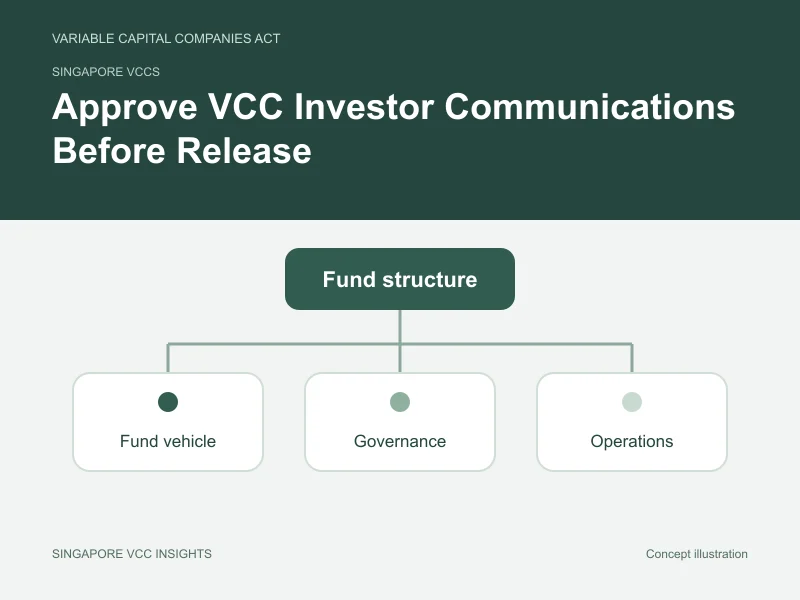
Approve a VCC investor communication only after classifying the message, identifying the affected VCC, sub-fund, share class and investor population, and tracing each material statement to current records. Separate content ownership, legal or compliance input where needed, operational population checks and final release authority. Test whether different investors have different rights or delivery channels. Preserve the approved version, recipients, release evidence and any correction. A polished message is not ready if the facts, audience or authority remain unclear.
At a glance
- Classify the communication before choosing its review path.
- Trace material statements to current fund, custody, accounting and governance records.
- Separate drafting, specialist review, approval and distribution execution.
- Test investor population, rights and channel before release.
- Preserve the final version, release evidence and correction route.
Who this is for
- Managers, directors, administrators, transfer agents and communications teams preparing operational, governance or investor-service messages for a VCC.
Important exclusions
- A substitute for the operative offering documents, marketing rules, legal advice, distribution approvals or investor-specific contractual analysis.
Classify the message and affected audience
Begin by naming the communication: dealing notice, operational update, valuation or NAV message, governance notice, financial statement delivery, service disruption, correction, request for action or marketing material. Identify the issuing VCC, affected sub-fund and share class, then build the recipient population from current records. The classification determines which source facts, approvals and delivery controls matter. Do not route every message through one generic template. A change to bank details, a dealing delay and an educational article carry different risks even when the same distribution platform sends them.
Sources: Monetary Authority of Singapore · Monetary Authority of Singapore · Accounting and Corporate Regulatory Authority| Message type | Primary question | Evidence focus |
|---|---|---|
| Operational notice | What process or timing changed for affected investors? | Provider record and authorised operating decision |
| Fund event | What occurred and which pool or class is affected? | Manager, custody, valuation and governance evidence |
| Investor action request | What must the recipient decide or submit? | Rights, instructions, deadline source and response channel |
| Correction | What was wrong, who received it and what replaces it? | Original release population and approved corrected facts |
| Marketing content | Who may receive it and what approval route applies? | Distribution scope, current disclosures and specialist review |
Define inclusions and exclusions before drafting. An umbrella-level message may not apply identically to every sub-fund, and a class-specific fee or dealing issue should not be presented as a fund-wide fact. Check whether former, pending or transferred investors need the notice based on the event and source records. Record the population date and owner. If there is doubt about rights or regulatory treatment, pause the release and obtain the appropriate review. The workflow should expose uncertainty instead of hiding it behind broad wording.
Sources: Monetary Authority of Singapore · Monetary Authority of Singapore · Monetary Authority of SingaporeRelated guidance: VCC side-letter obligations register
Build a fact pack before drafting
Collect the authoritative records that support the message. Depending on the event, these may include approved board or manager decisions, fund documents, administrator reports, custody or bank confirmations, valuation records, investor registers, provider incident records and prior communications. Mark each statement as confirmed, conditional or unresolved. Use exact dates, amounts or deadlines only when the source and affected population are clear. Keep private deliberation, credentials and unnecessary personal data outside the drafting pack. The objective is a compact evidence set that another reviewer can use without relying on oral history.
Sources: Monetary Authority of Singapore · Inland Revenue Authority of Singapore · Monetary Authority of SingaporeFact-pack checks
- Identify the authoritative record for every material event, amount, deadline or instruction.
- Confirm the VCC, sub-fund, class, account and investor population use aligned identifiers.
- Separate confirmed facts from scenarios, proposed actions and unresolved interpretation.
- Check prior notices for promises, terminology or instructions that the new message changes.
- Remove internal commentary, credentials and unnecessary personal or portfolio information.
Resolve differences before polishing prose. If the administrator population does not match the transfer record, or custody timing conflicts with the proposed statement, assign an owner and hold the message. Do not select the most convenient number or soften the wording until it becomes technically true but operationally misleading. Where information is genuinely conditional, say what condition remains and who will provide the next update. A clear limitation is safer and more useful than false certainty. Preserve the final source pack with the approved version.
Sources: Monetary Authority of Singapore · Inland Revenue Authority of SingaporeRelated guidance: VCC subscription override register
Choose the right approval route
Map approval to the decision behind the message. The operational owner can confirm process facts, the manager can confirm portfolio or dealing decisions, the administrator can confirm records it maintains, and directors can address matters within their governance role. Legal, tax or compliance input may be needed where the message interprets rights, obligations, distribution scope or sensitive claims. Do not turn a provider’s factual confirmation into authority to release the message. Likewise, do not ask a senior person to approve facts they cannot verify. Each sign-off should have a defined purpose.
Sources: Monetary Authority of Singapore · Accounting and Corporate Regulatory Authority · Monetary Authority of SingaporeApproval route decision tree
- Routine factual update?Use the approved operating route only if source facts, audience and standing authority are all clear.
- Investor rights affected?Route the message through the document and specialist review needed for the actual right or restriction.
- Fund or portfolio decision described?Obtain confirmation from the authorised manager or governance body that made the decision.
- Distribution or marketing element?Confirm the intended audience, current disclosure basis and required approval before release.
- Unresolved fact remains?Do not release as final; use a controlled holding message only when its facts and authority are clear.
Record approvals against a frozen version. Comments on an earlier draft do not approve later changes unless the route explicitly allows them. Identify who can make non-material edits and what forces resubmission. Test names, accounts, links, attachments and response addresses separately from prose. Where several teams approve, appoint one release owner who confirms all conditions were satisfied. Parallel reviews can save time, but they do not remove the need to resolve conflicting comments and preserve the final decision trail.
Sources: Monetary Authority of Singapore · Inland Revenue Authority of SingaporeTest fairness, clarity and operational readiness
Read the message from the affected investor’s position. State what happened, who is affected, what the recipient needs to do, what remains unchanged and where a genuine question can go. Define technical terms and avoid implying certainty about approval, tax or market outcomes. If different classes or investors have different rights, prepare controlled variants or clearly identify the distinctions. Check that the response channel is staffed, secure and connected to the workflow. A communication fails operationally when recipients cannot act on accurate instructions or when replies disappear into an unowned inbox.
Sources: Monetary Authority of Singapore · Monetary Authority of SingaporePre-release reading test
- The subject and opening identify the relevant VCC, sub-fund, event and investor action.
- Dates, amounts, links, attachments and contact routes match the approved fact pack.
- Conditional statements explain the condition and next update without promising an outcome.
- Audience variants preserve the correct rights, instructions and disclosures for each group.
- The response team can authenticate, route and record questions or instructions received.
Test delivery using a non-sensitive sample before loading the live recipient list. Verify sender identity, reply routing, formatting, attachments, links and any portal notification. Protect confidential investor and portfolio information by limiting content and audience to what the message needs. If the communication requests bank, identity or dealing information, use the approved secure channel and explain how recipients can verify authenticity. Avoid last-minute channel changes that bypass the approved evidence or create a phishing-like message. Operational readiness is part of approval, not a separate afterthought.
Sources: Monetary Authority of Singapore · Monetary Authority of Singapore · Inland Revenue Authority of SingaporeRelated guidance: VCC investor complaint response workflow
Release, reconcile and correct
Release only the frozen approved version to the reconciled population through the authorised channel. Preserve the release time, sender, recipient count, delivery result and final attachments. Investigate bounces, rejected portal messages and excluded recipients based on the significance of the notice. Match responses or instructions to the relevant investor record and route them to named owners. Do not treat a platform status of sent as proof that every required investor received or could act on the message. The closure record should explain remaining delivery exceptions.
Sources: Monetary Authority of Singapore · Inland Revenue Authority of Singapore · Monetary Authority of SingaporeRelease and correction sequence
- FreezeLock the approved content, recipient population, attachments, sender identity and every release condition before distribution.
- TestConfirm formatting, links, reply routing and secure channels using non-sensitive sample data.
- ReleaseSend through the authorised channel and preserve time, version and platform evidence.
- ReconcileReview delivery exceptions, responses and required actions against the complete approved investor population and message version.
- CorrectIf an error is found, assess affected recipients, approve replacement facts and issue a linked correction.
When correction is needed, do not silently edit a portal file or send an unlinked replacement. Identify what was wrong, which recipients received it, what information supersedes it and whether any investor action needs to be repeated or halted. Use the appropriate approval route for the corrected fact and preserve both versions. After closure, review the cause: source data, population, drafting, approval, channel or provider execution. Turn the lesson into a specific control change rather than adding generic review language to every future message.
Sources: Monetary Authority of Singapore · Inland Revenue Authority of Singapore · Accounting and Corporate Regulatory AuthorityRelated guidance: VCC investor data handover test
Frequently asked questions
Does every investor communication need board approval?
No universal route fits every message. Approval should follow the underlying decision, governing documents, current authority matrix and any specialist review required. Routine operational notices and material governance events may have different owners.
Can the administrator approve a VCC communication?
An administrator can confirm records and perform agreed operational work, but that does not automatically give it authority over the manager’s decision, investor rights or final release. The responsibility schedule should make each sign-off purpose clear.
How should different share classes be handled?
Identify whether facts, rights, fees, dealing terms or instructions differ. Use controlled variants or explicit distinctions, then reconcile each version to the correct recipient population and preserve the approved mapping.
What if a fact is still uncertain?
Do not present it as final. Resolve it before release or, where communication is necessary, issue a controlled holding message that states the confirmed facts, the open point and the next update route.
What should happen after a distribution error?
Stop further release where possible, identify affected recipients, assess investor consequences, approve corrected facts, issue a linked correction and preserve both versions. Then fix the source, population, approval or channel weakness that caused it.
Official sources and further reading
- Governance and Management of Variable Capital Companies (Monetary Authority of Singapore)
- Legal Obligations of a VCC Director (Accounting and Corporate Regulatory Authority)
- Understanding VCC Features, Eligibility and Requirements (Accounting and Corporate Regulatory Authority)
- Record Keeping Requirements (Inland Revenue Authority of Singapore)
- UBS (SG) Select Opportunities VCC Prospectus (Monetary Authority of Singapore)
- CISNet Notification System for Restricted Schemes (Monetary Authority of Singapore)
- Frequently Asked Questions on the Notice on Technology Risk Management (Monetary Authority of Singapore)
Discuss a Singapore VCC structure
For help coordinating a Singapore VCC setup or corporate administration, contact Raffles Corporate Services.
General information only. This article is not legal, tax, regulatory or investment advice and does not imply affiliation with or endorsement by ACRA, MAS or IRAS.