Singapore VCC insights
VCC custody under MAS Notice SFA 04-N09 — Eligibility and requirements checklist
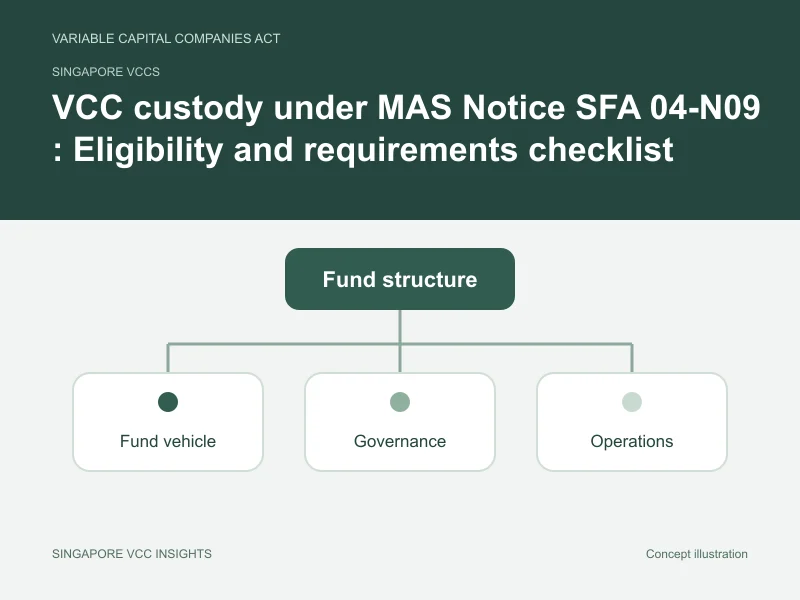
vcc custody under mas notice sfa 04-n09 concerns how a Variable Capital Company’s assets are held and safeguarded, and how the Monetary Authority of Singapore’s customer-asset requirements apply through the VCC’s regulated fund manager. The most common mistake is assuming the fund vehicle can self-custody or hold client money loosely; the safeguarding rules are prescriptive and the board carries the oversight duty.
Raffles Corporate Services works with a panel of corporate and employment law firms; this article is general information, not legal advice.
What VCC custody under MAS Notice SFA 04-N09 requires
MAS Notice SFA 04-N09 sets out requirements on the handling of customer’s moneys and assets by holders of a capital markets services licence. Because a Variable Capital Company must appoint a permissible fund manager regulated by the Monetary Authority of Singapore, the safeguarding framework reaches the VCC’s assets. At its core the notice requires that customer assets are segregated from the intermediary’s own assets, held with an eligible custodian, properly recorded and reconciled, and protected in the event of the intermediary’s insolvency.
For a VCC this translates into appointing an eligible custodian for the fund’s investments, keeping the fund’s assets separate from the manager’s, and reconciling records regularly. Section 17 of the Variable Capital Companies Act 2018 establishes the VCC as a legal person capable of holding assets in its own name, which is precisely why clean custody arrangements and accurate registers matter , the assets belong to the VCC and, economically, to its shareholders.
Who is responsible
As with anti-money-laundering, custody duties are shared between the VCC board and the permissible fund manager, with an eligible custodian appointed to hold the assets. The board oversees; the manager, as the licensed intermediary, operates within the notice; the custodian safeguards. Delegation to a reputable custodian is normal and expected, but it does not relieve the directors of their oversight duty. Directors weighing this alongside their other statutory responsibilities can cross-refer to the role and duties of a Singapore company secretary, who typically maintains the VCC’s registers.
Managers setting up custodian and banking relationships for the first time should read our guide to private banking onboarding for newly licensed CMS holders, because custodian selection and account opening are the practical gateway to compliant custody.
Eligibility and the custody checklist
A compliant VCC custody arrangement under MAS Notice SFA 04-N09 typically covers the following. An eligible custodian is appointed, whether a licensed bank, a depository or another custodian recognised for the purpose. Customer assets are segregated from the intermediary’s proprietary assets so they cannot be used to meet the intermediary’s own liabilities. A custody or safekeeping agreement documents the arrangement and the custodian’s duties. Records identify the assets held for the VCC and each sub-fund. Reconciliations between the intermediary’s records and the custodian’s statements are performed at regular intervals and breaks are investigated. And any client money is held in trust in a designated account.
For an umbrella VCC the segregation runs to the sub-fund level. The Variable Capital Companies Act 2018 requires that the assets and liabilities of each sub-fund are segregated, so custody records must be capable of showing, at any time, which assets belong to which sub-fund. Blurred sub-fund custody is a serious defect, not a bookkeeping nicety.
Cost and timeline
Custody costs are largely the custodian’s fees, which vary with asset type and volume but commonly run from a few basis points on assets under custody to fixed minimums of several thousand Singapore dollars per year. Appointing a custodian and opening the safekeeping account typically takes four to eight weeks, driven mostly by the custodian’s own due diligence on the VCC and its manager. Establishing the reconciliation process and integrating it with the fund administrator’s records adds a further short lead time. The recurring cost is the discipline of periodic reconciliation and break resolution, which continues for the life of the fund.
Step-by-step: putting custody in place
The sequence is straightforward but exacting. Select an eligible custodian and complete its onboarding due diligence. Execute a custody or safekeeping agreement setting out duties, standards and reporting. Open segregated accounts, at the sub-fund level for an umbrella VCC. Instruct that the fund’s assets are held separately from the manager’s own assets. Establish a reconciliation cadence between the administrator’s records and the custodian’s statements. Investigate and clear reconciliation breaks promptly. Document the arrangement so the board can evidence oversight, and review the custodian relationship periodically. The custody audit confirmation process, covered in our companion piece on running VCC audit confirmations across service providers, tests exactly this at year end.
Worked example: a reconciliation break that matters
Consider an umbrella VCC with two sub-funds sharing one custodian. At month end the administrator’s records show Sub-Fund A holding 100,000 units of a security, but the custodian statement shows 100,000 units held for the umbrella with no sub-fund breakdown. On the surface the totals agree, so a careless reconciliation ticks the box. The defect is that the custody records do not evidence sub-fund segregation. If Sub-Fund B later incurs a liability, the absence of a clear record showing which units belong to Sub-Fund A weakens the very protection the Variable Capital Companies Act 2018 requires.
The fix is to require the custodian to maintain sub-fund-level designations, and to reconcile at that level rather than only at the umbrella. A break at the total level is obvious; a break hidden inside an aggregated total is the dangerous one, because it is invisible until a dispute or an insolvency forces the question of ownership.
Sub-fund segregation in practice
Sub-fund segregation is the defining feature of the umbrella VCC and the point custody arrangements most often fail. The Act requires that the assets of a sub-fund are used only to discharge that sub-fund’s liabilities, and that its assets are not available to creditors of another sub-fund. Custody records have to make this real: designated accounts or clearly designated holdings per sub-fund, agreements that acknowledge the segregation, and reconciliations that prove it. Where a custodian cannot support sub-fund designation, that is a reason to question the custodian, not to compromise the segregation. A board that signs off custody without testing sub-fund segregation has not discharged its oversight of the fund’s core legal protection.
Common mistakes and gotchas
The failures cluster around segregation and reconciliation. Holding fund assets in an account that is not clearly segregated from the manager’s own assets. Failing to segregate at the sub-fund level in an umbrella VCC, so one sub-fund’s assets are exposed to another’s liabilities. No custody agreement, or one that does not reflect the actual arrangement. Reconciliations performed late or not at all, so discrepancies fester. Client money held outside a proper trust account. And a board that has never reviewed the custody arrangement and cannot evidence oversight. Each of these is a direct safeguarding risk and each is examined on audit and inspection.
FAQs
Can a VCC hold its own assets without a custodian? In practice the safeguarding framework operating through the regulated manager expects assets to be held with an eligible custodian and segregated from the manager’s own assets. Self-custody is not the norm and raises safeguarding concerns.
Does each sub-fund of an umbrella VCC need segregated custody? Yes. The Variable Capital Companies Act 2018 requires sub-fund asset and liability segregation, so custody records must identify which assets belong to which sub-fund.
How often should custody reconciliations be performed? Regularly and consistently, with breaks investigated promptly. The exact cadence depends on the fund’s activity, but infrequent or ad hoc reconciliation is a common inspection finding.
Who bears responsibility if the custodian fails? Segregation and trust arrangements are designed to protect the VCC’s assets from the intermediary’s insolvency, but the board retains an oversight duty to select and monitor an appropriate custodian.
Is client money treated differently from investments? Yes. Client money is generally held in trust in a designated account, distinct from the safekeeping of investment assets, and both are within the safeguarding framework.
Related guides and authority sources
The Monetary Authority of Singapore issues Notice SFA 04-N09 on customer assets, the Accounting and Corporate Regulatory Authority administers the VCC register, and the governing statute is the Variable Capital Companies Act 2018.
Need help with this? Call, SMS or WhatsApp +65 8501 7133, or email hello@rafflescorporateservices.com. Raffles Corporate Services works with a panel of corporate and employment law firms; this article is general information, not legal advice.