Singapore VCC insights
Singapore VCC vs Irish ICAV — Eligibility and requirements checklist
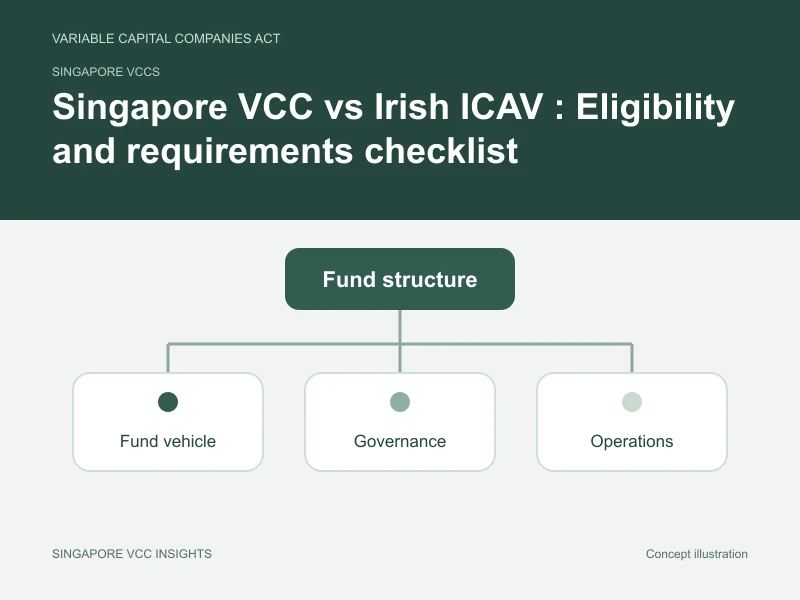
A Singapore VCC vs Irish ICAV comparison comes down to a Singapore corporate fund vehicle regulated by MAS and ACRA against an Irish corporate fund vehicle regulated exclusively by the Central Bank of Ireland , both use umbrella sub-fund structures with legally segregated liability, but they sit inside very different regulatory and distribution ecosystems.
What a Singapore VCC and an Irish ICAV actually are
A Variable Capital Company (VCC) is Singapore’s dedicated corporate fund structure, established under the Variable Capital Companies Act 2018 and jointly administered by the Monetary Authority of Singapore (MAS) and the Accounting and Corporate Regulatory Authority (ACRA). Section 3 of the Variable Capital Companies Act 2018 sets out the name and constitution requirements for a VCC, including that its name carries the designation “Variable Capital Company” or “VCC”.
An Irish Collective Asset-management Vehicle (ICAV) is Ireland’s equivalent purpose-built corporate fund structure, introduced under the Irish Collective Asset-management Vehicles Act 2015. The key structural distinction is that an ICAV is registered and supervised exclusively by the Central Bank of Ireland, rather than through Ireland’s Companies Registration Office , meaning it is not subject to certain EU company law directives that were designed for trading companies rather than funds. An ICAV can be established as an umbrella fund with multiple sub-funds, and can be authorised as either a UCITS (retail, EU-passportable) fund or an AIF (alternative investment fund, including the Qualifying Investor AIF, or QIAIF, category aimed at professional and institutional investors).
Who each structure suits
The Singapore VCC suits managers already regulated by MAS who want a Singapore-domiciled vehicle, often alongside a family office or a fund management business already operating out of Singapore, and who are targeting Asia-Pacific investors or investors comfortable with a Singapore fund domicile. The Irish ICAV suits managers who want EU market access , particularly UCITS funds distributed to European retail investors under the EU passporting regime, or QIAIFs targeting global institutional and professional investors who are comfortable with an EU-regulated but lightly restricted alternative fund vehicle.
Managers choosing between the two are often really choosing between an Asia-domiciled fund with Singapore tax incentives and an EU-domiciled fund with passporting rights , a decision that usually follows the investor base and distribution strategy rather than pure cost.
Eligibility and requirements checklist
For a Singapore VCC, the checklist includes: a fund manager regulated, licensed or registered by MAS; at least one Singapore-resident director; a Singapore registered office and company secretary; an approved auditor; a Singapore-based AML/CFT officer; and, for umbrella structures, a constitution addressing sub-fund segregation. Section 29 of the Variable Capital Companies Act 2018 establishes that the assets and liabilities of each sub-fund of an umbrella VCC are legally segregated, so the assets of one sub-fund cannot be used to discharge the liabilities of another.
For an Irish ICAV, the checklist includes: a minimum of two directors, with independence and fitness-and-probity requirements assessed by the Central Bank; an authorised Alternative Investment Fund Manager (AIFM) or UCITS management company (or a self-managed structure meeting equivalent conditions); an independent depositary regulated by the Central Bank, responsible for safekeeping of assets and oversight duties; an Irish registered office; and, for umbrella ICAVs, an instrument of incorporation that provides for segregation between sub-funds. Section 35 of the Irish Collective Asset-management Vehicles Act 2015, titled “Segregated liability of ICAV sub-funds”, establishes that any liability incurred on behalf of a sub-fund is to be discharged solely out of that sub-fund’s assets, and that neither the umbrella ICAV nor its directors may apply one sub-fund’s assets to satisfy another sub-fund’s liabilities.
Singapore VCC vs Irish ICAV: side-by-side comparison
- Regulator: VCC , jointly MAS and ACRA. ICAV , the Central Bank of Ireland exclusively, with no separate companies registry filing required.
- Distribution reach: a VCC is a Singapore-domiciled vehicle typically distributed to Asia-Pacific and offshore investors; a UCITS ICAV can be passported for retail distribution across the European Economic Area, while a QIAIF ICAV is typically marketed to professional investors globally.
- Umbrella and sub-fund structure: both support umbrella structures with statutorily segregated sub-funds , Section 29 of the VCC Act for Singapore, Section 35 of the ICAV Act for Ireland.
- Tax treatment: Singapore VCCs can apply for the Section 13O or Section 13U fund tax exemption schemes at the umbrella level; ICAVs benefit from Ireland’s gross roll-up regime, under which the ICAV itself is generally exempt from Irish tax on income and gains, with Irish tax typically arising only at the level of certain Irish-resident investors.
- Investor-protection features: a VCC typically appoints a custodian or trustee as a matter of market practice and licence conditions; an ICAV is required to appoint an independent depositary regulated by the Central Bank, which is a harder statutory requirement carried over from the EU’s UCITS and AIFMD frameworks.
Cost and timeline in numbers
ACRA’s fee schedule for a Singapore VCC sets a name application fee of S$15, a registration fee of S$8,000, and a sub-fund registration fee of S$400 per sub-fund, with annual return filing at S$1,600. A standalone VCC typically takes a practitioner-estimated 6 to 10 weeks from engagement to registration once the fund manager, auditor and constitution are in place.
The Central Bank of Ireland does not publish a fixed statutory filing fee equivalent to ACRA’s schedule; ICAV costs are driven mainly by legal, fund administrator, depositary and audit fees, with the Central Bank instead recovering its supervisory costs through an industry funding levy on regulated funds generally. On timeline, a Qualifying Investor AIF (QIAIF) ICAV can use the Central Bank’s 24-hour fast-track authorisation process where a complete application , including confirmations from an authorised AIFM and depositary , is submitted by 3pm on a business day, with authorisation following the next business day (property and crypto-asset QIAIFs are excluded from this fast track). A UCITS ICAV, being retail-facing, goes through fuller product-level review and typically takes considerably longer, commonly estimated by practitioners at several weeks to a few months depending on complexity and the completeness of the initial filing.
Two thresholds are worth noting when comparing the investor base each structure is built for. A QIAIF ICAV is generally restricted to “qualifying investors” who meet minimum initial investment thresholds of the order of €100,000 (or confirm they are professional or otherwise qualifying investors under the applicable rules), which keeps the fast-track regime aligned with a sophisticated investor base rather than retail money. A Singapore VCC carries no equivalent statutory minimum investment threshold at the vehicle level , restrictions instead flow from whichever securities law exemption or authorisation basis the offer relies on, such as offers restricted to institutional or accredited investors under the Securities and Futures Act. This difference matters when a manager is deciding how granular to make an umbrella structure’s investor eligibility criteria across sub-funds or, for the ICAV, across QIAIF sub-funds.
Step-by-step process
Setting up a Singapore VCC generally follows: engage a MAS-regulated fund manager; reserve the VCC name with ACRA (S$15, held for 120 days); draft the constitution, addressing sub-fund segregation for umbrella structures; appoint a Singapore-resident director, company secretary and auditor; lodge the registration application (S$8,000); register sub-funds (S$400 each); and apply for Section 13O or 13U tax exemption where relevant.
Setting up an Irish ICAV generally follows: appoint an authorised AIFM or UCITS management company and an independent depositary; prepare the instrument of incorporation and, for umbrella structures, sub-fund-specific supplements; submit the application to the Central Bank of Ireland (using the 24-hour fast track where the fund qualifies as a QIAIF); respond to any Central Bank queries; and receive authorisation and registration directly from the Central Bank, without a separate companies registry step.
Common mistakes and gotchas
On the VCC side, the most common misstep is underestimating how gating the fund manager appointment is , ACRA will not register a VCC without a MAS-regulated manager already confirmed, so delays in the manager’s own licensing timeline flow straight through to the fund’s launch date. A related error is drafting umbrella constitutions with vague or inconsistent sub-fund segregation wording that does not clearly track Section 29 of the Act. On the ICAV side, the most common mistake is assuming every ICAV automatically qualifies for the 24-hour fast track , property and crypto-asset QIAIFs are carved out, and any incomplete filing (missing AIFM or depositary confirmations, for instance) knocks the application out of the fast-track queue entirely, sometimes adding weeks. Managers also frequently underestimate the ICAV’s ongoing depositary and administrator costs relative to a VCC, since the depositary function is a harder statutory requirement in Ireland than the more market-practice-driven custodian arrangements typical of a Singapore VCC.
Managers weighing a Singapore-domiciled vehicle against an EU one often also need to think through their broader Singapore tax position; the practicalities of the Section 13U enhanced-tier fund scheme are worth reviewing before committing to a VCC structure, particularly for larger funds that may outgrow the Section 13O thresholds. Where the manager’s own operating entity is itself a foreign business setting up in Singapore for the first time, the requirements around director and capital pitfalls for a subsidiary of a foreign parent are a useful parallel checklist, since the fund manager entity is frequently incorporated shortly before the VCC itself.
FAQs
Can an Irish ICAV be sold to retail investors the way a Singapore VCC sub-fund can? A UCITS ICAV can be distributed to retail investors across the EU under the passporting regime, which is broader retail reach than a Singapore VCC typically achieves without separate authorisation under the Securities and Futures Act for retail offers.
How fast can each structure actually launch? A QIAIF ICAV can be authorised within 24 hours of a complete filing under the Central Bank’s fast-track process, which is faster on paper than a Singapore VCC’s typical 6 to 10 week practitioner timeline , though the ICAV’s pre-filing preparation (AIFM and depositary appointment, full documentation) is itself substantial and not instant.
Do both structures require a locally regulated fund manager? Yes. A VCC must appoint a fund manager regulated, licensed or registered by MAS; an ICAV must appoint an authorised AIFM or UCITS management company (or meet self-managed equivalent conditions), which in practice means EU-authorised management functions.
How does sub-fund segregation compare? Section 29 of the Variable Capital Companies Act 2018 and Section 35 of the Irish Collective Asset-management Vehicles Act 2015 both establish that each sub-fund’s assets and liabilities are legally ring-fenced from every other sub-fund in the same umbrella structure , the underlying legal technique is very similar despite the different statutes.
Is a depositary mandatory for a VCC the way it is for an ICAV? An ICAV’s independent depositary is a firm statutory requirement under EU-derived rules. A VCC does not carry an identical statutory depositary mandate, though custodian or trustee arrangements are common market practice and are sometimes required as a matter of the fund manager’s own licence conditions.
What happens if an ICAV sub-fund runs into financial difficulty? Because Section 35 of the Irish Collective Asset-management Vehicles Act 2015 confines a sub-fund’s liabilities to that sub-fund’s own assets, creditors of one troubled sub-fund cannot reach the assets of other sub-funds or the ICAV’s general assets. A VCC sub-fund is wound up on an equivalent segregated basis under Section 29 of the Variable Capital Companies Act 2018, with the Insolvency, Restructuring and Dissolution Act’s sub-fund-specific provisions governing the winding-up mechanics in Singapore.
Related guides
For a further comparator, see our companion checklist on the Singapore VCC vs Luxembourg SICAV eligibility and requirements checklist, which covers the other major EU fund domicile often weighed alongside Ireland.
For primary regulatory information, see the Monetary Authority of Singapore at mas.gov.sg and the Accounting and Corporate Regulatory Authority at acra.gov.sg, both of which publish current VCC guidance and fee schedules.
Need help with this? Call, SMS or WhatsApp +65 8501 7133, or email hello@rafflescorporateservices.com. Raffles Corporate Services works with a panel of corporate and employment law firms; this article is general information, not legal advice.