Independent Singapore VCC guidance
Direct answer
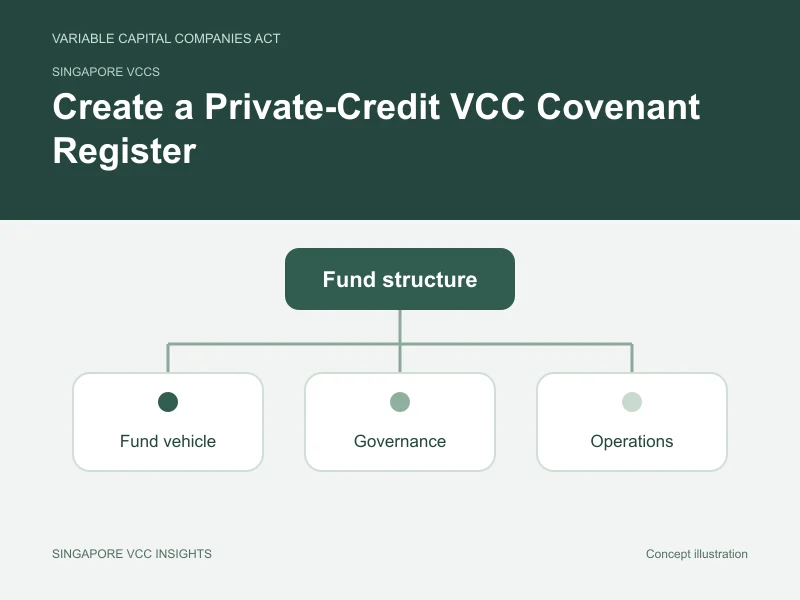
Build the covenant register from executed loan documents, not from a deal-team summary. Give every test a defined borrower, facility, clause reference, calculation, evidence source, test date, delivery date, owner, reviewer and status. Link amendments, waivers and reservations of rights without overwriting the original term. Use the register to trigger portfolio, valuation, cash, conflict and investor-reporting reviews; it is a control index, not a substitute for the legal documents.
At a glance
- One row should represent one testable obligation or information deliverable.
- Definitions, permitted adjustments and evidence sources belong beside the formula.
- A waiver changes treatment for a stated scope; it should not erase the original event.
- Connect covenant status to valuation, funding, conflicts and reporting decisions.
Who this is for
- Private-credit managers and fund operations teams using a VCC or VCC sub-fund to hold loan assets.
Important exclusions
- Legal interpretation, enforcement strategy, restructuring advice or a determination that a borrower is in default.
Create the facility master
Begin with a facility master that identifies the legal borrower, guarantors, facility and security documents, VCC or sub-fund investor, booking entity, currency, commitment, maturity, agent, advisers and controlled document location. ACRA’s materials describe the VCC as an investment-fund structure and emphasise separate sub-fund records within an umbrella. That makes exact fund identity part of the monitoring design: a covenant alert must point to the portfolio pool that owns the exposure.
Sources: ACRA · ACRA| Field group | Minimum content | Control purpose |
|---|---|---|
| Identity | Borrower, guarantor, facility, VCC and sub-fund | Prevents the alert attaching to the wrong exposure |
| Documents | Executed agreement, amendments, accession and security records | Establishes the controlled source set |
| Economics | Currency, commitment, drawn amount, margin and maturity | Connects tests with current exposure |
| Parties | Agent, lender contacts, manager owner and operations reviewer | Creates an accountable information route |
| Systems | Portfolio, accounting and document identifiers | Allows reconciliation across records |
Do not use the register as the only copy of contractual terms. Keep controlled executed documents and record the version that each extracted field came from. When a facility is amended, preserve the old version, effective point and affected tests. This allows a reviewer to explain why the same borrower had different thresholds or reporting obligations across periods without reconstructing history from email.
Sources: MAS · ACRARelated guidance: Singapore VCC guide · VCC sub-funds guide
Turn clauses into testable rows
Create one row for each financial covenant, information undertaking, consent condition or other monitored obligation. Capture the exact clause reference, plain-language label, contractual definition set, formula, permitted adjustments, threshold, test frequency, test date, evidence delivery date and grace or cure treatment where the documents provide one. Legal counsel may need to interpret ambiguous drafting; operations should record that interpretation and source rather than silently choosing a spreadsheet convention.
Sources: MAS · ACRA| Field | Example content type | Why it is retained |
|---|---|---|
| Clause and version | Controlled document reference and effective amendment | Returns the reviewer to authoritative wording |
| Test definition | Formula, inclusions, exclusions and permitted adjustments | Makes the calculation reproducible |
| Dates | Measurement, borrower delivery and internal review points | Separates economic period from workflow timing |
| Evidence | Certificate, accounts, bank data or approved source | Shows what supports each input |
| Status | Pending, passed, watch, exception, waived or escalated | Drives a consistent operating response |
| Decision link | Approval, waiver, reservation or remediation record | Preserves governance after the calculation |
Control borrower evidence and calculations
Use a delivery calendar that starts before the borrower due point and identifies expected evidence, sender, secure channel and internal recipient. When information arrives, preserve the original file and reception time, then validate completeness before calculating. A signed certificate may still need supporting accounts or schedules. If the portfolio team supplies an adjustment, identify its contractual basis and reviewer rather than embedding an unexplained override in the formula.
Sources: MAS · ACRAEvidence-to-status workflow
- ReceiveIndex the original borrower or agent package, document its arrival and compare it with the expected evidence list.
- ValidateCheck period, entity, currency, definitions, signatures, supporting schedules and consistency with independent portfolio information.
- CalculateApply the controlled formula and retain source-to-input mapping, preparer, version and any unresolved interpretation.
- ReviewChallenge inputs, permitted adjustments, arithmetic and proximity to the threshold before assigning a monitoring status.
- ReleasePublish the approved status to portfolio, valuation, operations and reporting consumers with open actions clearly marked.
Missing information is its own status. Do not mark a covenant as passed because no adverse evidence arrived. The register should distinguish not due, awaited, incomplete, under review and confirmed. Escalate according to the documents, mandate and internal policy, and keep outreach records. This avoids turning borrower silence into false comfort and gives the board or manager a transparent view of evidence quality.
Sources: MASPreserve waivers and breach decisions
When a test is missed or evidence suggests a potential breach, freeze the calculation and source package. Open an issue record that separates the observed fact, contractual interpretation, legal advice, portfolio decision, communication and approved next step. A waiver, amendment or reservation of rights should be linked with its exact scope and effective point. Never overwrite the threshold, change the formula or backdate the status to make the historical row appear compliant.
Sources: MAS · ACRA| Record | Question answered | Common failure prevented |
|---|---|---|
| Observed result | What did the controlled calculation show? | Debate replacing the source evidence |
| Interpretation | Which document terms and advice determine treatment? | Operations making an unsupported legal conclusion |
| Authority | Who can decide, consent, waive or escalate? | A relationship owner acting outside authority |
| Scope and duration | Which test, period, facility and conditions are affected? | A narrow waiver becoming a permanent assumption |
| Downstream impact | What changes in valuation, funding, reporting or risk? | Closing the issue at the legal document only |
Conflicts deserve a visible field. A related borrower, connected sponsor, co-investment or fee consequence may affect who challenges or approves the response. Record the interest, conflicted person, alternative decision-maker and evidence used. Private credit often depends on negotiated judgment; that makes the decision trail more important, not less.
Sources: MASRelated guidance: VCC board evidence pack
Connect the register to fund operations
Covenant status can affect more than portfolio monitoring. Link relevant events to valuation, expected cash flows, drawdowns, distributions, liquidity planning, impairment analysis, watchlists, concentration reporting, investor communications and financial reporting. The link is a review trigger, not an automatic accounting or valuation conclusion. Each downstream owner should document its own decision using the same event evidence so conclusions remain consistent but role-appropriate.
Sources: MAS · ACRADownstream trigger map
- Valuation team assesses whether new information changes assumptions or uncertainty.
- Portfolio team reviews strategy, enforcement, amendment and exposure decisions within authority.
- Operations updates cash forecasts, draw conditions, payment controls and settlement expectations.
- Finance and auditor contacts receive the event package relevant to reporting and financial records.
- Investor-reporting owner tests disclosure and consistency with governing communications.
- Board or committee receives the issue at the level required by the governance map.
For an umbrella VCC, keep the exposure and every downstream posting with the correct sub-fund. An umbrella dashboard may aggregate risk for oversight, but the underlying loan, income, expense, valuation and investor consequences should remain traceable to the owning pool. Reconcile the covenant register to the portfolio system and general ledger so exited, transferred or restructured exposures do not remain orphaned.
Sources: ACRA · ACRA · ACRARelated guidance: VCC NAV error escalation workflow
Operate the register as a control
Assign a register owner and independent review route. At each reporting cycle, reconcile active facilities, verify upcoming dates, inspect missing evidence, sample calculations, review overrides and confirm that amendments and waivers are complete. Compare the register with portfolio and accounting records, not only with its prior version. A register that is internally consistent but omits a new facility or amendment is still wrong.
Sources: MAS · ACRAControl cycle
- Weekly horizonReview approaching borrower deliveries, tests, expiries, waivers and open outreach across the active facility population.
- Period closeReconcile facilities and statuses, release approved downstream triggers and preserve evidence used for reporting decisions.
- Quarterly quality reviewSample clause extraction, calculations, amendments, permissions, conflicts and closed issues against controlled documents.
- Annual design reviewUpdate the data model, responsibilities and system links for strategy, provider and document changes without rewriting history.
Related guidance: VCC compliance checklist
Frequently asked questions
Should the deal team own the covenant register?
The deal team supplies essential commercial and document knowledge, but the operating design should include preparation, review and escalation roles with enough independence to challenge inputs. Ownership depends on the manager’s model. What matters is that relationship responsibility does not make one person the unreviewed source, calculator and approver.
Is a borrower compliance certificate enough evidence?
It may be an important contractual deliverable, but the reviewer should compare it with the agreement and any supporting information the test calls for. Preserve the original certificate, map each material input and record gaps or interpretations. Receipt of a signed document is not the same as a completed monitoring decision.
How should a waiver appear in the register?
Keep the original test and observed result. Link the executed waiver or approval, affected facility, precise covenant, period, conditions, expiry and decision authority. Future calculations should use the amended treatment only for its stated scope. This preserves history and prevents a temporary concession from becoming an undocumented permanent rule.
What status should be used when borrower data is late?
Use a status that says the evidence is late or incomplete, then follow the outreach and escalation route. Do not assume pass or fail without the necessary facts. Distinguishing data quality from covenant outcome lets portfolio and governance teams respond proportionately while preserving an honest monitoring record.
Does a covenant breach automatically change NAV?
No automatic conclusion follows from the register alone. The event should trigger the valuation process and provide its evidence. Valuation specialists then consider the fund’s policy, facts, market information and applicable reporting framework. Preserve the link between the event and the separate valuation decision without treating them as the same control.
Official sources and further reading
- Understanding VCC features and eligibility requirements (ACRA)
- Overview of managing a variable capital company (ACRA)
- Filing annual returns for variable capital companies (ACRA)
- Governance and management of variable capital companies (MAS)
- Financial Institutions Directory: fund management activity (MAS)
Discuss a Singapore VCC structure
For help coordinating a Singapore VCC setup or corporate administration, contact Raffles Corporate Services.
General information only. This article is not legal, tax, regulatory or investment advice and does not imply affiliation with or endorsement by ACRA, MAS or IRAS.