Singapore VCC insights
VCC for digital asset and crypto funds — Timeline and processing benchmarks
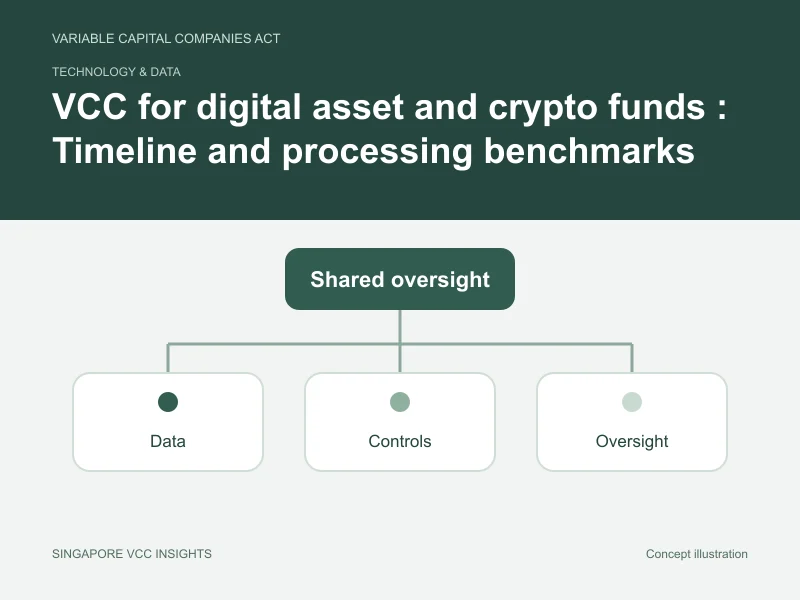
A Variable Capital Company (VCC) for digital asset and crypto funds offers a regulated, ring-fenced Singapore structure for managers running tokenised and digital-asset strategies. This guide sets out the timeline and processing benchmarks for a vcc for digital asset and crypto funds in 2026.
Raffles Corporate Services works with a panel of corporate and employment law firms; this article is general information, not legal advice.
Who this is for
This suits managers of tokenised and digital-asset strategies seeking an institutional, regulated Singapore fund vehicle with clear custody and segregation.
Why managers use a VCC for digital-asset strategies
Digital-asset funds often run multiple strategies, such as liquid tokens, venture-style token investments, and yield strategies, that benefit from segregation. The VCC umbrella lets a manager house these as separate ring-fenced sub-funds under one entity.
The structure also gives institutional investors a familiar corporate fund vehicle rather than an offshore special-purpose entity.
For a closely related perspective, see our guide on MAS Digital Payment Token (DPT) licensing , Eligibility and requirements checklist.
Eligibility and the licensing overlay
A VCC must appoint a Permissible Fund Manager, and where the strategy involves regulated digital payment tokens, the manager and any service providers must also consider licensing under the Payment Services Act 2019 administered by MAS. The Variable Capital Companies Act 2018 establishes the VCC and its ring-fencing.
Managers should confirm which activities fall within MAS's regulatory perimeter before launching, as digital-asset regulation continues to develop.
You may also find our related article on VCC for digital asset and crypto funds , Costs and fees breakdown useful.
Requirements: custody, valuation and administration
Custody of digital assets is a central requirement, and managers must use robust, auditable custody arrangements. A VCC needs a Singapore-resident director, a company secretary, an auditor, and a registered office, alongside the fund manager.
Valuation of volatile and sometimes illiquid tokens must follow a clear, documented policy, because it drives NAV, audit and investor reporting.
Cost and timeline benchmarks for 2026
VCC incorporation typically takes around 14 to 60 days once the manager and providers are engaged. Where a Payment Services Act licence or exemption is needed for the manager, that adds a separate and longer approval track.
Indicative costs in 2026: VCC set-up and first-year corporate services from around S$10,000 to S$25,000, with digital-asset custody and specialist audit adding materially to ongoing costs.
Common mistakes and gotchas
The most serious error is launching a digital-asset strategy without checking whether the manager needs a licence under the Payment Services Act 2019. Another is weak custody, which auditors and institutional investors will not accept.
Managers also underestimate the valuation and audit effort for volatile tokens, leading to delayed NAVs and reporting.
Step-by-step process
- Confirm whether the strategy involves regulated digital payment tokens and any licensing need.
- Appoint a Permissible Fund Manager and arrange robust digital-asset custody.
- Engage the VCC service providers and incorporate the VCC with ACRA.
- Adopt a documented valuation policy for volatile tokens.
- Launch the sub-funds and establish investor reporting and audit processes.
Vcc for Digital Asset and Crypto Funds at a glance
- Governing framework: Variable Capital Companies Act 2018; Payment Services Act 2019
- Typical timeline: VCC incorporation about 14-60 days; licensing separate
- Indicative cost (2026): Set-up S$10,000-S$25,000; custody and audit ongoing
Related guides
Across the Raffles group of sites, see VCC vs Cayman Islands SPC: Why Singapore Is the New Fund Domicile and our guide on MAS Digital Payment Token (DPT) licensing , Eligibility and requirements checklist for further reading.
Official references
FAQs
Can a VCC be used for a crypto fund?
Yes, a VCC can house digital-asset strategies through ring-fenced sub-funds, provided the manager and any regulated activities meet the applicable MAS requirements.
Does a crypto VCC need a Payment Services Act licence?
The VCC itself is a fund vehicle, but the manager or service providers may need a licence or exemption under the Payment Services Act 2019 depending on the activities involved.
How is custody handled?
Digital-asset custody must use robust, auditable arrangements that satisfy the auditor and institutional investors; it is a central launch requirement.
How long does set-up take?
VCC incorporation typically takes around 14 to 60 days, with any licensing track for the manager adding separate time.
Need help with this? Call, SMS or WhatsApp +65 8501 7133, or email hello@rafflescorporateservices.com. Raffles Corporate Services works with a panel of corporate and employment law firms; this article is general information, not legal advice.