Singapore VCC insights
Singapore VCC vs Cayman SPC — Eligibility and requirements checklist
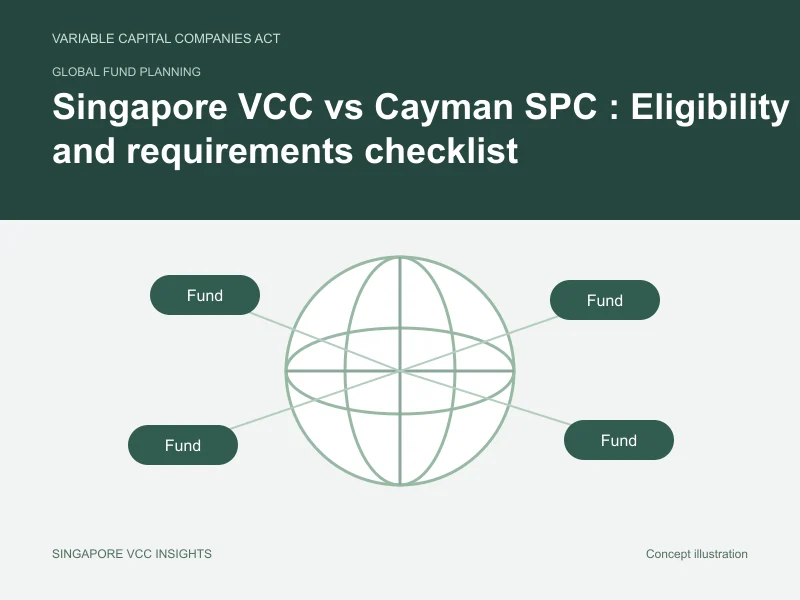
A Singapore VCC and a Cayman Segregated Portfolio Company (SPC) both offer umbrella fund structures with legal segregation between sub-funds or segregated portfolios, but the VCC is onshore, MAS-regulated and eligible for Singapore tax exemptions, while the Cayman SPC is offshore, lightly regulated and commonly used by managers who do not need a Singapore substance presence. This guide compares eligibility, cost and process for sponsors deciding between the two.
What each structure is
A Variable Capital Company (VCC) is a Singapore corporate structure purpose-built for investment funds, allowing an umbrella entity to house multiple sub-funds, each with segregated assets and liabilities, under a single legal entity registered with ACRA and regulated in substance by the Monetary Authority of Singapore (MAS). A Cayman SPC is a Cayman Islands exempted company that can create segregated portfolios, each ring-fenced from the others’ liabilities under Cayman law, registered with the Cayman Islands Monetary Authority (CIMA) where the fund is regulated. Both structures serve the same commercial purpose , running multiple strategies or share classes under one umbrella without cross-contamination of liability , but sit in different regulatory and tax regimes.
A useful way to frame the choice is substance versus flexibility. A VCC requires a genuine Singapore-based fund manager (licensed, registered or exempt) and, for tax-exempt status, real economic substance in Singapore , office space, local staff and a minimum level of business spending. A Cayman SPC imposes no equivalent onshore substance requirement of its own, which historically made it attractive to managers running the investment decision-making process from outside Cayman entirely. That flexibility comes at the cost of investors and regulators increasingly scrutinising “letterbox” offshore structures, which is part of why VCC adoption has grown steadily among managers who already have, or are building, a real Singapore presence.
Who this comparison is for
This is for fund sponsors, family offices and fund managers deciding whether to domicile a new fund onshore in Singapore or offshore in the Cayman Islands, particularly where the manager already has, or is considering, a Singapore-based investment management presence and wants to weigh up substance requirements, investor familiarity and total cost of ownership. It is equally relevant to managers who already run a Cayman SPC and are evaluating whether to redomicile into a VCC as their operations and investor base become more Singapore-centric, and to managers launching their first fund who want to avoid committing to the wrong domicile before understanding the full cost and compliance picture.
Eligibility and requirements
- Singapore VCC: must be incorporated and registered with ACRA; the fund manager must hold a Capital Markets Services licence, be a registered fund management company, or qualify as an exempt fund manager under MAS rules; to access the 13O or 13D tax exemption, the fund must also meet MAS’s economic substance conditions (minimum business spending and, in some cases, staff headcount).
- Cayman SPC: incorporated under the Companies Act (Cayman Islands) and, if constituted as a mutual fund, registered with or licensed by CIMA depending on investor numbers and structure; no local substance requirement in the way MAS imposes for tax-exempt Singapore funds, though economic substance rules apply to certain “relevant activities” under Cayman’s own economic substance legislation. Cayman’s fund regulatory regime distinguishes between lighter-touch registration categories for smaller, closely-held private funds and fuller licensing for funds offered more broadly, so the applicable category should be confirmed with Cayman counsel based on investor numbers and offering structure rather than assumed.
- Investors in both structures typically need to meet accredited or institutional investor thresholds if the fund is privately offered, though the specific investor protection regime differs between MAS and CIMA.
- Segregation of liability between sub-funds/segregated portfolios is a statutory feature of both structures, but enforceability in cross-border litigation can differ, since Cayman SPC segregation has been tested in more international courts to date.
- A VCC’s directors must include at least one Singapore-resident director, mirroring the general requirement for Singapore-incorporated companies; a Cayman SPC has no equivalent residency requirement for its directors, though CIMA-regulated funds typically expect at least some directors with relevant fund governance experience.
- Both structures require a registered office in their home jurisdiction (Singapore for a VCC, Cayman for an SPC) and a locally appointed corporate secretary or registered office provider to handle statutory filings.
Numerical comparison: Singapore VCC vs Cayman SPC
| Factor | Singapore VCC | Cayman SPC |
|---|---|---|
| Setup cost | S$15,000–S$35,000 (legal, admin, incorporation) | S$25,000–S$50,000 equivalent (typically billed in USD) |
| Ongoing annual cost | S$40,000–S$90,000 (admin, audit, tax, secretary, custody) | S$45,000–S$100,000 equivalent (admin, audit, registered office) |
| Typical setup timeline | 6–10 weeks | 4–8 weeks |
| Regulator | MAS (fund manager) / ACRA (corporate registry) | CIMA (if regulated mutual fund) |
| Segregation of liability | Statutory, under the Variable Capital Companies Act 2018 | Statutory, under the Companies Act (Cayman Islands), segregated portfolio provisions |
| Tax treatment | 13O/13D exemption available; otherwise standard Singapore corporate tax | No Cayman corporate tax; investor-level tax depends on investor’s home jurisdiction |
The setup cost gap narrows once legal and administration fees on both sides are compared like-for-like, but Singapore VCCs generally come out ahead on total cost of ownership once the fund also needs a genuine Singapore management presence, since the VCC avoids running two parallel cost bases (an onshore manager plus an offshore fund vehicle). Sponsors should also factor in currency: Cayman fees are typically billed in US dollars, which introduces FX exposure into the annual cost base that a Singapore dollar-denominated VCC engagement does not carry.
Per-sub-fund costs scale differently between the two structures. Adding an additional sub-fund to a VCC umbrella typically costs S$3,000–S$8,000 a year in incremental administration, audit and tax fees; adding an additional segregated portfolio to a Cayman SPC typically costs the equivalent of S$4,000–S$10,000 a year, reflecting Cayman’s generally higher base rates for administration and audit services. Neither structure charges materially different incorporation fees per additional sub-fund/segregated portfolio, since the legal work of adding one is usually a fraction of the cost of the initial umbrella setup.
Step-by-step process comparison
- Decide whether the fund manager will be based in Singapore , if yes, a VCC avoids duplicating substance across two jurisdictions; if the manager will operate entirely outside Singapore with no local presence planned, a Cayman SPC may be the simpler starting point.
- For a VCC: reserve the name with ACRA, appoint a licensed or exempt fund manager, file the constitution and register sub-funds, then apply for the 13O/13D exemption if relevant , this sequence typically takes 6–10 weeks end to end.
- For a Cayman SPC: incorporate the company, adopt segregated portfolio articles, register with CIMA if the fund meets the relevant investor or offering thresholds, and appoint an administrator and auditor , often completed in 4–8 weeks where CIMA registration (rather than a longer licensing process) applies.
- Both structures require an auditor and fund administrator to be appointed before the first financial year-end, and both benefit from engaging these providers early so that NAV calculation methodology and accounting policies are agreed before the fund starts trading.
- Ongoing filings: the VCC files an annual return with ACRA and a tax return with IRAS; the Cayman SPC files an annual return with the Cayman Registrar and, if CIMA-regulated, an annual fund return with CIMA, plus audited financial statements within the prescribed period after financial year-end.
- Where a manager later decides to consolidate an offshore Cayman structure into Singapore, the VCC Act’s inward redomiciliation provisions allow the existing fund (subject to conditions) to transfer its registration into a VCC rather than winding up and re-establishing from scratch.
Common mistakes and gotchas
- Assuming a Cayman SPC avoids all Singapore tax exposure , if the fund manager operates from Singapore, the manager’s own fees and profits are still taxed in Singapore regardless of where the fund vehicle sits.
- Underestimating Singapore substance conditions needed to keep a 13O/13D exemption , sponsors sometimes incorporate a VCC without first confirming the manager’s licensing status is in order.
- Treating segregation of liability as absolute in cross-border enforcement , while both structures are statutorily segregated at home, enforcement in a foreign court depends on that court recognising the segregation, which varies by jurisdiction.
- Comparing headline setup fees without including the recurring cost of custody, audit and tax compliance, which is where the two structures’ total cost of ownership actually diverges.
- Not revisiting the choice of structure as the fund’s investor base becomes more institutional , some investors have a stated preference for one domicile over the other.
- Overlooking the FX exposure created by Cayman fees typically being billed in US dollars, which can meaningfully move the annual cost base in Singapore dollar terms if the exchange rate shifts over the fund’s life.
- Assuming redomiciliation from Cayman to Singapore (or the reverse) is a quick administrative step , in practice it requires satisfying both the origin jurisdiction’s deregistration requirements and the destination jurisdiction’s registration requirements, and is usually a multi-month project rather than a simple filing.
Which factors should actually drive the decision
In practice, four questions tend to settle the choice for most sponsors. First, where will the investment manager genuinely operate from , a Singapore-based team with real decision-making authority points strongly towards a VCC, since the fund and the manager then sit in the same substance framework. Second, what does the target investor base expect , some institutional allocators still default to asking for a Cayman structure, particularly in strategies where Cayman has long been the market convention, while family offices and increasingly Asia-focused institutional investors are comfortable with a VCC. Third, how important is the 13O/13D tax exemption to the fund’s economics , if the fund manager can meet MAS’s substance conditions, the VCC’s exemption can be a meaningful saving over the life of the fund compared with structuring purely offshore. Fourth, is multi-jurisdiction distribution a near-term plan , if so, sponsors should also compare both structures against a Luxembourg SICAV, since neither a VCC nor a Cayman SPC offers EU passporting rights.
FAQs
Is a Singapore VCC cheaper than a Cayman SPC?
Setup costs are broadly comparable, but a VCC often has a lower total cost of ownership where the fund manager is already based in Singapore, since it avoids maintaining a parallel offshore cost base.
Does a VCC offer the same segregation of liability as a Cayman SPC?
Yes , both structures provide statutory segregation between sub-funds or segregated portfolios, under the Variable Capital Companies Act 2018 on the Singapore side and Cayman’s segregated portfolio company provisions on the other.
Can a VCC access tax exemptions unavailable to a Cayman SPC?
Yes , a VCC can apply for the 13O or 13D exemption under Singapore’s Income Tax Act, subject to MAS’s substance conditions, whereas a Cayman SPC’s tax position instead depends on the Cayman Islands’ zero corporate tax regime and the investors’ own home-jurisdiction tax rules.
How long does it take to set up each structure?
A VCC typically takes 6–10 weeks from name reservation to full registration; a Cayman SPC can often be set up in 4–8 weeks, though CIMA registration timelines add to this if the fund is regulated.
Which structure do institutional investors prefer?
It varies , some institutional investors are more familiar with Cayman structures historically, but VCC adoption has grown significantly since its 2020 launch, particularly among managers with a genuine Singapore presence.
Can an existing Cayman SPC be converted into a Singapore VCC?
Not by direct conversion, but the Variable Capital Companies Act 2018’s inward redomiciliation provisions allow an existing foreign fund vehicle to transfer its registration into a VCC, subject to meeting ACRA and MAS conditions , this is a distinct process from a fresh VCC incorporation and typically takes longer to plan.
Does the choice of structure affect ongoing FX risk?
Yes , Cayman SPC fees are usually billed in US dollars, so a Singapore-based sponsor budgeting in Singapore dollars carries FX exposure on the offshore cost base that a VCC’s Singapore dollar-denominated costs do not create.
Related guides
For a timeline-focused comparison of the same two structures, see our companion piece on Singapore VCC vs Cayman SPC , Timeline and processing benchmarks. Sponsors weighing a family office alongside either fund structure may also find Family office MAS approval, annual review and audit , Common mistakes and rejection reasons useful, and for the incorporation mechanics that precede either structure, see Redomiciling Your Foreign Company to Singapore: Full Process Guide.
Section 17 of the Variable Capital Companies Act 2018 establishes the sub-fund structure and its segregation of assets and liabilities, which is the direct Singapore counterpart to Cayman’s segregated portfolio provisions, and the Act’s annual filing requirements set the ongoing compliance rhythm that sponsors should compare against CIMA’s equivalent obligations. For authoritative detail, refer to MAS for fund manager licensing and exemption conditions, ACRA for VCC incorporation and registry filings, and IRAS for the tax treatment of Singapore-domiciled funds.
Need help with this? Call, SMS or WhatsApp +65 8501 7133, or email hello@rafflescorporateservices.com. Raffles Corporate Services works with a panel of corporate and employment law firms; this article is general information, not legal advice.