Singapore VCC insights
VCC Act 2018: Section 50 director residency requirements: Documents required and templates
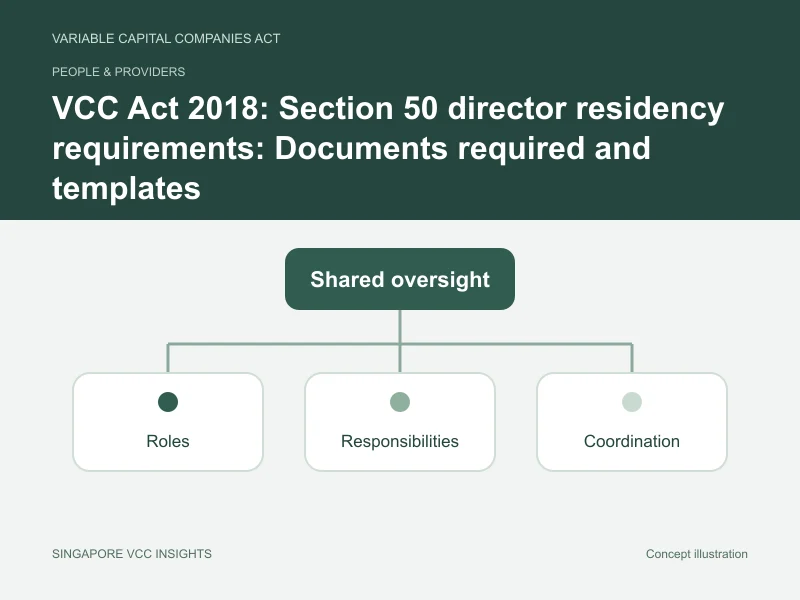
VCC Act 2018 Section 50 requires every Variable Capital Company to have at least one director who is ordinarily resident in Singapore, and getting this requirement wrong at incorporation is one of the more common reasons a VCC application stalls at MAS.
Raffles Corporate Services works with a panel of corporate and employment law firms; this article is general information, not legal advice.
What it is
Section 50 of the Variable Capital Companies Act 2018 requires a VCC to have at least one director who is ordinarily resident in Singapore, alongside at least one director who represents the permissible fund manager appointed under Section 46. In practice, many VCCs satisfy both requirements through the same individual where the fund manager’s Singapore-based representative is also Singapore-resident, but the two obligations are legally distinct and should be tracked separately.
The residency requirement mirrors, but does not duplicate, the general resident director requirement that applies to Singapore companies under the Companies Act 1967; a VCC needs to separately satisfy the VCC Act’s own Section 50 test even though the underlying policy rationale, ensuring a locally accountable individual sits on the board, is similar in spirit.
Who it’s for
This applies to every VCC regardless of size, and matters particularly for foreign fund sponsors establishing their first Singapore vehicle, who may need to appoint an independent resident director if no existing team member qualifies as Singapore-resident. It is also relevant when an existing resident director resigns or relocates, since the VCC must fill the gap promptly to remain compliant.
It is especially relevant for global asset managers setting up their first Singapore-domiciled fund vehicle as part of a broader regional expansion, where the group may not yet have any Singapore-resident senior staff and needs to decide between relocating an existing executive, hiring locally, or engaging a professional independent director as a bridge while the group builds out its own Singapore presence.
Eligibility and requirements
“Ordinarily resident in Singapore” generally means a Singapore citizen, permanent resident, or a work pass holder such as an Employment Pass holder with a genuine, settled connection to Singapore, consistent with the standard used elsewhere in Singapore company law for resident director requirements. The director representing the permissible fund manager under Section 46 must be properly authorised by that manager to act in that capacity, and this authorisation should be documented alongside the manager’s own licensing evidence.
Cost and timeline
Engaging a professional independent resident director through a corporate services provider typically costs S$2,500 to S$6,000 a year, depending on the scope of involvement and the provider’s risk appetite for the specific fund strategy. Sourcing and onboarding a resident director should be completed before the VCC’s MAS registration application is filed, since the application requires the director’s particulars and consent to act.
Step-by-step process
First, confirm whether any existing member of the fund sponsor’s team already qualifies as ordinarily resident in Singapore. Second, if not, engage a professional resident director through a corporate services provider, ensuring the individual understands the fiduciary duties involved in a regulated fund vehicle, not just a standard operating company. Third, separately confirm which director represents the permissible fund manager under Section 46, and document that authorisation. Fourth, include both directors’ particulars in the VCC’s constitution and MAS registration filing. Fifth, monitor residency status on an ongoing basis, particularly where the resident director holds a work pass that could lapse or change.
Documents required
Prepare each director’s proof of residency status (citizenship, permanent residency, or valid work pass with supporting address evidence), signed director consent to act, and, for the fund manager’s representative, written authorisation from the permissible fund manager confirming the individual acts on its behalf. A tracking template noting each director’s residency basis, its expiry (for work pass holders), and the fund manager authorisation date helps the VCC’s corporate secretary monitor ongoing compliance.
Common mistakes and gotchas
The most frequent gotcha is treating the Section 46 fund manager representative and the Section 50 resident director as automatically the same requirement, when a VCC actually needs to independently satisfy both, even if one person happens to fill both roles. Sponsors sometimes appoint a resident director who holds a work pass without checking that the pass remains valid throughout the VCC’s operating life, creating a compliance gap if the pass lapses or is not renewed. Some VCCs also delay appointing a resident director until late in the incorporation process, only to find the registration application cannot be completed without it. Finally, first-time sponsors occasionally underestimate that a professional resident director will expect genuine board involvement and documentation, not a purely nominal signature.
A further point of confusion is assuming any Singapore-resident individual, regardless of relevant experience, can fill the role satisfactorily. While Section 50 itself is a residency and authorisation test rather than a competency test, MAS and reputable professional director providers alike expect the individual to have a genuine understanding of the fund’s structure and regulatory obligations, since a resident director who cannot meaningfully engage with board discussions creates practical governance risk even where the technical residency requirement is satisfied on paper.
Succession planning for the resident director role
Because a vacancy in the resident director seat is a compliance breach, not merely a governance inconvenience, VCCs should build succession planning into their board composition from the outset. This typically means identifying a back-up candidate, whether an alternate professional director relationship or an internal successor, well before the incumbent resident director’s own circumstances (such as an expiring work pass, planned retirement, or relocation) create a gap. For VCCs relying on a work pass holder to satisfy the residency test, tracking that individual’s pass validity alongside the fund’s other compliance deadlines is a simple but easily overlooked safeguard against an avoidable breach.
Related guides
For the broader question of when relocating a founder or director makes sense, see Succession planning across Singapore PR / citizenship: common mistakes and rejection reasons. The general director’s duties that apply to any Singapore company, including a VCC, are set out in Director’s Duties in Singapore: A Complete Guide. This is part of our statute-level series, alongside VCC Act 2018: Section 24 variable capital and share redemption: documents required and templates.
FAQs
Can the same person satisfy both the Section 46 and Section 50 requirements?
Yes, provided that individual is both ordinarily resident in Singapore and properly authorised to represent the permissible fund manager, though the two requirements remain legally separate and should each be documented.
Does the resident director need to be a Singapore citizen?
No, a permanent resident or an appropriately qualifying work pass holder with a genuine settled connection to Singapore can also satisfy the ordinarily resident test.
What happens if the resident director resigns?
The VCC must appoint a replacement resident director promptly to remain compliant with Section 50; an unfilled gap is a breach of the Act.
Is a professional independent resident director a purely nominal appointment?
No, the director takes on genuine fiduciary duties and reputable providers expect real board involvement, not a signature-only role.
Numerical specifics
Typical annual cost of a professional independent resident director: S$2,500 to S$6,000. Key statutory reference: Section 50 of the Variable Capital Companies Act 2018 (resident director requirement), read alongside Section 46 (permissible fund manager representative requirement).
Selecting a professional resident director provider
Where a sponsor engages an external professional resident director rather than relocating its own staff, the selection process should look beyond fee levels alone. Relevant questions include how many other board seats the individual already holds, since an overextended professional director may not be able to give a fund the attention its governance genuinely requires, what fund or regulated-entity experience the individual brings, and how the provider handles conflicts of interest where it serves multiple funds with potentially overlapping investor bases or strategies. A sponsor’s own corporate services adviser can usually make an introduction to several suitable candidates and help assess fit before a formal appointment is made.
Need help with this? Call, SMS or WhatsApp +65 8501 7133, or email hello@rafflescorporateservices.com. Raffles Corporate Services works with a panel of corporate and employment law firms; this article is general information, not legal advice.
Verify the current text of the Act at Singapore Statutes Online, registration requirements at ACRA, and regulatory guidance at the Monetary Authority of Singapore.