Singapore VCC insights
VCC master-feeder structures — Documents required and templates
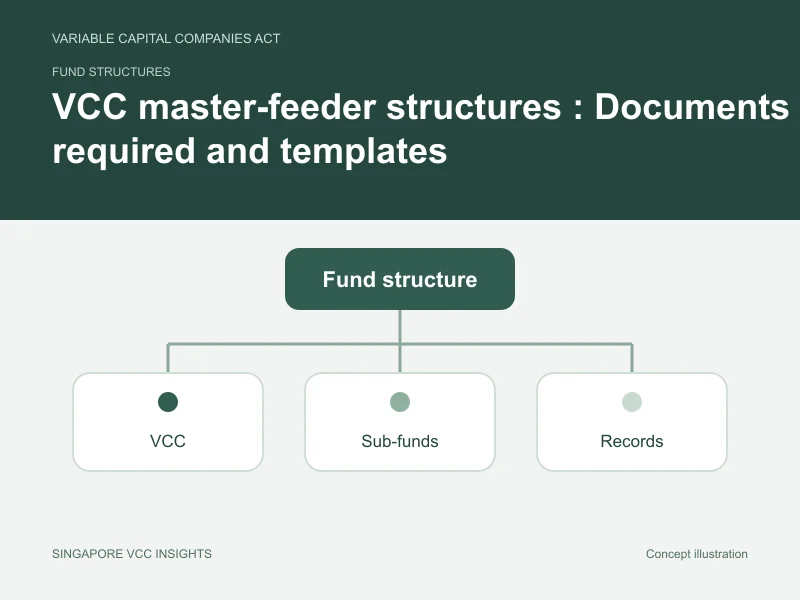
VCC master-feeder structures use a Singapore Variable Capital Company as either the master fund or a feeder fund, pooling capital from one or more feeders into a single master vehicle to achieve economies of scale, and setting one up requires specific constitutional, custody and cross-fund investment documentation.
What are VCC master-feeder structures?
In a typical master-feeder arrangement, investors subscribe into a feeder fund, which in turn invests substantially all of its assets into a master fund that executes the actual investment strategy. Where the VCC framework is used, either the master, the feeder, or both, can be structured as a VCC, a sub-fund of an umbrella VCC, or a related but separately domiciled vehicle. Section 2 of the Variable Capital Companies Act 2018’s definitions of “collective investment scheme” and “umbrella VCC” underpin how a VCC feeder can hold units in a VCC master as its principal investment.
Who is this structure for?
Master-feeder structures suit managers raising capital from investors across multiple jurisdictions or in multiple currencies, who want each investor group to access the same underlying strategy through a locally appropriate feeder while consolidating the actual trading and operations in a single master. It is commonly used where a manager wants a Singapore feeder for local or regional investors alongside a feeder domiciled elsewhere, both feeding into a single VCC master.
Eligibility and requirements
Both the master and feeder require a Singapore-based licensed or registered fund manager if structured as a VCC, a Singapore-resident director, and a Singapore-based auditor and company secretary. The feeder’s constitution must permit substantially all of its assets to be invested into the master, and the arrangement must be documented through an investment management agreement or inter-fund agreement setting out fee arrangements, redemption mechanics between feeder and master, and how each entity’s valuation is synchronised.
Cost and timeline
Incorporating a VCC master and a VCC feeder each typically takes 1 to 2 weeks, similar to a standalone VCC, though the inter-fund documentation (investment management or subscription agreements between feeder and master) typically adds 2 to 4 weeks to the overall structuring timeline. Ongoing administration costs are generally higher than a single VCC, since valuation, audit and reporting must be performed and reconciled at both the feeder and master level, commonly from S$18,000 per year per entity.
Step-by-step process
1. Confirm the fund manager’s MAS licensing or registration status for each entity to be structured as a VCC. 2. Draft the master and feeder constitutions, ensuring the feeder’s investment mandate permits substantially all assets to flow to the master. 3. Negotiate and document the inter-fund investment agreement, including valuation synchronisation and redemption mechanics. 4. Incorporate and register both entities with the Registrar of VCCs. 5. Appoint the required Singapore-resident directors, auditor and company secretary for each entity. 6. Establish parallel valuation and reporting processes across feeder and master.
Common mistakes
A common error is failing to align the feeder and master’s valuation dates and methodologies, causing a mismatch between the feeder’s reported net asset value and its actual claim on the master. Others under-document the inter-fund agreement’s redemption mechanics, leaving ambiguity over how quickly the feeder can redeem from the master to meet its own investor redemptions. A further mistake is assuming a master-feeder structure automatically reduces cost, when in practice dual-entity administration can increase costs unless scale genuinely justifies it.
FAQs
Must both the master and feeder be VCCs?
No, either can be a VCC while the other is domiciled elsewhere, depending on investor and regulatory considerations.
How is redemption timing coordinated between feeder and master?
Through the inter-fund investment agreement, which should specify redemption notice periods and settlement mechanics between the two entities.
Does a master-feeder structure cost more than a single VCC?
Generally yes, since valuation, audit and reporting are performed at both levels, though this is typically justified once assets under management reach sufficient scale.
How long does it take to set up a master-feeder structure?
Typically 4 to 8 weeks in total, allowing for incorporation of both entities and negotiation of the inter-fund agreement.
Can a VCC feeder invest in a non-VCC master?
Yes, provided the feeder’s constitution and investment mandate permit the arrangement and the relevant regulatory requirements are met.
Related guides
For the fund manager licensing considerations relevant to a master-feeder structure, see MAS Registered Fund Management Company (RFMC) sunset and migration: common mistakes and rejection reasons. For a domicile comparison, see VCC vs Cayman Islands SPC: why Singapore is the new fund domicile. See also our related eligibility checklist, VCC master-feeder structures: eligibility and requirements checklist.
Authoritative references: the Monetary Authority of Singapore’s explainer on the VCC, the Accounting and Corporate Regulatory Authority, and the Variable Capital Companies Act 2018 on Singapore Statutes Online.
Need help with this? Call, SMS or WhatsApp +65 8501 7133, or email hello@rafflescorporateservices.com. Raffles Corporate Services works with a panel of corporate and employment law firms; this article is general information, not legal advice.