Singapore VCC insights
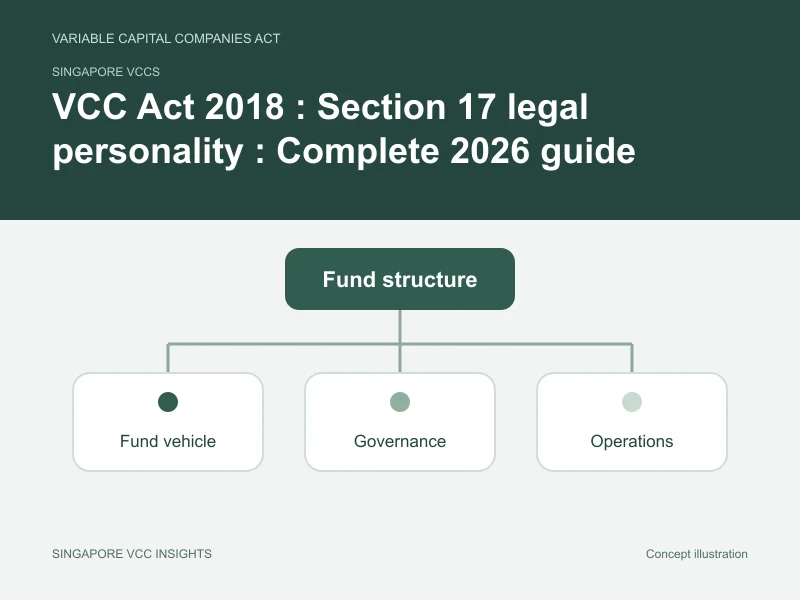
VCC Act 2018 — Section 17 legal personality — Complete 2026 guide
Raffles Corporate Services works with a panel of corporate and employment law firms; this article is general information, not legal advice.
Section 17 of the Variable Capital Companies Act 2018 confers on every VCC the status of a body corporate with separate legal personality from the moment of incorporation. The provision is the constitutional pillar of the VCC: it gives the fund the capacity to contract, hold property, sue and be sued in its own name, and to continue in existence until it is wound up or struck off. Every operational question that follows in the Act is built on this foundation.
What Section 17 actually says
Section 17(1) of the Variable Capital Companies Act 2018 provides that “a VCC is, on and from the date of its incorporation stated in the notice of incorporation issued under section 16, a body corporate by the name set out in its constitution.” Section 17(2) then confirms the VCC’s capacity to acquire, hold and dispose of movable and immovable property, to enter into contracts, to sue and be sued, and to do and suffer such other acts and things as bodies corporate may lawfully do.
Section 17(3) gives the VCC perpetual succession until it is dissolved , the entity outlives its directors, custodians and members. Section 17(4) reiterates that members are not, by reason only of being members, liable for the obligations of the VCC. In substance, the provision mirrors section 19 of the Companies Act 1967 but is reframed for an investment vehicle whose share capital flexes with net asset value (NAV) rather than sitting in a fixed account.
Why separate legal personality matters for a fund
For a manager incorporating a VCC under the supervision of ACRA and licensed by MAS, separate legal personality is not theoretical. It is the legal hook that allows the fund to:
- open bank and brokerage accounts in its own name rather than the manager’s;
- execute subscription agreements, ISDA documentation, repo agreements and side letters as principal;
- hold underlying portfolio assets , private equity stakes, structured notes, real estate , with a clean title chain;
- preserve continuity if the investment manager changes; and
- be liquidated cleanly without disturbing the manager or its other clients.
This is also what allows a VCC to be recognised as a tax resident in its own right when applying for the Section 13O or 13U exemptions discussed in our companion guide on Section 13O vs 13U family office incentives.
How Section 17 interacts with the rest of the VCC Act 2018
Section 17 does not stand alone. The capacity it grants is exercised through the architecture set out elsewhere in the Act:
- Section 24 permits the VCC’s share capital to vary continually so that capital movements can match NAV , impossible under the maintenance-of-capital regime that applies to ordinary Singapore companies.
- Section 29 allows the VCC to be constituted as an umbrella with segregated sub-funds; each sub-fund is not a separate legal person, but the umbrella is, and Section 17 is what gives that umbrella its standing.
- Section 38 requires the VCC to maintain a register of members at its registered office , consistent with its corporate status.
- Section 46 mandates the appointment of a regulated fund manager , recognising that the VCC, as a legal person, must act through directors and a manager.
The drafting borrows liberally from the Companies Act 1967 but disapplies provisions that would frustrate the VCC’s purpose. Section 76 of the Companies Act 1967 (financial assistance), for example, is disapplied to VCCs through Section 24, because a fund routinely uses subscriptions to redeem outgoing investors. Our explainer on Section 76 Companies Act financial assistance sets out the equivalent rule for an ordinary Pte Ltd.
Practical implications for directors and counsel
Directors of a VCC carry the same statutory and fiduciary duties as directors of any Singapore company , honest discharge of duty, no improper conflict, no misuse of position , but they discharge those duties in respect of a legal person whose share capital is in continuous flux. Three practical consequences follow:
1. Contracts must be in the VCC’s name, not the manager’s. A common error in early VCC implementations was for the appointed fund manager to continue executing portfolio documents in its own name. Because the VCC has separate legal personality under Section 17, every portfolio contract should be signed by, or on behalf of, the VCC itself. Where an umbrella VCC is in use, the documentation must also identify the relevant sub-fund.
2. Litigation runs against the VCC. A claim brought by an investor for misrepresentation or by a counterparty for breach of contract is brought against the VCC, not the manager (subject to any direct duty owed by the manager). Insurance cover , D&O for directors, professional indemnity for the manager, and bespoke fund cover , must reflect this.
3. Winding up is a corporate process. A VCC is wound up under Part 9 of the VCC Act 2018, which adopts (with modification) the insolvency regime in the Insolvency, Restructuring and Dissolution Act 2018. Because the VCC is a body corporate, the standard concepts of liquidators, statutory schemes of arrangement and creditor priorities apply.
Numerical thresholds and timelines
Section 17 itself does not contain numerical thresholds. The thresholds that operationalise it are in subsequent provisions:
- Minimum paid-up capital: S$1, like an ordinary Pte Ltd , there is no statutory minimum capital for a VCC.
- Minimum directors: at least three, of whom at least one must be ordinarily resident in Singapore and at least one must be a director or qualified representative of the fund manager (Section 46).
- Annual return: due within seven months after the end of the financial year (Section 96).
Common drafting mistakes
Three errors recur in early-stage VCC documentation we review:
Treating sub-funds as legal persons. They are not. Only the umbrella VCC has Section 17 legal personality. Sub-funds are accounting and ring-fencing constructs created under Section 29. Contracts “with a sub-fund” are, in law, contracts with the umbrella VCC acting in respect of that sub-fund.
Constitution language copied from a Pte Ltd. A constitution lifted from a private limited company template will often contain maintenance-of-capital language inconsistent with Section 24. The constitution should expressly authorise issue and redemption of shares at NAV.
Missing recognition of the body-corporate status. Some operating agreements describe the VCC as a “collective investment scheme” or “fund vehicle”. While accurate descriptively, the legal characterisation in primary documents should be “body corporate constituted under the Variable Capital Companies Act 2018” to avoid arguments about capacity.
Cross-references to other Raffles guides
For the operational mechanics of running a VCC end-to-end, see our VCC Singapore structure, setup and operations guide. For the secretarial perspective on how a VCC’s annual filings differ from a Pte Ltd, see Singapore Secretary Services on 13O vs 13U incentives. For an India-family-business worked example, see our companion piece on the Singapore VCC incorporation guide for Indian family businesses.
FAQs
Does a VCC have a separate legal personality from its sub-funds?
Yes. The VCC itself is a body corporate under Section 17. Each sub-fund, while ring-fenced from creditors of other sub-funds under Section 29, does not have separate legal personality. The umbrella VCC contracts on behalf of its sub-funds.
Can a VCC own shares in another company?
Yes. Section 17(2) gives the VCC general capacity to hold property, including shares in other companies, units in unit trusts, interests in limited partnerships and digital assets.
Are VCC directors personally liable for the VCC’s debts?
No, subject to the usual exceptions for fraudulent or wrongful trading. Section 17(4) confirms that members are not liable by reason only of membership; directors’ liability follows the standard corporate principles applied to companies in Singapore.
Can the VCC change its name?
Yes, by special resolution and on filing the requisite notice with ACRA. The body-corporate status under Section 17 is preserved through any name change.
What happens to a VCC’s assets and contracts when its manager is removed?
They remain with the VCC. Because Section 17 separates the VCC from its manager, removing or replacing the manager does not affect the VCC’s contractual or proprietary position. The new manager simply steps into the existing operational framework.
Comparative perspective: VCC versus Cayman, Luxembourg and Mauritius vehicles
Section 17’s grant of separate legal personality is not unique , comparable jurisdictions have analogous concepts , but the Singapore implementation has features that matter in negotiation. The Cayman Segregated Portfolio Company (SPC) is a corporation under Cayman law, but its segregated portfolios are not separate persons; the cell-level liability question is contractual. The Luxembourg SICAV is a body corporate under Luxembourg law, and the RAIF variant has been particularly popular for alternative strategies. The Mauritius Variable Capital Company, modelled on the Singapore VCC, also confers separate legal personality but operates in a different tax-treaty environment.
For managers comparing options, three Singapore advantages tend to dominate: tax-treaty access through Singapore’s extensive double-tax treaty network, the statutory rather than purely contractual ring-fence in Section 29, and the clear extension of Singapore corporate-law principles to the VCC through the disapplication architecture in Section 24 and elsewhere. The position is set out in detail by MAS.
Recent developments and 2026 watch-list
Three threads of legislative and regulatory development bear watching as Section 17 continues to be operationalised. First, the ongoing alignment of VCC obligations with the Corporate Service Providers Act 2024, which formalises CSP licensing and AML obligations. Second, the consolidated AML/CFT framework issued through MAS Notice VCC-N01, which clarifies what the corporate person is expected to do when onboarding investors and counterparties. Third, the work-in-progress on cross-border passporting of VCCs into ASEAN jurisdictions, which would let a single legal person market itself across multiple markets without re-papering.
None of these developments dilutes Section 17’s core grant of legal personality. They build on it. The VCC remains a body corporate with the full set of corporate powers, and continues to be the workhorse vehicle for Singapore-domiciled funds across the strategies that the regime was designed to serve , long-only equity, hedge, private equity, private credit, real estate, infrastructure and digital assets.
Section 17 in litigation: what to expect
Three categories of dispute exercise Section 17 in practice. The first is investor-led: a member or former member alleging misrepresentation in the offering document, breach of the constitution, or improper application of the redemption mechanics in Section 24. Because the VCC has separate legal personality, such claims are brought against the VCC. The manager and directors may be joined where direct duties are alleged, but the primary defendant is the VCC itself.
The second category is counterparty-led: a prime broker, ISDA counterparty or trade vendor enforcing rights under contract. Section 17 again places the VCC as the defendant. Enforcement against assets of the umbrella is constrained by Section 29 where a sub-fund is involved , counterparties of one sub-fund cannot reach the assets of another.
The third category is regulator-led: MAS or ACRA enforcement against the VCC for breach of the licensing regime, AML obligations or filing requirements. The VCC, as the corporate person, is the addressee of any directive, penalty or condition. Directors may face personal consequences where statutory duties are breached, but the primary disciplinary surface is the VCC.
The doctrinal stability of Section 17 means that disputes are typically resolved within familiar corporate-law parameters. Singapore High Court practice in commercial and equity matters applies; the choice of arbitration where the constitution so provides is enforced under the International Arbitration Act 1994. There is no significant body of VCC-specific case law yet on the limits of Section 17, but the general expectation among practitioners is that the standard Companies Act 1967 jurisprudence on corporate capacity, ultra vires and lifting the corporate veil will be persuasive.
Operational checklist for incorporation
Counsel and the company secretary will typically work through the following at incorporation, all of which flow from Section 17’s body-corporate grant:
- Reserve the name with ACRA and confirm absence of conflicts.
- Draft the constitution, including the sub-fund schedule if the VCC is to be an umbrella.
- Appoint at least three directors (Section 46), with at least one ordinarily resident in Singapore.
- Appoint the regulated fund manager and execute the investment management agreement on behalf of the VCC.
- Appoint the company secretary, auditor and (where relevant) custodian.
- Open the VCC’s bank account in its own name.
- File the notice of incorporation; receive the unique entity number; the VCC’s legal personality crystallises from this date.
- Adopt board resolutions adopting the constitution, appointing officers, opening accounts and authorising the offering document.
Related guides
For the broader Singapore funds ecosystem, see MAS’s explainer on the VCC and the consolidated text of the VCC Act 2018 on SSO. ACRA publishes the corresponding filings and forms at acra.gov.sg.
Need help with this? Call, SMS or WhatsApp +65 8501 7133, or email hello@rafflescorporateservices.com. Raffles Corporate Services works with a panel of corporate and employment law firms; this article is general information, not legal advice.