Singapore VCC insights
VCC Act 2018 — Section 29 sub-fund segregation — Complete 2026 guide
Raffles Corporate Services works with a panel of corporate and employment law firms; this article is general information, not legal advice.
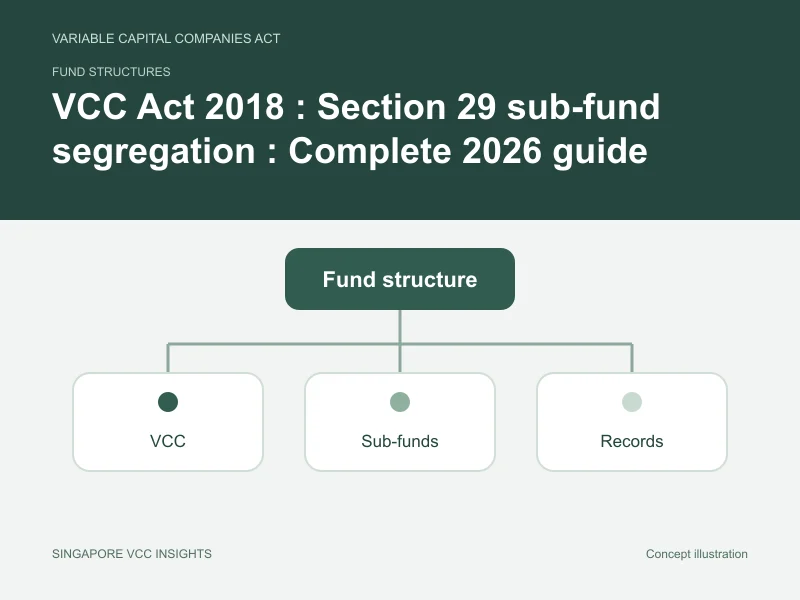
Section 29 of the Variable Capital Companies Act 2018 enables a single VCC to operate as an umbrella with multiple sub-funds, each with its own portfolio, NAV and investor base, and , critically , with statutory ring-fencing between sub-funds. It is the provision that lets a manager build a multi-strategy platform on one corporate shell without exposing one strategy’s investors to another strategy’s creditors.
What Section 29 actually says
Section 29(1) of the Variable Capital Companies Act 2018 provides that a VCC may be constituted as an umbrella VCC with two or more sub-funds. Section 29(2) requires each sub-fund to have its own assets and liabilities, separately accounted for. Section 29(3) provides the statutory ring-fence: the assets of a sub-fund must be applied solely in respect of the liabilities and obligations of that sub-fund, and not to satisfy liabilities or obligations of any other sub-fund or of the umbrella VCC as a whole. Section 29(4) clarifies that the umbrella VCC remains a single legal person under Section 17 , the sub-funds are not separate legal entities.
Section 29(5) requires the constitution of an umbrella VCC to specify the manner in which sub-funds are established, varied and wound up. Sections 29(6) and 29(7) then deal with insolvency: a sub-fund can be wound up without winding up the umbrella VCC, and the insolvency of one sub-fund does not, of itself, cause the umbrella or any other sub-fund to be insolvent.
Why a statutory ring-fence matters
In other jurisdictions, ring-fencing between cells or compartments often depends on contractual segregation reinforced by careful operational discipline. Section 29 makes ring-fencing a matter of Singapore primary statute. Three consequences follow:
- Creditor reach is limited by law, not contract. A trade counterparty of Sub-Fund A cannot, on insolvency of Sub-Fund A, look to the assets of Sub-Fund B. The position is binding regardless of what the contract says (subject to fraud).
- Investors get statutory comfort. An investor in Sub-Fund B can rely on Section 29(3) without separately diligencing the contractual arrangements of Sub-Fund A.
- Cross-fund insolvency is contained. A failed sub-fund can be wound up while the rest of the umbrella keeps trading, an option not generally available in non-statutory cell structures.
How Section 29 interacts with the rest of the VCC Act 2018
The ring-fence is supported by surrounding provisions:
- Section 17 gives the umbrella VCC its legal personality; sub-funds inherit standing through the umbrella.
- Section 24 applies at sub-fund level: each sub-fund’s share capital varies with its own NAV, and subscriptions and redemptions operate at sub-fund level.
- Section 38 requires separate registers of members for each sub-fund.
- Section 87 requires separate accounting records, financial statements and audit for each sub-fund , the operational backbone of the ring-fence.
- Section 76 of the Companies Act 1967 is disapplied by Section 24, including at sub-fund level , redemptions of one sub-fund’s shares can be funded by subscriptions to that sub-fund.
For the broader umbrella architecture , including cross-sub-fund expense allocation, FX hedging and master-feeder overlays , see our VCC sub-funds and umbrella architecture guide.
Practical implications for directors and counsel
1. Operational separation is essential. Statutory ring-fencing requires real operational segregation. Each sub-fund must have its own bank account, its own custody account, its own NAV calculation, its own audit and its own books and records. A claimant arguing that the segregation was a sham will look first at operational practice, not the constitution.
2. Common expenses must be allocated transparently. Costs that benefit the umbrella as a whole , directors’ fees, audit fees, regulatory fees , must be allocated to sub-funds on a published basis (typically pro rata to NAV). The allocation policy belongs in the constitution and the offering document.
3. Cross-sub-fund transactions must be at arm’s length. If Sub-Fund A buys a position from Sub-Fund B, the transaction must be priced and documented as if between unrelated funds. Anything less invites challenge from the buying sub-fund’s investors and risks piercing the ring-fence.
4. Sub-fund winding up is procedurally distinct. A sub-fund can be terminated without winding up the umbrella. The constitution should set out the procedure , notice period, valuation method, distribution waterfall , and the directors should ensure that creditors of that sub-fund are paid (or provided for) before distributions to investors.
Numerical thresholds and timelines
Section 29 does not impose numerical limits. The supporting framework introduces these:
- Minimum sub-funds to be an umbrella: two.
- Maximum sub-funds: no statutory cap; subject to operational capacity and audit resourcing.
- NAV calculation: at least once at each dealing date, separately for each sub-fund.
- Annual return for the umbrella: due within seven months of financial year-end (Section 96), with sub-fund-level financial statements appended.
- Section 13U commitment: S$50 million committed at application, measured at umbrella level but typically allocated across qualifying sub-funds.
Common drafting and operational mistakes
Treating sub-funds as legal persons. They are not. Only the umbrella VCC has legal personality under Section 17. Contracts “with Sub-Fund A” are, in law, contracts with the umbrella acting in respect of Sub-Fund A. The execution block should reflect this: “[Umbrella VCC Name], acting in respect of [Sub-Fund A].”
Commingled bank or custody accounts. A single bank account holding cash for multiple sub-funds undermines the ring-fence in practice, even if the books segregate the balances. Each sub-fund should have its own designated accounts.
Allocating sub-fund-specific costs to the umbrella. Manager fees, performance fees and dealing costs that arise from a particular sub-fund’s activity must be charged to that sub-fund, not socialised across the umbrella.
Omitting the ring-fence in the constitution. Even though Section 29(3) provides the statutory ring-fence, the constitution should restate it for the benefit of counterparties reviewing the document. The omission has caused negotiation friction with lenders, prime brokers and ISDA counterparties.
Worked example: an umbrella with three sub-funds
An umbrella VCC has three sub-funds: Sub-Fund A (Asian equities, S$200 million NAV), Sub-Fund B (private credit, S$120 million NAV) and Sub-Fund C (digital assets, S$45 million NAV). Sub-Fund C suffers a custody loss arising from an exchange failure on 15 June 2026 that wipes out its NAV.
Sub-Fund C’s creditors may look only to Sub-Fund C’s remaining assets , not to Sub-Fund A or Sub-Fund B. The directors call a board meeting and, under the procedure in the constitution, resolve to wind up Sub-Fund C without disturbing the umbrella. A separate liquidator is appointed for Sub-Fund C; its remaining assets (if any) are distributed in the statutory order. Sub-Fund A and Sub-Fund B continue dealings uninterrupted, subject to disclosure to their respective investors of the unrelated event affecting Sub-Fund C.
Two weeks later, the umbrella adds a new Sub-Fund D (Singapore-listed REITs) by a board resolution amending the constitutional sub-fund schedule. Subscriptions open at Sub-Fund D level on 1 July 2026 with a NAV per share of S$10.00.
FAQs
Are sub-funds separate legal persons?
No. Section 29(4) confirms the umbrella VCC remains a single legal person under Section 17. Sub-funds are statutory ring-fenced compartments, not entities.
Can a creditor of one sub-fund pursue another sub-fund’s assets?
No. Section 29(3) provides that assets of a sub-fund must be applied solely in respect of the liabilities and obligations of that sub-fund. The ring-fence is binding regardless of contract.
Can a sub-fund be wound up without winding up the umbrella?
Yes. The procedure must be set out in the constitution and complied with, including provision for creditors of the relevant sub-fund.
Are sub-funds taxed separately?
For Section 13O and 13U incentive purposes, the umbrella VCC is the taxpayer but the conditions can be applied at sub-fund level under the existing Inland Revenue Authority of Singapore guidance. See our Singapore Pte Ltd registration guide for the corporate tax baseline, and our family office worked example for an applied scenario.
Does each sub-fund need its own auditor?
The umbrella appoints a single auditor for the VCC, who audits each sub-fund separately. The auditor must be a Singapore-registered public accounting firm.
Section 29 in operation: the documentation stack
Statutory ring-fencing only delivers commercial value if the documentation stack supports it. A workable umbrella VCC will have the following documents, each aligned with Section 29’s architecture: an umbrella constitution defining the procedure to create, vary and wind up sub-funds; sub-fund supplements specifying the investment objective, fee schedule and dealing cycle for each sub-fund; an investment management agreement at umbrella level with sub-fund-specific schedules; a global custody agreement with sub-fund segregation; a fund administration agreement covering NAV calculation and transfer agency at sub-fund level; an offering document or PPM at sub-fund level; subscription agreements and side letters at sub-fund level; and AML/CFT and FATCA/CRS onboarding documentation for each investor.
Maintaining the stack requires discipline. New sub-funds should be created only through the constitutional procedure, with corresponding board resolutions, supplements and operational onboarding (bank accounts, custody accounts, administrator setup, audit scope). Investors should be subscribed at sub-fund level using the relevant subscription agreement; subscribing “to the umbrella” is meaningless and creates downstream documentation problems.
Comparative view: SPCs, ICCs, RAIFs and Section 29 sub-funds
Cell and compartment structures exist in several leading fund jurisdictions. The Cayman Segregated Portfolio Company (SPC) provides contractual cell segregation supported by Cayman case law and the standard SPC documentation. The Guernsey Protected Cell Company (PCC) and Incorporated Cell Company (ICC) offer statutory cell separation; in the ICC variant, each cell is itself a legal person. The Luxembourg RAIF and SICAV can be constituted with separate compartments, supported by Luxembourg statute.
Section 29 of the Singapore VCC Act 2018 sits within this landscape with three notable features. The ring-fence is statutory rather than contractual (unlike the Cayman SPC). The sub-funds are not separate legal persons (unlike the Guernsey ICC), which keeps the contracting surface and operational footprint small. And the regime is integrated with Singapore corporate law through targeted disapplications, which gives counterparties a familiar legal map.
Cross-sub-fund services and the role of the manager
The fund manager appointed under Section 46 acts for the umbrella VCC and, in practice, for each sub-fund. The investment management agreement should specify how the manager is remunerated at sub-fund level , ordinarily through management and performance fees calculated separately for each sub-fund , and how cross-sub-fund services, such as a centralised research team or shared compliance function, are allocated. Where the manager itself benefits from a Section 13U exemption applied at umbrella level, the conditions are typically traced through to each qualifying sub-fund.
Operational documentation should not paper over the ring-fence. Subscription agreements, side letters and offering documents should each be issued at sub-fund level, identifying the sub-fund as the unit of investment within the umbrella VCC. Investors get exposure to a sub-fund, not to the umbrella as a whole; that is the entire commercial point of Section 29.
Insolvency: what happens when a sub-fund fails
The insolvency of a sub-fund under Section 29(6) and (7) of the VCC Act 2018 is procedurally distinct from the insolvency of the umbrella. The directors must determine whether the sub-fund can pay its debts as they fall due. If not, the constitution’s winding-up procedure for sub-funds is invoked. A separate liquidator may be appointed for the sub-fund; the umbrella continues to operate; other sub-funds are insulated. The Section 29(3) ring-fence means that the failed sub-fund’s creditors cannot reach the assets of solvent sub-funds.
This is more than a paper protection. In practice, it allows a multi-strategy platform to survive the failure of one strategy without contagion, while remaining a single corporate entity for ACRA, MAS and IRAS purposes. The contrast with non-statutory cell structures, where cross-cell contagion has been a feature of historic disputes, is sharp.
Related guides
The consolidated VCC Act 2018 text on SSO is the authoritative source. MAS’s explainer on the VCC is the cleanest summary of the policy intent. ACRA publishes the corresponding filing forms. For sub-fund architecture in depth, see our VCC sub-funds and umbrella architecture guide.
Need help with this? Call, SMS or WhatsApp +65 8501 7133, or email hello@rafflescorporateservices.com. Raffles Corporate Services works with a panel of corporate and employment law firms; this article is general information, not legal advice.