Singapore VCC insights
Standalone VCC vs umbrella VCC — decision framework — Complete 2026 guide
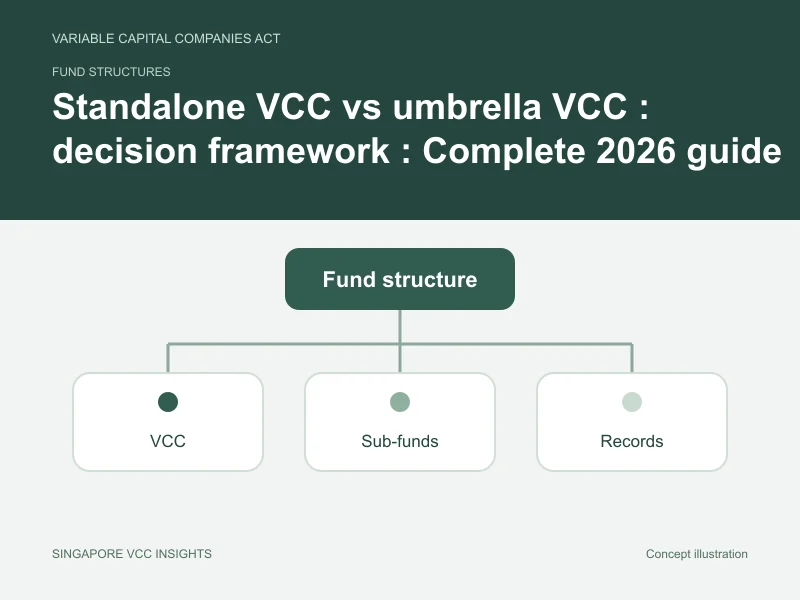
The standalone VCC vs umbrella VCC decision is among the first structural choices a sponsor faces under the VCC Act 2018. A standalone VCC operates as a single corporate vehicle with one pool of assets; an umbrella VCC holds two or more statutorily ring-fenced sub-funds, each with its own portfolio, investors and economic terms but sharing a common board, fund manager, registered office and corporate infrastructure.
Raffles Corporate Services works with a panel of corporate and employment law firms; this article is general information, not legal advice.
What a standalone VCC is
A standalone VCC is a single corporate entity. It has one constitution, one set of audited accounts, one investor register and one capital pool. Variable capital under Section 24 of the VCC Act 2018 still applies , the VCC can issue and redeem shares at NAV without the share-buyback formalities of a Companies Act 1967 company , but the structural simplicity is closer to a traditional Singapore Pte Ltd than to a complex multi-portfolio fund. Standalone VCCs are well-suited to single-strategy funds, single-investor club deals, and the holding-vehicle layer of family office structures where ring-fencing within the entity is not needed.
The standalone VCC enjoys the same VCC-specific advantages as an umbrella VCC: variable capital, ability to qualify for Section 13O or Section 13U incentive, eligible to redomicile under Part 13, and access to the VCC sub-fund-style fund administration ecosystem. It simply does not deploy the sub-fund segregation mechanism.
What an umbrella VCC is
An umbrella VCC holds two or more sub-funds, each ring-fenced under Section 29 of the VCC Act 2018. Each sub-fund has its own assets and liabilities, its own NAV calculation, its own series of shares and its own economic terms. Creditors of one sub-fund can only access the assets of that sub-fund (subject to limited exceptions). The umbrella VCC has one board, one fund manager, one constitution and one regulatory filing footprint, but each sub-fund is operationally a self-contained pool.
Umbrella VCCs are well-suited to multi-strategy fund houses, fund-of-funds platforms, multi-family office structures with several family branches, and platform sponsors offering serial fund vintages. The umbrella VCC infrastructure spreads fixed costs (board, fund manager, fund admin retainer, auditor base fees) across multiple sub-funds.
The economic case for an umbrella structure
The headline argument for an umbrella structure is cost efficiency at scale. Setting up a new sub-fund within an existing umbrella VCC typically takes 3 to 6 weeks and costs S$15,000 to S$35,000 in incremental cost, versus 10 to 14 weeks and S$60,000 to S$120,000 to set up a fresh standalone VCC. The board, fund manager, auditor and fund admin relationships are already in place; the marginal cost is the new sub-fund constitution exhibit, the resolution to create the sub-fund, additional regulatory notification and incremental fund admin set-up.
Operating costs also scale efficiently. Annual fund administration retainers are typically S$25,000 to S$45,000 per sub-fund (compared to S$45,000 to S$70,000 for a standalone VCC of similar AUM), corporate secretarial retainers add S$8,000 to S$15,000 per sub-fund (vs S$15,000 to S$25,000 standalone), and audit fees scale from a common base. Once a platform houses three or more sub-funds, the umbrella structure typically costs 30 to 45 per cent less per fund than equivalent standalone vehicles.
The economic case for a standalone structure
The headline argument for standalone is simplicity and isolation. A standalone VCC is its own corporate body with no shared infrastructure obligations to other sub-funds. Investors who are particularly sensitive to cross-contamination risk , institutional LPs with specific compliance constraints, family offices wishing to keep family branches structurally separate, or sponsors marketing into jurisdictions where sub-fund segregation has uncertain recognition , often prefer standalone vehicles.
Standalone is also the natural shape for single-strategy single-vintage funds where no future sister-fund is contemplated, and for special-purpose investment vehicles (SPVs) being used for individual co-investments or club deals. Building umbrella infrastructure for a one-and-done deployment is over-engineering.
Sub-fund segregation , the legal mechanics
Section 29 of the VCC Act 2018 establishes that the assets and liabilities of each sub-fund are segregated and ring-fenced. A creditor of sub-fund A generally has no recourse to the assets of sub-fund B, and a contract entered into on behalf of sub-fund A is enforceable only against sub-fund A’s assets. The fund manager and board owe duties to each sub-fund separately and must avoid cross-subsidisation.
The segregation operates as a matter of Singapore law. Recognition by foreign courts is a separate question , Cayman segregated portfolios have decades of cross-border recognition history; Singapore VCC sub-fund segregation is younger and counsel may recommend additional contractual protections (segregated portfolio agreements, sub-fund-only recourse clauses) when contracting with counterparties in jurisdictions that have not yet had a Singapore VCC segregation question litigated.
Tax treatment , Section 13O and 13U at sub-fund level
The Section 13O and Section 13U fund tax incentive frameworks apply at the sub-fund level. Each sub-fund applies separately for the incentive, satisfies the local hire, AUM and qualifying-investor conditions separately, and reports on its own incentive return. The umbrella structure does not create a single incentive umbrella , each sub-fund stands on its own.
This has practical consequences. A sub-fund that fails an incentive condition does not directly affect sibling sub-funds, but reputational and operational consequences across the umbrella are real. For the broader incentive landscape, see 13O → 13U transition mechanics , Complete 2026 guide.
Decision framework , when to choose which
Choose a standalone VCC when: the strategy is a single, defined vintage with no expectation of sister-funds; the LP base is institutional with structural-isolation preferences; the entity is a holding company or SPV with no requirement for sub-fund mechanics; or the redomiciliation pathway favours a simpler entity.
Choose an umbrella VCC when: the sponsor expects to launch multiple sub-funds over time (typical for a fund house or platform); a multi-family office structure with separate family branches is needed; cost efficiency at scale is a key objective; or a serial-vintage fund programme is planned. For the on-the-ground mechanics of sub-fund segregation see also VCC Act 2018 Section 29 sub-fund segregation. For the underlying entity type choice in adjacent group structures, see sole proprietorship vs LLP vs Pte Ltd.
Cost and timeline comparison
Standalone VCC: incorporation cost S$60,000 to S$120,000; timeline 10 to 14 weeks from kick-off to operational; annual run-rate S$80,000 to S$140,000 for a S$50–S$200 million AUM fund.
Umbrella VCC initial set-up: S$80,000 to S$160,000 (slightly more than standalone given the umbrella constitution and sub-fund framework); timeline 12 to 16 weeks; annual run-rate for a 3-sub-fund umbrella S$160,000 to S$280,000 (vs S$240,000 to S$420,000 for three equivalent standalones). Incremental sub-fund: S$15,000 to S$35,000 set-up, 3 to 6 weeks.
Common mistakes and gotchas
First mistake: over-engineering for a single-vintage deployment. Sponsors who set up an umbrella for one fund typically pay umbrella set-up cost without realising the scale benefits. Second mistake: under-engineering for a serial-vintage platform. Sponsors who launch standalone after standalone end up with three or four parallel corporate stacks, each with their own annual costs. Third mistake: failing to plan board capacity. The umbrella board owes duties to every sub-fund; board members need experience and bandwidth to discharge those duties. Fourth mistake: insufficient sub-fund-level contractual hygiene , contracts that purport to bind the “VCC” without naming the specific sub-fund can create ambiguity on the ring-fencing question.
FAQs
Can a standalone VCC be converted into an umbrella VCC? Yes, by amending the constitution to add the sub-fund framework. Existing assets become a “deemed initial sub-fund”. Counsel work is required for the conversion.
Can a sub-fund have its own LPA or PPM separate from the umbrella? Yes. In practice, each sub-fund has its own PPM and subscription documents, even though the umbrella has a single constitution.
What if a sub-fund becomes insolvent? Section 29 ring-fencing means insolvency of a sub-fund does not automatically lead to insolvency of the umbrella or other sub-funds. The relevant sub-fund is wound up on its own terms.
Can sub-funds invest in each other? Yes, subject to the fund manager managing conflicts of interest and the constitution permitting cross-sub-fund investments. Many platforms prohibit this except in narrow circumstances.
Does each sub-fund need its own auditor? The umbrella has one auditor for the whole entity, but each sub-fund’s financial statements are reported separately. The auditor opines on sub-fund-level financials and the umbrella-wide group of sub-funds.
Need help with this? Call, SMS or WhatsApp +65 8501 7133, or email hello@rafflescorporateservices.com. Raffles Corporate Services helps sponsors design standalone and umbrella VCC structures and incremental sub-fund launches , book a structuring scoping call.