Singapore VCC insights
VCC for digital asset and crypto funds — Complete 2026 guide
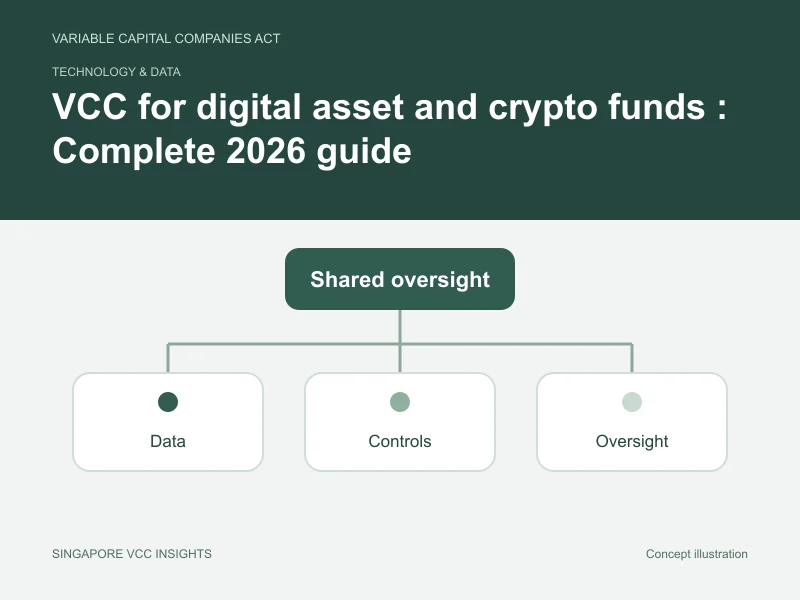
VCC for digital asset and crypto funds , Complete 2026 guide. This guide is for fund sponsors structuring Singapore digital-asset, crypto and tokenised-asset funds. It explains what vcc for digital asset and crypto funds is, who it applies to, the eligibility and process, the costs and timeline, the common mistakes to avoid, and where it fits inside the wider Singapore framework. All figures are practitioner-grade and aligned to current statute and regulator guidance.
This article is published by Raffles Corporate Services for the variablecapitalcompaniesact.com knowledge hub; this article is general information, not legal advice.
What is vcc for digital asset and crypto funds?
A Variable Capital Company (VCC) is a Singapore investment-fund vehicle under the Variable Capital Companies Act 2018. For digital-asset and crypto funds, the VCC offers a regulated, audit-ready structure that can sit alongside the Payment Services Act 2019 licensing framework , typically with a MAS-licensed Capital Markets Services (CMS) holder as Permissible Fund Manager and a custodian capable of holding digital assets.
Who vcc for digital asset and crypto funds is for
Digital-asset hedge funds, crypto venture funds, tokenised-asset funds and structured-product issuers seeking a Singapore-domiciled fund vehicle that institutional LPs recognise.
Eligibility and requirements
- VCC incorporation under section 17 of the Variable Capital Companies Act 2018.
- A Permissible Fund Manager holding a CMS licence under the Securities and Futures Act 2001 and able to manage capital-market products that include digital assets.
- A custodian capable of segregating client digital assets , typically a MAS-licensed digital-payment-token (DPT) provider under the Payment Services Act 2019.
- AML/CFT controls aligned with MAS Notice PSN02 and the FATF Travel Rule.
This article is published by Raffles Corporate Services for the variablecapitalcompaniesact.com knowledge hub; this article is general information, not legal advice.
Cost and timeline for vcc for digital asset and crypto funds
The total cost depends on the complexity of the matter and whether external advisers are engaged. Indicative ranges in S$ are set out below.
| Item | Indicative range |
|---|---|
| VCC incorporation (ACRA) | S$8,000 |
| Sub-fund registration | S$400 each |
| Permissible Fund Manager | S$80,000–S$300,000 per year |
| Digital-asset custodian (qualified) | 0.10%–0.50% of AUM per year |
| Statutory audit (crypto-aware auditor) | S$45,000–S$200,000 |
| Tax-incentive certification (13O/13U) | S$0 filing, advisory S$25,000–S$80,000 |
Timeline: VCC + sub-fund: 8–12 weeks; tax-incentive certification: 12–24 weeks. For complex multi-jurisdictional matters, factor in additional weeks for legal opinions in the other relevant jurisdictions.
Step-by-step process
- Confirm whether the strategy involves capital-markets products (security tokens, fund tokens) or DPT-only exposure , this drives the licensing stack.
- Engage a Permissible Fund Manager with CMS coverage and digital-asset experience.
- Engage a qualified digital-asset custodian under the Payment Services Act 2019.
- Draft the VCC constitution with valuation, NAV cutoff and pricing source provisions specific to digital assets (e.g., 24/7 markets, oracle pricing).
- Incorporate the VCC with ACRA under section 17 of the Variable Capital Companies Act 2018.
- Register the sub-fund(s) under section 29; obtain MAS tax-incentive certification if applicable.
- Launch , manage AML/CFT, the FATF Travel Rule and the operational nuances of holding digital assets in a regulated fund.
For related governance and tax considerations, see our broader guide on Foreign-Sourced Income Exemption (FSIE) Singapore 2026: How Section 13(8) Works and the deeper-dive piece at Singapore VCC for Digital Assets, Crypto Funds and Alternative Investments. For the cross-site perspective, see Drag-along, tag-along and shareholder agreements , Complete 2026 guide.
Common mistakes to avoid
- Confusing the Payment Services Act licensing with the SFA licensing , both can be relevant; only one may be needed depending on tokens held.
- Choosing a custodian without a clear segregation regime , sub-fund ringfencing under section 29 of the Variable Capital Companies Act 2018 needs custody to match.
- Using an unaudited stablecoin or unverified oracle as the NAV source , auditors will require defensible pricing.
- Underestimating the AML/CFT and FATF Travel Rule operational burden , these dominate ongoing operating costs.
- Applying for 13O / 13U without sufficient Singapore substance specific to the digital-asset team , MAS scrutinises this category closely.
Where vcc for digital asset and crypto funds sits in the wider Singapore framework
Vcc for digital asset and crypto funds interacts with several adjacent Singapore regimes. Personal tax and treaty considerations are covered in our cross-site article on Foreign-Sourced Income Exemption (FSIE) Singapore 2026: How Section 13(8) Works. Corporate-secretarial mechanics are detailed in Drag-along, tag-along and shareholder agreements , Complete 2026 guide. Reading these alongside the present guide gives the rounded picture.
The relevant Singapore regulators publish authoritative guidance on this area , see mas.gov.sg and acra.gov.sg for the current rule positions.
FAQs
Can a Singapore VCC hold Bitcoin and Ethereum directly?
Yes, via a qualified custodian. The fund manager must hold the appropriate CMS or PSA licence depending on whether the strategy treats the tokens as capital-markets products or digital payment tokens.
Does a digital-asset VCC need a CMS licence or a PSA licence?
Both can be relevant. The CMS licence covers fund management of capital-markets products. The Payment Services Act 2019 covers the custody and movement of digital payment tokens. The Permissible Fund Manager arrangement determines exactly which licences apply.
How are crypto gains taxed inside a Singapore VCC?
If the VCC qualifies for Section 13O or 13U under the Income Tax Act 1947, the gains are exempt at the fund level. Without the incentive, gains taxable nature depends on whether they are capital or revenue in character.
Can a VCC sub-fund hold a single token strategy?
Yes. Sub-fund segregation under section 29 of the Variable Capital Companies Act 2018 supports strategy-by-strategy ringfencing within one umbrella.
Are there restrictions on accepting retail investors?
Yes. Most digital-asset funds are restricted to accredited and institutional investors under section 304 of the Securities and Futures Act 2001 and the related Notice on Retail Investor Restrictions.
Related guides
- Foreign-Sourced Income Exemption (FSIE) Singapore 2026: How Section 13(8) Works , cross-site companion guide.
- Drag-along, tag-along and shareholder agreements , Complete 2026 guide , wider Singapore-secretary or fund context.
- Singapore VCC for Digital Assets, Crypto Funds and Alternative Investments , adjacent topic on this site.
Need help with this? Call, SMS or WhatsApp +65 8501 7133, or email hello@rafflescorporateservices.com. Raffles Corporate Services works with a panel of corporate and employment law firms; this article is general information, not legal advice.