Singapore VCC insights
VCC for family office investment vehicles — Complete 2026 guide
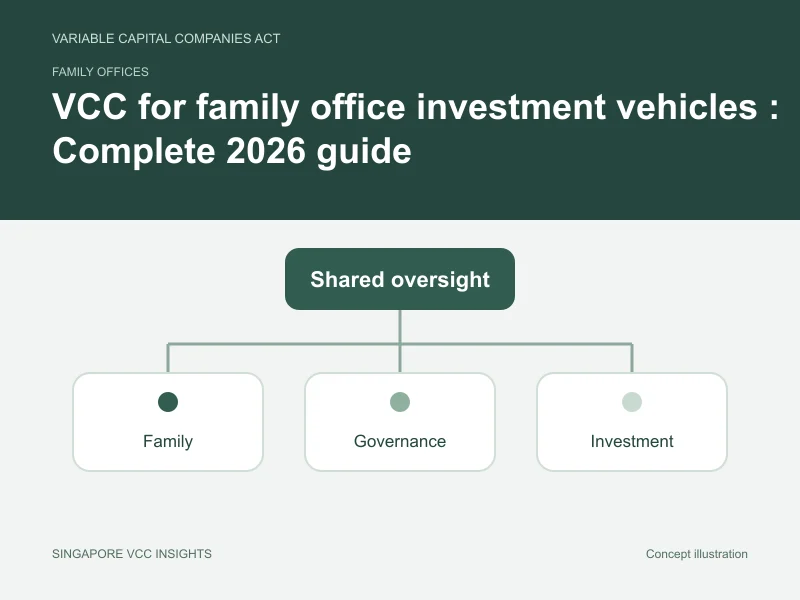
VCC for family office investment vehicles , Complete 2026 guide. This guide is for single family offices and multi-family offices structuring Singapore investment vehicles. It explains what vcc for family office investment vehicles is, who it applies to, the eligibility and process, the costs and timeline, the common mistakes to avoid, and where it fits inside the wider Singapore framework. All figures are practitioner-grade and aligned to current statute and regulator guidance.
This article is published by Raffles Corporate Services for the variablecapitalcompaniesact.com knowledge hub; this article is general information, not legal advice.
What is vcc for family office investment vehicles?
A Variable Capital Company (VCC) is a Singapore investment-fund vehicle under the Variable Capital Companies Act 2018. For family offices, the VCC sub-fund structure enables a single umbrella to house multiple investment strategies , direct equity, fund-of-funds, real estate, philanthropy sleeve , with ringfenced assets and liabilities under section 29 of the Variable Capital Companies Act 2018.
Who vcc for family office investment vehicles is for
Single family offices, multi-family offices, and SFOs operating under the MAS Single Family Office Tax Incentive (Section 13O of the Income Tax Act 1947) or the Enhanced-Tier Fund Tax Incentive (Section 13U) where the family AUM is large enough.
Eligibility and requirements
- VCC incorporation under section 17 of the Variable Capital Companies Act 2018.
- A Permissible Fund Manager , for family offices, this is typically the family’s own MAS-licensed entity or an exempted single-family-office manager.
- At least one Singapore-resident director under section 46 of the Variable Capital Companies Act 2018.
- Section 13O or 13U tax-incentive certification with MAS where the family meets the AUM, business-spending and Singapore-employment thresholds.
This article is published by Raffles Corporate Services for the variablecapitalcompaniesact.com knowledge hub; this article is general information, not legal advice.
Cost and timeline for vcc for family office investment vehicles
The total cost depends on the complexity of the matter and whether external advisers are engaged. Indicative ranges in S$ are set out below.
| Item | Indicative range |
|---|---|
| VCC incorporation (ACRA) | S$8,000 |
| Sub-fund registration | S$400 each |
| Annual ACRA filing | S$100 |
| Fund administrator | S$40,000–S$120,000 per year |
| Auditor | S$25,000–S$80,000 per year |
| Permissible Fund Manager (family-office operated) | S$200,000–S$500,000 setup; ongoing depending on AUM |
Timeline: VCC formation: 6–10 weeks; sub-fund registration: 2–4 weeks each; 13O/13U: 12–24 weeks. For complex multi-jurisdictional matters, factor in additional weeks for legal opinions in the other relevant jurisdictions.
Step-by-step process
- Confirm AUM eligibility for Section 13O (minimum S$20 million AUM with 2 investment professionals) or Section 13U (S$50 million AUM with 3 investment professionals).
- Engage the family's MAS-licensed fund manager or set up the single-family-office exempted vehicle.
- Draft the VCC constitution with class-share mechanics aligned to the family's children, branches and trust beneficiaries.
- Incorporate the VCC with ACRA under section 17 of the Variable Capital Companies Act 2018.
- Register the sub-funds under section 29 , typically one per asset class or one per family branch.
- Apply for Section 13O or 13U tax-incentive certification with MAS.
- Operationalise , fund administration, custody, audit, periodic reporting to the family principal and the next generation.
For related governance and tax considerations, see our broader guide on Multi-jurisdiction family office structures , Complete 2026 guide and the deeper-dive piece at The Permissible Fund Manager Problem: Can a Singapore Single Family Office Manage Its Own VCC in 2026?. For the cross-site perspective, see Single vs Multi-Family Office in Singapore: Costs, Pros and Cons (2026).
Common mistakes to avoid
- Treating the family-office VCC as a substitute for the trust , they serve different functions; most families end up with both.
- Applying for 13O when the family qualifies for 13U , the 13U thresholds bring stronger benefits and longer-term certainty.
- Drafting a single sub-fund that mixes assets across family branches , sub-fund segregation under section 29 should be used to ringfence.
- Failing to plan succession of the fund manager , family-office leadership transitions need to be reflected in the constitution and MAS reporting.
- Underweighting the Singapore employment substance , MAS scrutinises business spending and headcount carefully.
Where vcc for family office investment vehicles sits in the wider Singapore framework
Vcc for family office investment vehicles interacts with several adjacent Singapore regimes. Personal tax and treaty considerations are covered in our cross-site article on Multi-jurisdiction family office structures , Complete 2026 guide. Corporate-secretarial mechanics are detailed in Single vs Multi-Family Office in Singapore: Costs, Pros and Cons (2026). Reading these alongside the present guide gives the rounded picture.
The relevant Singapore regulators publish authoritative guidance on this area , see mas.gov.sg and acra.gov.sg for the current rule positions.
FAQs
Can a single family office operate a VCC without a CMS licence?
Yes, under the Single Family Office exemption under section 99(1)(h) of the Securities and Futures Act 2001 and MAS Guidelines. The fund manager must be wholly owned by the family and serve only family-related entities.
Is Section 13O or Section 13U better for a family office?
It depends on AUM, investment-professional count and the family's overall plans. Section 13O suits smaller AUM (S$20m+); Section 13U is for larger AUM (S$50m+) with broader benefits and 3-professional minimum.
Can the VCC hold investments in the family's operating business?
Yes, subject to the constitution and the MAS Designated Investments list under the Income Tax (Designated Investments and Income) Regulations. Operating-business shares often qualify.
How are family-office VCC distributions taxed?
Distributions from a Section 13O / 13U fund to non-Singapore-resident investors are exempt at source. Singapore-resident individuals receive distributions tax-free in many cases under the foreign-sourced income exemption.
Can the next generation take over the VCC?
Yes. Class-share mechanics, family-charter alignment and MAS notification of the change in beneficial ownership manage the transition.
Related guides
- Multi-jurisdiction family office structures , Complete 2026 guide , cross-site companion guide.
- Single vs Multi-Family Office in Singapore: Costs, Pros and Cons (2026) , wider Singapore-secretary or fund context.
- The Permissible Fund Manager Problem: Can a Singapore Single Family Office Manage Its Own VCC in 2026? , adjacent topic on this site.
Need help with this? Call, SMS or WhatsApp +65 8501 7133, or email hello@rafflescorporateservices.com. Raffles Corporate Services works with a panel of corporate and employment law firms; this article is general information, not legal advice.