Independent Singapore VCC guidance
Direct answer
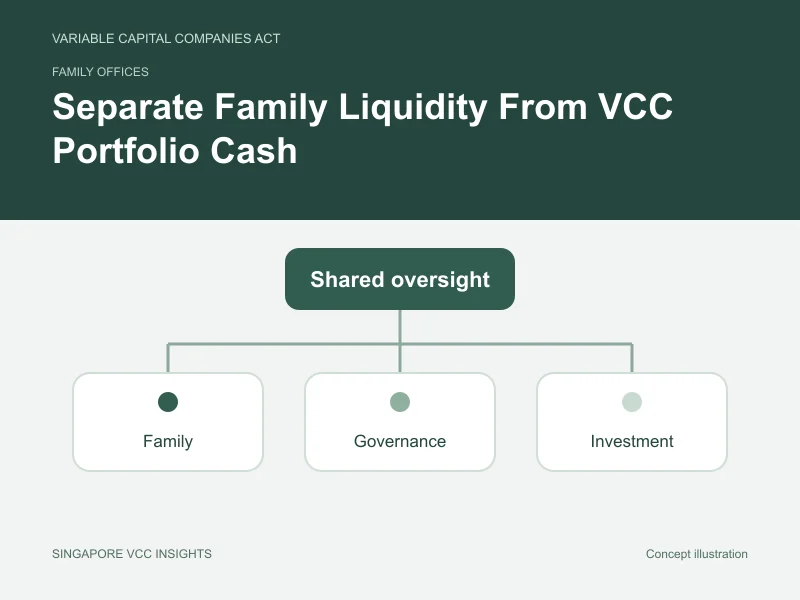
Keep three liquidity plans separate: the family’s personal and household reserve, the ownership entities’ capital needs, and the VCC’s portfolio and investor cash. A family request should enter the VCC through the governing subscription, redemption, distribution or other approved route, not as an informal transfer. Map the owner, decision-maker, timing, valuation and evidence for each pool, then test the request against fund terms and portfolio consequences before money moves.
At a glance
- A family balance sheet can be consolidated for planning without treating every account as interchangeable cash.
- Household, succession and business needs should be forecast before they become urgent fund requests.
- The VCC process follows the affected investor, sub-fund and class rather than the family’s informal understanding.
- Use scenario ranges and decision triggers, not a promise that portfolio assets will be liquid on demand.
Who this is for
- Families using or considering a VCC within a professionally managed family-office structure.
Important exclusions
- Personal financial advice, trust distributions, matrimonial claims, estate administration or fund-specific legal and tax conclusions.
Draw the three cash boundaries
Singapore’s family-office ecosystem supports investment, governance and professional services, but a family office is still an operating model rather than permission to treat every asset as one bank account. Start by drawing three boundaries: personal or household cash; holding, trust, estate or business capital outside the fund; and cash or assets inside the VCC. Record legal ownership, authorised decision-makers, account controls and the purpose of each pool. A consolidated dashboard can show all three without collapsing them.
Sources: EDB · ACRA| Pool | Typical planning purpose | Decision path |
|---|---|---|
| Personal and household reserve | Living costs, personal commitments and emergency capacity | Individual, family governance or relevant ownership arrangement |
| Family entities outside the VCC | Business capital, estate, trust, philanthropy or holding-company needs | Governing documents and authorised entity decision-makers |
| VCC investor capital | Investment strategy, dealing, portfolio expenses and approved investor cash events | Affected fund terms, manager process and VCC governance |
| Sub-fund operating cash | Strategy-specific settlement, expenses and liquidity buffer | Correct sub-fund records and authorised fund controls |
Related guidance: VCC for family offices
Build the family demand forecast
Forecast family cash demand before looking at portfolio liquidity. Separate recurring household spending, known commitments, business support, education, property, philanthropy, succession events and contingent calls. Record currency, earliest date, flexibility, owner and confidence range. The forecast should avoid invented precision: a property completion is different from a possible opportunity, and a family member’s preference is different from a binding obligation.
Sources: EDB · EDBDemand-forecast fields
- Purpose and legal owner of the anticipated payment.
- Base, high and low amount ranges without implying certainty.
- Earliest, target and latest useful payment dates.
- Currency, transfer restrictions and destination account.
- Whether timing or amount can change without harming the family objective.
- Named family-governance owner and the evidence supporting the request.
Then identify which needs can be met from outside-fund reserves. This is the first resilience test. If every household event depends on selling or redeeming portfolio assets at short notice, the family has a cash-architecture problem even when its total wealth is substantial. The remedy may involve reserve sizing, staged commitments, external financing analysis or changing portfolio construction, each considered with appropriate advice rather than an assumed VCC withdrawal.
Sources: EDB · EDBRelated guidance: family-office operating model decision
Translate demand into a fund request
When outside reserves do not cover the planned need, translate the family objective into the VCC’s language. Identify the investor, exact sub-fund and class, permitted cash-event route, notice process, valuation point, bank details, approvals and expected evidence. Do not send the portfolio team a message saying “the family needs cash” and leave it to operations to infer the legal and economic transaction. The request should be complete enough to test against governing terms and current portfolio facts.
Sources: ACRA · ACRA · MASRequest translation
- Identify the ownerConfirm which person or entity holds the relevant interest and which account should receive any approved payment.
- Identify the fund interestName the VCC, sub-fund and class so valuation, rights, fees and records are tested against the correct pool.
- Select the routeUse the governing redemption, distribution or other documented capital process instead of inventing an informal withdrawal.
- State the flexibilityGive the amount range and timing window so the manager can assess options without misunderstanding the family priority.
If the governing terms do not support the requested route or timing, the family office should report that fact clearly. Do not re-label the payment, pressure providers to backdate documents or assume common family ownership cures the gap. Consider alternatives and advice at the appropriate ownership level, and record any proposed document or structure change as a separate decision with prospective effect.
Sources: MAS · ACRAWork the scenario through the VCC
Hypothetical scenario: a family expects a property completion and a business capital call in the same quarter. Its household reserve covers the property only. One family holding entity owns shares in a private-markets sub-fund, while another owns shares in a liquid-markets sub-fund. The first step is not to move cash between the pools. The office identifies each owner and request, checks the relevant fund terms, and asks the manager for evidence on portfolio liquidity, settlement timing and consequences.
Sources: ACRA · ACRA · MAS| Question | Private-markets interest | Liquid-markets interest |
|---|---|---|
| Correct owner | Entity linked to the business commitment | Different family holding entity |
| Portfolio profile | Illiquid assets and committed obligations | More frequently valued assets but still fund-dependent |
| Request route | Test available documented capital event and timing | Test redemption or distribution route under its terms |
| Key consequence | Asset sale, financing or commitment pressure may arise | Pricing, settlement and remaining portfolio exposure may change |
| Decision output | Proceed, resize, defer or use outside-fund alternative | Proceed through controlled dealing or retain reserve |
The investment committee or manager evaluates the portfolio consequences within its mandate; the VCC board considers the corporate and governance matters reserved to it; the administrator reproduces the investor and dealing records; and the family governance process decides whether the resulting option still meets the family objective. Those roles may interact, but the scenario stays intelligible because each decision is recorded at the level where its authority and evidence sit.
Sources: MAS · ACRARelated guidance: family-office board and investment committee roles
Protect sub-fund and investor integrity
An umbrella can separate strategies and investor pools, which is useful for family portfolios with different mandates. That architecture should not become a mechanism for one pool to fund another informally. Cash instructions, invoices, portfolio assets, investor records and approvals should identify the correct sub-fund. If one family member’s urgent need would economically burden another investor, class or strategy, stop and obtain the necessary governance and advice before any transaction.
Sources: ACRA · ACRA · MASIntegrity checks before cash moves
- The requesting owner matches the investor record and receiving account.
- The transaction follows the affected sub-fund and class terms.
- Valuation and dealing inputs come from the approved process.
- Portfolio cash and settlement impacts are understood and authorised.
- Fees, expenses and economic effects are attributed to the correct pool.
- Related-party, conflict and unequal-treatment questions have an explicit review route.
Where several family members control the wider structure, add a conflicts view. A person may sit on a family council, investment committee, holding-company board and VCC board while each role applies a different duty and information set. The meeting record should state which capacity is acting, what interest exists and who challenges or approves the decision. Familiarity should improve communication, not erase decision boundaries.
Sources: MAS · EDBRelated guidance: VCC sub-funds guide
Close the event and reset reserves
After an approved payment, reconcile the request, governing route, valuation, cash settlement, investor record, portfolio impact and receiving account. Update the family demand forecast with the actual outcome and reset outside-fund reserves. If the event forced asset sales, changed strategic exposure or revealed a recurring mismatch, bring those consequences into the next portfolio and family-governance review instead of treating the payment as a completed administrative ticket.
Sources: MAS · ACRALiquidity-event close
- Confirm settlementMatch the approved instruction, source account, receiving owner, amount, currency and bank evidence without relying on email alone.
- Reconcile recordsUpdate the investor, capital, portfolio and accounting records that the selected transaction route affects.
- Review consequencesMeasure changes to reserves, exposures, commitments, future cash needs and provider actions across the correct pools.
- Improve the planAdjust triggers, forecast assumptions or governance responsibilities where the event exposed preventable urgency or confusion.
Related guidance: VCC redemption control checklist
Frequently asked questions
Can a family office keep one consolidated liquidity dashboard?
Yes. A consolidated view can improve planning if it clearly labels ownership, account control, liquidity assumptions and decision routes. The dashboard should distinguish personal reserves, outside-fund entities and each VCC interest. Aggregation is an analytical tool; it does not make the underlying accounts or assets interchangeable.
Why not keep all family cash inside the VCC?
The family has needs that may not match a fund’s investors, mandate, valuation cycle, portfolio commitments or transaction routes. Maintaining an outside-fund reserve can reduce pressure to force a portfolio action at an unsuitable time. The appropriate amount depends on the family’s circumstances and advice, not a universal formula.
Can the principal simply instruct the VCC to pay?
The instruction needs to follow the authority and transaction process that applies to the relevant investor, sub-fund and class. A principal may hold several roles, but those roles should be identified rather than blended. Clear documentation protects the family, providers and other affected interests from ambiguity.
Does an umbrella solve family liquidity automatically?
No. An umbrella can organise separate strategies, but each pool still needs its own assets, liabilities, records and decisions. Liquidity in one sub-fund should not be treated as available to another without a valid transaction route and appropriate review. Good architecture makes boundaries more visible; it does not remove them.
What should happen after a large family liquidity event?
Reconcile the fund and ownership records, update the demand forecast, reassess reserves and review the portfolio consequences. If the event exposed unclear authority, missing data or repeated urgency, change the governance and planning process. Closing the bank transfer without learning from the event leaves the structural problem in place.
Official sources and further reading
Discuss a Singapore VCC structure
For help coordinating a Singapore VCC setup or corporate administration, contact Raffles Corporate Services.
General information only. This article is not legal, tax, regulatory or investment advice and does not imply affiliation with or endorsement by ACRA, MAS or IRAS.