Singapore VCC insights
VCC master-feeder structures — Step-by-step walkthrough
Raffles Corporate Services works with a panel of corporate and employment law firms; this article is general information, not legal advice.
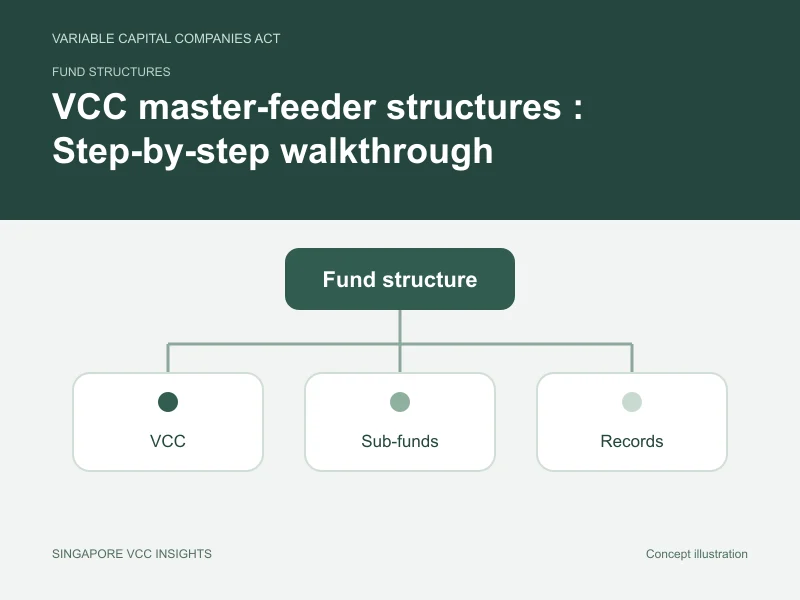
VCC master-feeder structures channel capital from one or more feeder funds into a single master fund that holds the portfolio. Using the Variable Capital Company framework, the feeder and master can both sit within the same umbrella or across entities. This step-by-step walkthrough explains the mechanics, tax and set-up.
What VCC master-feeder structures are
A master-feeder structure pools investors into one or more feeder funds, each of which invests substantially all of its assets into a single master fund that carries out the actual investment programme. The benefit is operational efficiency: one portfolio is managed at the master level while different feeders cater to different investor types, tax profiles or jurisdictions. The Variable Capital Company (VCC) framework is well suited to this because sub-funds within an umbrella can act as feeders, or a standalone VCC can be the master.
The structure is built on the Variable Capital Companies Act 2018. For the tax-incentive planning that often accompanies these structures, see Singapore charitable structures and donor-advised vehicles , Step-by-step walkthrough; for incorporation context, Ordinary vs Special Resolutions in Singapore Companies: A Practical Guide is a useful companion.
This article is general information, not legal or tax advice; Raffles Corporate Services works with a panel of corporate and employment law firms.
Why fund managers use master-feeder structures
Master-feeder consolidates trading and reduces duplication: a single master portfolio is simpler to manage, custody and value than several parallel portfolios. Feeders let a manager offer a Singapore-domiciled onshore feeder alongside an offshore feeder, or separate feeders for taxable and tax-exempt investors. Within a VCC umbrella, each feeder can be a ring-fenced sub-fund, so investor groups are segregated while sharing the master’s economics.
How the VCC framework supports master-feeder
A VCC can be incorporated as a standalone or umbrella under the Act, and Section 17 of the Variable Capital Companies Act 2018 provides for the incorporation of a VCC with the capacity to operate one or more sub-funds. A feeder sub-fund subscribes for shares or interests in the master, and the master may itself be a VCC, a Singapore limited partnership, or a foreign vehicle. Because VCC capital is variable and struck at NAV, subscriptions and redemptions flow cleanly between feeder and master without capital-maintenance friction.
Tax and incentive considerations
Master-feeder VCCs commonly apply for the fund tax incentives under sections 13O and 13U of the Income Tax Act 1947, which can exempt qualifying fund income. An umbrella VCC enjoys a single set of incentive conditions tested at the umbrella level for some purposes, which can be more efficient than running separate entities. Economic-substance, manager-regulation and reporting conditions must be met. The authoritative incentive and regulatory overview is the MAS VCC framework.
Cost, timeline and step-by-step set-up
Indicative anchors and sequence:
- VCC incorporation: from S$8,000 to S$15,000 in professional fees plus ACRA fees.
- Each feeder sub-fund: from S$400 ACRA registration plus servicing.
- Timeline: 6 to 12 weeks including manager appointment and incentive application.
- Annual running cost: audit, administration and tax compliance, commonly from S$30,000 across the structure.
Steps: (1) design the master and feeder layout and pick domiciles; (2) incorporate the VCC and any sub-funds; (3) appoint the MAS-regulated manager and service providers; (4) document the feeder-into-master subscription; (5) apply for the relevant fund tax incentive; (6) operate with segregated records. Our companion explainer at VCC 13U enhanced-tier , application and conditions , Complete 2026 guide sets out the layout choices.
Common mistakes and gotchas
Errors include treating a feeder as economically separate from the master when it is not, neglecting substance conditions for the tax incentive, mismatching valuation timing between feeder and master so NAVs do not reconcile, and overlooking that cross-border feeders bring foreign regulatory and tax obligations. Registry steps run through ACRA and the statutory framework is published on Variable Capital Companies Act 2018. Reconcile feeder and master NAV cut-offs every dealing day.
Designing the master-feeder layout
The first design choice is where the master sits. It can be a Singapore VCC, a Singapore limited partnership, or a foreign vehicle, and the choice is driven by investor expectations, tax treaty access and operational familiarity. The feeders are then arranged to serve distinct investor groups: a Singapore-domiciled onshore feeder for investors who want local domicile, an offshore feeder for those who prefer a familiar jurisdiction, or separate feeders for taxable and tax-exempt investors. Within a VCC umbrella, each feeder can be a ring-fenced sub-fund, which keeps investor groups segregated while they share the master’s economics.
The layout should be settled before incorporation, because it determines how many entities and sub-funds you register, how subscriptions flow, and which incentive applications you make. Retrofitting a master-feeder layout after launch is disruptive, so the design work repays careful attention at the outset.
Subscription flows and NAV reconciliation
In a master-feeder structure each feeder subscribes for interests in the master, so the master’s NAV aggregates the capital from all feeders while each feeder’s NAV reflects its slice of the master plus any feeder-level items. The operational discipline is to align dealing days and valuation cut-offs so that feeder and master NAVs reconcile cleanly. A mismatch in timing, where a feeder strikes its NAV on a different basis or date from the master, creates reconciliation breaks and can disadvantage investors. Fund administrators manage this with a single dealing calendar across the structure.
Tax incentives and substance
Master-feeder VCCs frequently apply for the fund tax incentives under sections 13O and 13U of the Income Tax Act 1947. The 13O scheme suits smaller funds with a Singapore-based fund manager, while 13U suits larger funds meeting higher assets-under-management and spending thresholds. Both require economic substance in Singapore, including a regulated fund manager, local business spending and, for 13U, a minimum fund size and investment-professional headcount. Because the incentive conditions can be tested at the umbrella or sub-fund level depending on the structure, the layout and the incentive application should be designed together.
Worked example: onshore and offshore feeders
Consider a manager raising capital from both Singapore institutions and overseas family offices. It establishes an umbrella VCC with two feeder sub-funds, one onshore for the local institutions and one structured for the overseas investors, both feeding a single VCC master that holds the portfolio. The master applies for the 13U incentive given its expected size, and the manager maintains the required substance in Singapore. Trades are executed once at the master level, valuation runs on a single calendar, and each feeder reports cleanly to its own investors. The structure delivers operational efficiency without forcing different investor types into one vehicle.
Related guides and where to go next
Master-feeder design connects to fund tax incentives and to incorporation choices. For the incentive context, Singapore charitable structures and donor-advised vehicles , Step-by-step walkthrough is a useful companion, and for incorporation, Ordinary vs Special Resolutions in Singapore Companies: A Practical Guide is relevant. Our deeper explainer at VCC 13U enhanced-tier , application and conditions , Complete 2026 guide sets out the layout decision tree and incentive conditions.
FAQs
What is a master-feeder structure? Feeder funds pool investors and invest into a single master fund that holds and trades the portfolio.
Can a VCC be both master and feeder? Yes. A VCC or its sub-funds can act as feeders, and a VCC can be the master; the master may also be a foreign vehicle.
What tax incentives apply? Sections 13O and 13U of the Income Tax Act 1947 commonly apply to qualifying VCC funds, subject to conditions.
Why use feeders at all? To serve different investor types or jurisdictions while running one consolidated master portfolio.
Where is the regime defined? The Variable Capital Companies Act 2018; see MAS VCC framework for the regulatory overview.
Need help with this? Call, SMS or WhatsApp +65 8501 7133, or email hello@rafflescorporateservices.com. Raffles Corporate Services works with a panel of corporate and employment law firms; this article is general information, not legal advice.