Independent Singapore VCC guidance
Direct answer
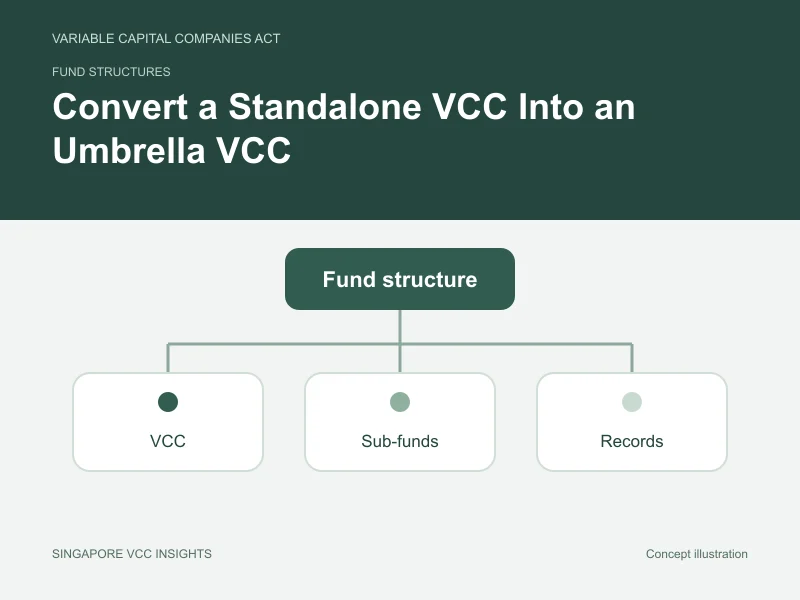
A registered non-umbrella VCC can change its type, but the portal update should be the final corporate step in a wider restructuring plan. First define why a second segregated pool is needed, approve the target architecture, settle how the existing portfolio and investors will be represented, amend the constitution and fund documents, and align contracts, accounts and systems. Then update the VCC type and register each formed sub-fund through the VCC Portal within the applicable filing windows.
At a glance
- Do not convert merely to preserve an option; require a real second-pool business case.
- Approve the legal, investor and operational target state before submitting the type change.
- Treat formation, ACRA registration and operational launch of a sub-fund as separate gates.
- Reconcile every contract, account, ledger, disclosure and system identifier after the change.
Who this is for
- Sponsors and directors of an existing non-umbrella VCC preparing to add genuinely separate investment pools.
Important exclusions
- Automatic asset migration instructions, investor consent advice, tax advice or a substitute for amending the constitution and offering documents.
Prove that conversion solves the right problem
An umbrella structure is useful when the sponsor needs separate pools with different assets, liabilities, investors or strategies under one VCC. It is not a remedy for poor share-class design, informal internal portfolios or a wish to market future flexibility. ACRA describes a non-umbrella VCC as one fund and an umbrella VCC as a vehicle with sub-funds whose assets and liabilities are kept separate. Write the proposed second-pool use case and test whether a new share class, a new standalone vehicle or no structural change would solve it more cleanly.
Sources: ACRA · ACRAInitial architecture decision
- Only investor economics differTest whether a properly documented share class can handle fees, currency or distribution terms without a new asset pool.
- Assets and liabilities must separateEvaluate umbrella conversion and a new sub-fund because class accounting does not create the same pool separation.
- Control or provider model differs radicallyCompare a separate VCC because one umbrella may create more dependencies than the sponsor wants.
- The future strategy is still hypotheticalKeep the current form and define a decision trigger instead of converting for an unapproved possibility.
Related guidance: standalone versus umbrella VCC guide · share classes versus sub-funds decision tool
Define the target state before filing
The target-state memorandum should identify the existing VCC, proposed sub-funds, investors, share classes, assets, liabilities, contracts, bank and custody accounts, tax workstreams, accounting records, service providers and governing documents. Do not assume the current standalone portfolio automatically becomes a particular sub-fund in the way the sponsor intends. Legal, tax, accounting and operational advisers should confirm the implementation path, required approvals and effective sequence for the actual facts before any transfer, re-designation or investor communication occurs.
Sources: ACRA · ACRA · Singapore Statutes OnlineTarget-state approval pack
- Business case explaining why separate pools are required.
- Before-and-after structure map with every investor and share class located.
- Document amendment list covering constitution, offering terms and contracts.
- Asset, liability, account and ledger treatment confirmed by accountable advisers.
- Investor communication and approval analysis for the actual governing documents.
- Filing, provider, system and operational launch sequence with stop conditions.
Related guidance: VCC sub-funds guide
Work through an illustrative conversion
Assume Harbour Strategy VCC currently runs one private-credit portfolio and the sponsor now wants a separately financed special-situations strategy with different investors. The proposal is not approved merely because both are managed by the same team. The board first compares a class, a second standalone VCC and an umbrella. It chooses umbrella form only after confirming that separate assets and liabilities, separate investor terms and shared governance are operationally supportable. This is a hypothetical process example, not a conclusion for any real fund.
Sources: ACRA · ACRA · Monetary Authority of Singapore| Decision | Harbour scenario answer | Evidence before release |
|---|---|---|
| Why a separate pool? | Different assets, financing and investor group | Approved architecture memorandum |
| What happens to the current portfolio? | Treatment remains a legal and accounting implementation item | Signed advice and reconciled opening records |
| What changes publicly or contractually? | VCC type, constitution, offering and provider records | Filed and executed document index |
| When does the new strategy launch? | After formation, registration and operational testing | Sub-fund acceptance certificate |
| Who monitors shared dependencies? | Named umbrella-level owners with sub-fund reporting | Board-approved responsibility matrix |
Sequence the corporate and sub-fund actions
ACRA states that a VCC type change and other listed VCC information changes should be updated within 14 days, and that those other information changes are free. Its post-registration guide says an umbrella VCC registers a sub-fund within seven days of formation; the current service-fee page lists a S$400 sub-fund registration fee, while the post-registration page indicates processing within three working days. These are filing facts, not a promise that the commercial launch is complete or that another authority will not need to review a name.
Sources: ACRA · ACRA · ACRAControlled implementation sequence
- Approve the architectureRecord the business case, target structure, advice, investor analysis, costs, risks and stop conditions.
- Complete document actionsExecute the constitution and fund-document changes using the approvals required by the actual documents.
- Update the VCC typeSubmit the correct VCC Portal transaction and retain the acknowledgement and effective record.
- Form and register sub-fundsControl the formation date, name, portal registration and resulting identifiers for each pool.
- Release operationsLaunch only after contracts, accounts, records, systems, disclosures and reconciliations pass acceptance.
Prove the umbrella works after conversion
The final check is horizontal and vertical. Horizontally, reconcile umbrella-level governance, providers and policies across all sub-funds. Vertically, trace one investor, asset, liability, cash movement, fee and report through the correct sub-fund documents, account, ledger and system identifier. Investigate shared-data shortcuts that could post a transaction to the wrong pool. The board should receive the completed reconciliation, remaining dependencies and the first post-conversion reporting pack before closing the project.
Sources: ACRA · ACRA · Monetary Authority of SingaporeRelated guidance: sub-fund expense allocation controls
Frequently asked questions
Can a non-umbrella VCC change into an umbrella VCC?
Yes, ACRA’s current guidance allows a VCC type to change after registration. The sponsor still needs to complete the constitution, approval, investor, contract, accounting and operational work appropriate to its own documents and facts.
Is changing the VCC type the same as launching a sub-fund?
No. Treat the vehicle-type change, legal formation of a sub-fund, ACRA registration and operational release as separate controls. Acknowledgement of one event does not prove that the other workstreams are complete.
Does the existing portfolio automatically become the first sub-fund?
Do not assume a treatment. The implementation path should be confirmed against the constitution, approvals, investor rights, accounting position, contracts and tax facts. Record the conclusion before moving or re-labelling any asset or liability.
Should investors be told before the conversion?
Review the governing and offering documents and the nature of the change. The communication or approval requirement may differ by fund. The project plan should identify the analysis, owner, timing and retained evidence.
What is the best post-conversion test?
Trace representative investors, assets, liabilities, cash movements and reports through the correct sub-fund documents, accounts, ledgers and systems. Any item that depends on an oral explanation should remain open for remediation.
Official sources and further reading
- Choosing a VCC type and financial year end (ACRA)
- Understanding VCC features and eligibility requirements (ACRA)
- Updating VCC information and officers (ACRA)
- Post-registration guide for variable capital companies (ACRA)
- Service and transaction fees for variable capital companies (ACRA)
- Overview of managing a variable capital company (ACRA)
- Governance and Management of Variable Capital Companies (Monetary Authority of Singapore)
- Variable Capital Companies Act 2018 (Singapore Statutes Online)
Discuss a Singapore VCC structure
For help coordinating a Singapore VCC setup or corporate administration, contact Raffles Corporate Services.
General information only. This article is not legal, tax, regulatory or investment advice and does not imply affiliation with or endorsement by ACRA, MAS or IRAS.