Independent Singapore VCC guidance
Direct answer
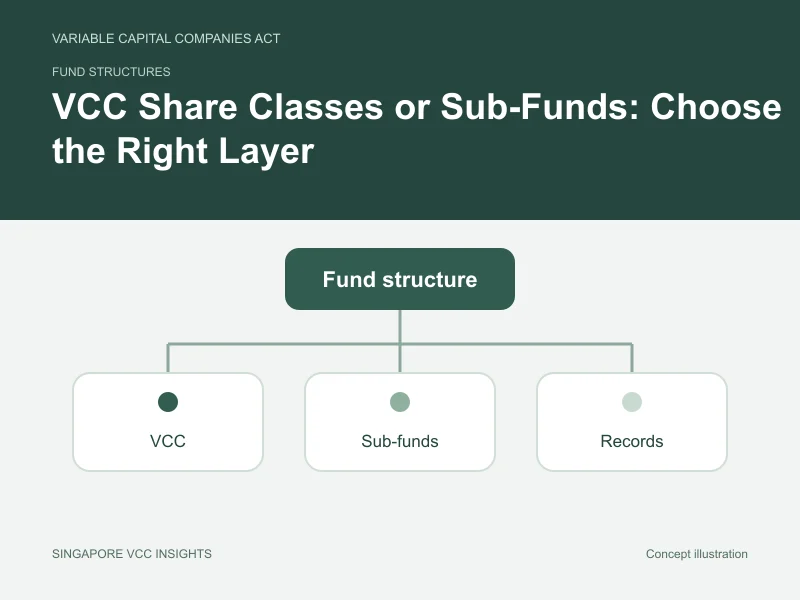
Use another VCC share class when investors share the same underlying portfolio and mandate but need different economic or participation terms. Use a separate sub-fund when the strategy needs its own asset and liability pool, contracts, books, risk controls or investor proposition. A class is a way to differentiate rights within the same fund layer; it is not a substitute for sub-fund segregation. If a loss, financing arrangement or strategy decision should remain isolated, the analysis should start with a sub-fund.
At a glance
- Share classes vary investor terms inside one fund layer.
- Sub-funds separate strategy pools within an umbrella VCC.
- Choose from the downside and operational perimeter, not the preferred label.
- Confirm the constitution, offering documents and provider systems can implement the choice.
Who this is for
- Sponsors deciding how to add currencies, fee terms, investor groups, strategies or portfolios to a VCC.
Important exclusions
- A conclusion on tax, securities offering or accounting treatment for a particular class or sub-fund.
Start with the separation you need
The fastest decision test is to imagine the downside. If one strategy incurs a liability, should another investor group’s portfolio remain outside that exposure? If yes, a class label is not the right control. ACRA describes a VCC as either a standalone fund or an umbrella with multiple sub-funds and explains the separation between those fund pools. The current VCC legislation defines a sub-fund as a collective investment scheme within an umbrella VCC and attributes assets and liabilities to that sub-fund.
Sources: ACRA · Singapore Statutes Online| Question | Share class signal | Sub-fund signal |
|---|---|---|
| Underlying portfolio | Investors participate in the same asset pool | A distinct strategy or asset pool is intended |
| Liability perimeter | No separate ring-fencing is expected | Obligations should be attributed to one strategy pool |
| Investor economics | Currency, fee, distribution or participation terms differ | Returns arise from different assets or mandate decisions |
| Contracts and accounts | Common contracts and books can support class-level allocation | Dedicated contracts, accounts or ledgers are operationally important |
| Governance | One mandate with class-specific controls | Separate risk, valuation, liquidity or approval treatment is needed |
| Future change | Variation can be managed within common documents and systems | Independent launch, closure or provider treatment is valuable |
Related guidance: standalone versus umbrella VCC guide
Use a sub-fund for a distinct strategy pool
A sub-fund is the stronger signal when assets, liabilities and strategy operations should be attributable to a particular pool within an umbrella VCC. That choice affects contracting language, books and records, bank or custody arrangements, valuation, expense allocation and investor reporting. The umbrella remains the corporate vehicle, so central governance and selected providers can still be shared, but the records must make the relevant sub-fund visible wherever a transaction or obligation belongs to it.
Sources: ACRA · Singapore Statutes Online| Workstream | Design question | Evidence of separation |
|---|---|---|
| Mandate | Does the strategy have its own objective, limits and risk profile? | Approved supplement and mandate controls |
| Assets and liabilities | Can every position, cash flow and obligation be attributed? | Sub-fund ledger and reconciled position records |
| Contracts | Do counterparties know which sub-fund the umbrella acts for? | Correct sub-fund identification in agreements and confirmations |
| Expenses | Which costs are direct and how are shared costs allocated? | Board-approved allocation method and periodic review |
| Operations | Are dealing, valuation and liquidity controls strategy-specific? | Dedicated procedures, calendars and exception reporting |
| Lifecycle | Can the strategy launch or close without disturbing others? | Sub-fund-specific approvals, records and close-out plan |
Related guidance: VCC sub-fund segregation and operations
Apply the decision tree to common proposals
From business request to structure
- Same assets?If all investors participate in the same portfolio, continue to the rights test; otherwise begin a sub-fund analysis.
- Only terms differ?If the difference is a measurable investor term such as currency, fee or distribution policy, test a share class.
- Separate downside?If liabilities, financing, illiquidity or strategy failure should remain attributable to one pool, prefer a sub-fund analysis.
- Systems can prove it?Reject any design that the administrator, custody model, registers and reporting cannot represent consistently.
- Documents agree?Proceed only when the constitution, offering material, contracts, approvals and operational procedures express the same architecture.
Related guidance: VCC launch readiness test
Validate documents, systems and governance
Pre-approval architecture review
- The constitution permits the proposed class or umbrella and sub-fund architecture.
- Offering documents describe rights, risks, allocation and lifecycle treatment consistently.
- The manager can enforce the correct mandate and risk limits at the selected layer.
- The administrator can calculate NAV, capital, fees, expenses and reporting without manual ambiguity.
- Contracts and payment instructions identify the correct VCC and sub-fund where relevant.
- The board pack explains why the chosen layer matches the intended downside and investor treatment.
Do not let a future marketing label decide the legal and operational architecture. Document the proposal, alternative considered, allocation method, systems evidence and residual risk. A sound paper should also explain what would force redesign, for example, a new asset pool, incompatible liquidity terms, separate financing or a need to isolate contracts. That record helps the board review later expansions without repeating the full analysis from memory.
Sources: Monetary Authority of SingaporeRelated guidance: Singapore VCC guide
Frequently asked questions
Do VCC share classes ring-fence assets and liabilities?
A class should not be treated as the statutory asset-and-liability segregation provided for sub-funds. Class accounting can allocate economics between investors, but a sponsor seeking a distinct downside perimeter should start with a sub-fund analysis and confirm the documents and operations.
Can one sub-fund have several share classes?
Yes, where the governing documents and operating model support them. This can combine sub-fund-level strategy separation with class-level variations such as currency or fees. The manager and administrator must keep both layers intelligible in approvals, registers, calculations and investor reports.
Is a sub-fund always more expensive to operate?
It usually creates more dedicated workstreams, but the answer depends on strategy, providers, transaction volume and control design. Cost should follow the required separation. Choosing a class merely to avoid operating work can create larger legal, accounting and investor-treatment problems later.
Can a share class later become a sub-fund?
That is not a simple relabelling exercise. The sponsor would need to assess approvals, asset and liability movement, investor consent, dealing, tax, accounting and contractual consequences. Design the intended risk perimeter at the outset and obtain advice for any migration.
Who should approve the architecture decision?
Follow the constitution, offering documents, delegated authorities and applicable law. In practice, the sponsor and manager develop the proposal, providers confirm operability, advisers address legal and tax consequences, and the VCC board records the decision through the appropriate approval route.
Official sources and further reading
- Understanding VCC features and eligibility requirements (ACRA)
- Overview of managing a VCC (ACRA)
- Variable Capital Companies Act 2018 (Singapore Statutes Online)
- Governance and Management of Variable Capital Companies (Monetary Authority of Singapore)
Discuss a Singapore VCC structure
For help coordinating a Singapore VCC setup or corporate administration, contact Raffles Corporate Services.
General information only. This article is not legal, tax, regulatory or investment advice and does not imply affiliation with or endorsement by ACRA, MAS or IRAS.