Singapore VCC insights
VCC Act 2018 — Section 17 legal personality — Timeline and processing benchmarks
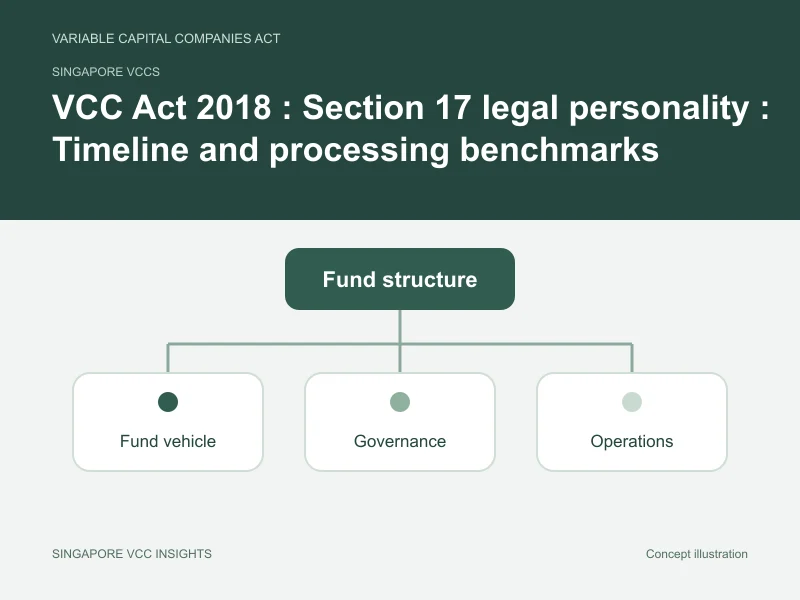
The vcc act 2018 establishes that a variable capital company is a body corporate with separate legal personality from the moment ACRA issues its notice of incorporation. Section 17 gives a VCC perpetual succession and the capacity to sue and be sued, to hold property and to enter contracts in its own name, distinct from its members and its manager.
Raffles Corporate Services works with a panel of corporate and employment law firms; this article is general information, not legal advice.
What the vcc act 2018 says about separate legal personality
Section 17 of the Variable Capital Companies Act 2018 provides that a variable capital company, on incorporation, is a body corporate by the name under which it is registered, with the capacity, rights, powers and privileges of an individual. From that point the VCC has perpetual succession and a legal existence independent of the persons who own or manage it, so a change of members, directors or manager does not affect the continuity of the entity itself.
The consequences are the familiar attributes of corporate personality. A VCC may hold real and personal property in its own name, may sue and be sued in its own name, may enter contracts and grant security, and its members enjoy limited liability to the extent of the amounts unpaid on their shares. In substance the VCC sits alongside the ordinary company as a distinct corporate form purpose-built for collective investment schemes, rather than being a variant of the company limited by shares under the Companies Act 1967.
Because separate personality flows automatically from incorporation, the practical work is front-loaded into the registration itself: getting the constitution, the manager and the directors correct so that the entity that springs into existence is fit for its intended fund strategy.
Who Section 17 matters to
The provision matters first to fund managers and their investors, because it is what allows the fund to own assets and bear liabilities in its own right rather than through a trustee or a chain of nominee arrangements. Counterparties such as prime brokers, custodians and banks rely on the VCC being a contracting person with clear capacity, which shortens onboarding and reduces the legal opinions that a less certain structure would demand.
It also matters to directors and their counsel. Directors of a VCC owe their duties to the company as a separate person, and the assets and business of the VCC are not theirs to treat as their own. Where the VCC is an umbrella with sub-funds, the separate personality of the umbrella must be read together with the segregation rules that govern the sub-funds beneath it, which changes how directors think about ring-fencing and cross-liability.
Umbrella VCCs and the sub-fund distinction
A VCC may be a standalone fund or an umbrella that holds two or more sub-funds. The umbrella is the body corporate with separate legal personality under Section 17. A sub-fund is not itself a separate legal person; it is a segregated portfolio of assets and liabilities within the umbrella. This is the single most important distinction for anyone reading the Act closely, because it drives who contracts, who is sued, and whose assets answer a given claim.
The segregation of a sub-fund’s assets and liabilities is governed by Section 29 of the Variable Capital Companies Act 2018, which ring-fences each sub-fund so that its assets may be applied only to meet its own liabilities. In effect the umbrella is one legal person whose internal balance sheets are walled off from one another. Contracts are entered by the VCC acting for a named sub-fund, and it is good practice for counterparties to document which sub-fund is the relevant one so that recourse is clear if things go wrong.
- The umbrella VCC is the legal person that incorporates, contracts and is sued.
- A sub-fund is a segregated cell, not a separate legal person.
- Assets of one sub-fund are not available to creditors of another.
- Each sub-fund is separately registered with ACRA and can be wound up on its own.
Incorporation mechanics: resident director and fund manager requirements
A VCC is incorporated by lodging an application with ACRA, together with the proposed constitution. The Act sets baseline governance conditions that distinguish a VCC from an ordinary private company. A VCC must have at least one director who is ordinarily resident in Singapore, and at least one director who is either a director or a qualified representative of its fund manager. In many structures a single individual satisfies both limbs, but the two requirements are conceptually separate and should be checked against the manager’s licensing position.
Every VCC must appoint a Singapore-based fund manager that is either licensed or regulated by the Monetary Authority of Singapore, or an exempt manager falling within a recognised category, such as a related-corporation or single-family office exemption. The manager requirement is continuous, not merely a condition at incorporation, so a VCC that loses its manager needs to appoint a replacement promptly. The VCC must also maintain a registered office in Singapore and appoint a company secretary, and its financial statements are prepared under the Singapore Financial Reporting Standards or, where permitted, International Financial Reporting Standards or US GAAP.
Fees and timeline benchmarks
The registration cost is modest relative to the setup effort. The figures below are the ACRA benchmarks that apply to a straightforward incorporation, before professional fees for drafting the constitution, arranging the manager and onboarding a custodian.
- Name application lodged with ACRA: S$15.
- VCC incorporation fee payable to ACRA: S$8,000.
- Name application and incorporation together typically clear in 1 to 2 weeks where the manager and directors are in place.
- Timelines lengthen where MAS considerations arise, for example confirming the manager licence or exemption, which can add several weeks.
- Annual financial statements are prepared under SFRS or IFRS and audited by a Singapore public accountant.
Step-by-step: incorporating a VCC
The sequence below reflects how practitioners run an incorporation so that a legal person under Section 17 comes into being cleanly and is immediately usable.
- Confirm the fund strategy and whether the vehicle is standalone or an umbrella with sub-funds.
- Appoint or confirm the Singapore-based licensed or exempt fund manager and check the licence or exemption is current.
- Identify at least one Singapore-resident director and at least one director who is a director or qualified representative of the manager.
- Lodge the name application with ACRA and pay S$15.
- Prepare the constitution and lodge the incorporation application, paying the S$8,000 fee.
- On the notice of incorporation issuing, the VCC exists as a body corporate; open bank and custody accounts and begin operations.
Common mistakes and gotchas
The most common error is treating a sub-fund as though it were a separate company. Because only the umbrella has legal personality, contracts, litigation and bank accounts must be documented as the VCC acting for a specified sub-fund, not as the sub-fund contracting on its own. Getting this wrong can blur the ring-fence that investors are paying for.
A second trap is letting the manager appointment lapse or assuming an overseas manager is sufficient; the manager must be Singapore-based and either regulated by MAS or within a recognised exemption. A third is under-budgeting the incorporation itself: the S$8,000 ACRA fee is materially higher than the fee for an ordinary company, and it is a common surprise for founders comparing a VCC with a standard Pte Ltd. Finally, some founders assume incorporation will complete in days as it does for a company; the 1 to 2 week benchmark, and longer where manager licensing must be confirmed, should be built into launch timelines.
Related context: how the Companies Act 1967 applies
The Variable Capital Companies Act 2018 does not stand entirely alone. It applies numerous provisions of the Companies Act 1967 to VCCs, often with modifications, so that established company-law concepts on directors’ duties, registers, meetings and winding up carry across in adapted form. Reading the VCC Act therefore frequently means reading it alongside the applied Companies Act provisions and the regulations made under the VCC Act.
For directors and counsel the practical takeaway is that Section 17 supplies the foundation, separate legal personality, on which the rest of the framework is built. The capital flexibility in Section 24 and the sub-fund segregation in Section 29 both presuppose that there is a single body corporate at the centre. Understanding personality first makes the rest of the Act far easier to apply with confidence.
Related guides
- GST Overseas Vendor Registration (OVR) Singapore (2026): Digital Services, Non-Digital Services and Low-Value Goods Rules
- Singapore Pte Ltd company registration for foreigners , Timeline and processing benchmarks
- VCC Act 2018 , Section 17 legal personality , Costs and fees breakdown
Official sources and further reading
FAQs
Does a VCC have separate legal personality?
Yes. Under Section 17 of the Variable Capital Companies Act 2018 a VCC is a body corporate from incorporation, with perpetual succession and the capacity to hold property, contract, and sue and be sued in its own name.
Is a sub-fund a separate legal person?
No. A sub-fund is a segregated portfolio within an umbrella VCC. Only the umbrella has legal personality; the sub-fund’s assets and liabilities are ring-fenced under Section 29 but it is not itself a company.
How much does it cost to incorporate a VCC with ACRA?
The ACRA name application is S$15 and the VCC incorporation fee is S$8,000, before professional fees for the constitution, manager arrangements and account onboarding.
How long does VCC incorporation take?
Name application and incorporation typically clear in 1 to 2 weeks where the manager and directors are in place, and longer where MAS licensing or exemption points for the manager need to be confirmed.
Does a VCC need a Singapore-resident director?
Yes. A VCC must have at least one director ordinarily resident in Singapore and at least one director who is a director or qualified representative of its fund manager, and it must appoint a Singapore-based licensed or exempt fund manager.
Need help with this? Call, SMS or WhatsApp +65 8501 7133, or email hello@rafflescorporateservices.com. Raffles Corporate Services works with a panel of corporate and employment law firms; this article is general information, not legal advice.