Singapore VCC insights
VCC Act 2018 — Section 29 sub-fund segregation — Timeline and processing benchmarks
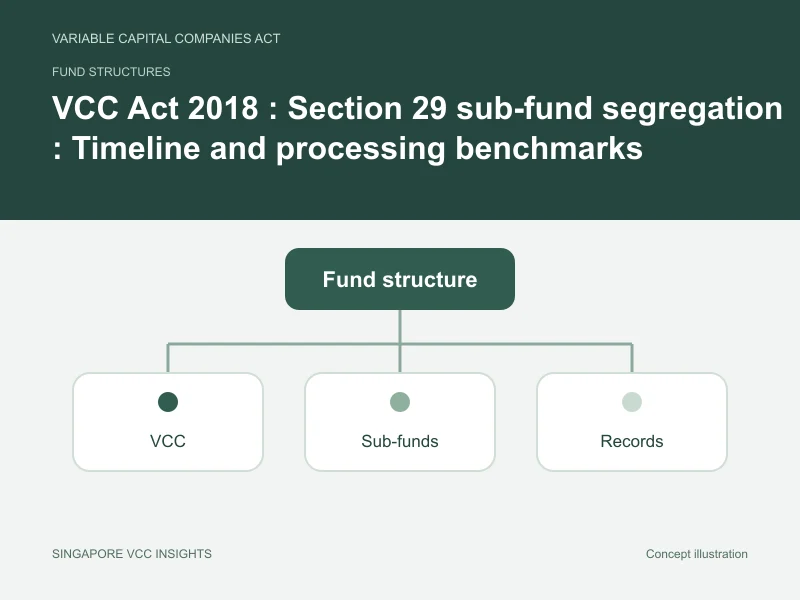
The vcc act 2018 lets a single umbrella entity hold multiple ring-fenced sub-funds. Section 29 provides that the assets of a sub-fund may be used only to meet the liabilities of that same sub-fund, so a loss or claim arising in one cell cannot reach the assets of another, protecting investors and counterparties across the whole umbrella structure.
Raffles Corporate Services works with a panel of corporate and employment law firms; this article is general information, not legal advice.
What the vcc act 2018 says about sub-fund segregation
Section 29 of the Variable Capital Companies Act 2018 is the ring-fencing provision that makes the umbrella VCC workable. It provides that the assets of a sub-fund are to be used to discharge the liabilities of that sub-fund only, and are not available to discharge the liabilities of any other sub-fund or of the umbrella itself. In the language practitioners use, each sub-fund is a segregated cell, and there is a statutory wall between one cell and the next.
The provision works together with Section 17, which gives the umbrella its separate legal personality. The umbrella is the one legal person that contracts and is sued, but Section 29 dictates which pool of assets answers a given liability. A creditor who deals with the VCC in respect of Sub-Fund A can look only to the assets of Sub-Fund A, and cannot cross into Sub-Fund B, even though both sit within the same body corporate. This prevents cross-cell contagion, the risk that losses in one strategy sweep across and damage unrelated investors in another.
Who ring-fencing matters to: creditors and counterparties
For investors, segregation is the reassurance that their money is exposed only to the strategy they chose. An investor in a conservative bond sub-fund is not underwriting the leverage of a derivatives sub-fund sharing the same umbrella. This is what allows a manager to run several distinct strategies under one corporate roof without asking each investor to accept the risks of the others.
For creditors and counterparties, segregation changes how contracts are documented and how recourse is assessed. Because each sub-fund is a separate pool for the purpose of meeting liabilities, banks, brokers and service providers need to know which sub-fund they are contracting with, and their security and set-off rights are confined to that sub-fund’s assets. Careful counterparties record the relevant sub-fund on the face of the agreement and confirm it is registered, because the statutory ring-fence is only useful if the paperwork reflects it.
How segregation works in practice
In day-to-day operation, the manager and administrator keep separate books and records for each sub-fund, with assets held in segregated accounts and liabilities tracked to the correct cell. Section 29 gives legal force to that separation, but the operational discipline is what makes it hold up. Assets of different sub-funds should not be commingled, and any expense shared across the umbrella should be allocated on a documented and reasonable basis.
The ring-fence is intended to be respected in an insolvency as well as in ordinary trading, so that if one sub-fund fails its creditors take from its assets alone. That is why the winding up of a single sub-fund can proceed without dragging in the others, and why a sub-fund can be wound up as if it were a separate company even though it is not a separate legal person.
- Assets of a sub-fund meet only that sub-fund’s liabilities.
- Books, records and bank accounts are kept separately per sub-fund.
- Shared expenses are allocated on a documented, reasonable basis.
- A single sub-fund can be wound up without affecting the others.
Registering each sub-fund with ACRA
The segregation is not self-executing simply because the manager labels internal accounts. Each sub-fund of an umbrella VCC is registered with ACRA, and the umbrella must maintain the sub-fund register. Registration puts the existence of the sub-fund on the public record and is part of what allows counterparties to verify that the cell they are dealing with is properly constituted. A sub-fund that has not been registered is not a recognised segregated cell, which undermines the protection Section 29 is meant to provide.
The umbrella VCC is incorporated first under the general framework of the Variable Capital Companies Act 2018, with at least one Singapore-resident director, at least one director who is a director or qualified representative of the fund manager, and a Singapore-based licensed or exempt fund manager. Sub-funds are then registered under that umbrella, either at incorporation or as the platform adds strategies over time. Financial statements are prepared for the umbrella and its sub-funds under SFRS or IFRS and audited by a Singapore public accountant.
Naming, fees and timeline benchmarks
Sub-fund naming and registration carry their own administrative steps and fees, which are separate from the umbrella incorporation. The benchmarks below are the figures practitioners plan around.
- ACRA name application for the umbrella: S$15; umbrella VCC incorporation fee: S$8,000.
- Registration of each sub-fund with ACRA: a separate fee per sub-fund, commonly around S$400 per sub-fund.
- Umbrella incorporation typically completes in 1 to 2 weeks once the manager and directors are confirmed.
- Registering an additional sub-fund under an existing umbrella is faster, often a few business days once the sub-fund particulars are settled.
- Each sub-fund’s assets and liabilities are accounted for separately, with statements under SFRS or IFRS.
Winding up a single sub-fund
Because segregation is respected in insolvency, a single sub-fund can be wound up on its own while the rest of the umbrella continues to operate. The Variable Capital Companies Act 2018 applies the winding-up machinery of the Companies Act 1967 to VCCs with modifications, and adapts it so that a sub-fund may be wound up as if it were a separate company. Its creditors are paid from its assets, its shares are cancelled, and the umbrella and other sub-funds are unaffected.
This is a significant practical advantage over running several standalone funds, where closing one still leaves shared overheads and separate wind-down costs. Within an umbrella, a failed or matured strategy can be retired cleanly while the platform lives on. Directors should nonetheless take advice early, because the interaction between the sub-fund ring-fence and the applied Companies Act 1967 provisions is technical and the sequencing matters.
Step-by-step: adding a sub-fund
The sequence below shows how a new segregated cell is brought into being under an existing umbrella VCC.
- Confirm the new strategy and that the manager’s licence or exemption covers it.
- Settle the sub-fund’s name, constitution particulars and offering terms.
- Register the sub-fund with ACRA and pay the per-sub-fund registration fee.
- Open segregated bank and custody accounts in the name of the VCC for that sub-fund.
- Update the umbrella’s sub-fund register and internal books to reflect the new cell.
- Begin dealing, ensuring assets and liabilities are booked only to the new sub-fund.
Common mistakes and gotchas
The most serious mistake is failing to register a sub-fund with ACRA while treating it internally as segregated. Without registration the cell is not a recognised sub-fund, and the Section 29 ring-fence cannot be relied on with confidence. The second is commingling assets: holding two sub-funds’ cash or securities in one undesignated account defeats the segregation the Act provides and exposes investors to exactly the cross-contagion the structure is meant to prevent.
A third trap is sloppy contracting, where agreements name only the umbrella and not the relevant sub-fund, leaving it unclear which pool of assets answers a claim. A fourth is careless allocation of shared expenses, which can transfer value between cells and give investors in one sub-fund a grievance against the manager. Clean registration, segregated accounts, sub-fund-specific contracts and documented cost allocation are the four disciplines that keep Section 29 protection intact.
Related guides
- VCC vs Cayman SPC: Why Singapore Is the New Fund Domicile of Choice
- Setting Up a Variable Capital Company Sub-Fund in 2026: Whats Changed and Why Asset Managers Are Taking Notice
- Sub-fund creation, valuation and ring-fencing mechanics , Costs and fees breakdown
Official sources and further reading
FAQs
What does Section 29 of the VCC Act 2018 do?
It ring-fences each sub-fund of an umbrella VCC, so the assets of a sub-fund may be used only to meet that sub-fund’s liabilities and cannot be reached by creditors of another sub-fund or of the umbrella.
Does each sub-fund have to be registered with ACRA?
Yes. Each sub-fund of an umbrella VCC is registered with ACRA and recorded in the umbrella’s sub-fund register; an unregistered cell is not a recognised sub-fund and the statutory ring-fence cannot be relied on.
Can one sub-fund be wound up without the others?
Yes. A sub-fund can be wound up as if it were a separate company under the winding-up rules applied by the Variable Capital Companies Act 2018, with its creditors paid from its own assets while the umbrella and other sub-funds continue.
How much does it cost to register a sub-fund?
The umbrella incorporation fee is S$8,000 with a S$15 name application, and each sub-fund carries a separate registration fee, commonly around S$400 per sub-fund.
What happens if sub-fund assets are commingled?
Commingling undermines the Section 29 segregation and exposes investors to cross-cell contagion. Assets, accounts and records should be kept separately for each sub-fund to preserve the ring-fence.
Need help with this? Call, SMS or WhatsApp +65 8501 7133, or email hello@rafflescorporateservices.com. Raffles Corporate Services works with a panel of corporate and employment law firms; this article is general information, not legal advice.