Singapore VCC insights
VCC Act 2018 — Section 29 sub-fund segregation — Documents required and templates
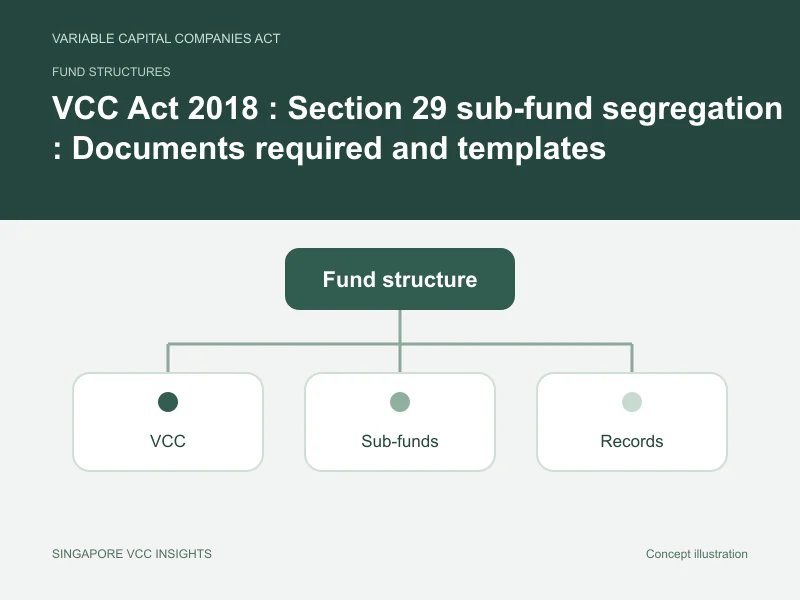
Section 29 of the VCC Act 2018 is the provision that gives an umbrella VCC’s sub-funds true legal segregation, meaning the assets and liabilities of one sub-fund cannot be used to satisfy the liabilities of another. This guide sets out, for directors and counsel, the documents and templates needed to establish and maintain that segregation properly under the VCC Act 2018.
What Section 29 of the VCC Act 2018 covers
Section 29 of the Variable Capital Companies Act 2018 provides that where a VCC is constituted as an umbrella structure, the assets of a sub-fund belong exclusively to that sub-fund and are not available to meet the liabilities of the VCC generally or of any other sub-fund. This statutory ring-fencing is what allows a single VCC to house multiple, commercially unrelated investment strategies, each with different investors, share classes and asset exposures, without one sub-fund’s losses or creditors threatening another. It is a materially stronger form of segregation than an ordinary Companies Act 1967 company can offer through internal accounting divisions alone, since under Section 29 the segregation is a matter of statute rather than contract or internal policy.
This segregation is what allows umbrella VCCs to be marketed to different classes of investor on a sub-fund-by-sub-fund basis, and it is the reason MAS and auditors pay close attention to whether a VCC’s actual operations, banking arrangements and record-keeping match the segregation the constitution promises on paper.
Who this matters for
This provision is central to the work of VCC directors, the fund manager, the fund administrator, custodians and banks maintaining sub-fund-level accounts, and the auditor who must be satisfied that segregation is being observed in substance, not just in the constitution. Legal counsel drafting sub-fund supplements and cross-sub-fund service agreements also rely on Section 29 as the statutory foundation for the ring-fencing language used in those documents.
Documents and templates required
To establish and evidence segregation consistent with Section 29 of the Variable Capital Companies Act 2018, the typical document set includes:
- The VCC’s constitution, expressly establishing the umbrella structure and confirming that each sub-fund’s assets and liabilities are segregated from every other sub-fund.
- A sub-fund supplement or instrument of designation for each sub-fund, setting out its specific investment objective, share classes, fees and dealing terms.
- Separate bank account mandates and account structures for each sub-fund, since commingled cash accounts undermine the segregation the constitution claims.
- A cross-sub-fund transaction policy, addressing whether and how one sub-fund may transact with another (for example short-term cash sweeps), and the arm’s-length basis on which this is permitted.
- Segregated custody arrangements or, at minimum, custodian sub-accounts identifiable to each sub-fund.
- Separate management accounts and, ultimately, separate financial statement notes or schedules for each sub-fund to support the annual audit.
Where a VCC’s sub-funds share a common fund manager or administrator, the service agreements with those parties should also make clear that fees, expenses and liabilities are allocated to the correct sub-fund rather than pooled at the umbrella level.
Cost and timeline
Drafting the constitution and initial sub-fund supplement for an umbrella VCC typically costs S$4,000 to S$9,000 in legal fees, with each additional sub-fund supplement added later usually costing S$1,500 to S$3,000. Setting up segregated banking and custody arrangements for a new sub-fund generally takes 2 to 6 weeks, depending on the bank’s or custodian’s onboarding process and whether the sub-fund requires a fresh account or a sub-account under an existing umbrella facility. Administrator onboarding for a new sub-fund, including setting up separate NAV calculation and reporting lines, typically adds a further 2 to 4 weeks before the sub-fund can commence dealing.
Step-by-step process
- Confirm the umbrella structure and segregation language in the VCC’s constitution, consistent with Section 29 of the Variable Capital Companies Act 2018.
- Draft a sub-fund supplement for each sub-fund, specifying its investment objective, share classes and dealing terms.
- Open segregated bank accounts or clearly identifiable sub-accounts for each sub-fund before any subscriptions are accepted.
- Agree a cross-sub-fund transaction policy with the manager and administrator, covering permitted cash sweeps or shared services and how they are priced.
- Instruct the custodian to maintain segregated sub-accounts or holdings records by sub-fund.
- Set up separate management accounting lines with the administrator so that income, expenses and liabilities are tracked by sub-fund from inception.
- At year end, ensure the auditor receives sub-fund-level trial balances and schedules sufficient to opine on segregation being maintained in substance.
Worked example
Consider an umbrella VCC with a listed-equities sub-fund and a private credit sub-fund, both administered by the same fund administrator and both banking with the same institution. Under Section 29 of the Variable Capital Companies Act 2018, the two sub-funds must maintain segregated assets, so the administrator opens a distinct sub-account for each sub-fund at the bank, tags all custodian holdings by sub-fund identifier, and maintains separate general ledgers for each. When the listed-equities sub-fund has a short-term cash surplus and the private credit sub-fund has a temporary funding need ahead of a capital call being drawn down from investors, the manager may wish to arrange a short-term intercompany-style cash sweep between the two. This is only permissible if the constitution and a documented cross-sub-fund transaction policy allow it, and it should be priced at a market rate of interest and formally recorded as a loan between sub-funds, with its own repayment terms, rather than treated as an informal transfer. Absent that documentation, the transaction risks being characterised as undermining the very segregation Section 29 is meant to guarantee.
Board governance and documentation practice
Directors of an umbrella VCC should treat segregation as an operational discipline that needs periodic verification, not a one-off drafting exercise completed when the constitution was signed. Good practice includes an annual (or more frequent) segregation review, in which the board confirms with the administrator and custodian that each sub-fund’s assets, liabilities, income and expenses have in fact been tracked and reported separately throughout the period, and that any cross-sub-fund transactions were properly documented and priced on an arm’s-length basis. Board minutes should record this review explicitly, since it is the kind of evidence that demonstrates the segregation promised to investors in the constitution and offering documents has been maintained in substance. Where a new sub-fund is added to an existing umbrella VCC, the board should also confirm, before the sub-fund accepts its first subscription, that segregated banking and custody arrangements are actually in place, rather than assuming the existing umbrella infrastructure will automatically extend to the new sub-fund.
Common mistakes and gotchas
The most frequent failure is commingled banking: sub-funds sharing a single bank account with internal allocations tracked only in a spreadsheet, which weakens the practical protection Section 29 is meant to provide and creates real difficulty if one sub-fund becomes insolvent while others remain solvent. A second common gap is a cross-sub-fund cash sweep arrangement that is not documented or priced on an arm’s-length basis, which can look like an undocumented intercompany loan between sub-funds and raises questions for auditors and MAS alike. Umbrella VCCs also sometimes fail to update sub-fund supplements when a sub-fund’s strategy or share classes change, leaving the constitutional documents out of step with what investors were actually sold. Finally, some VCCs under-resource sub-fund-level management accounting early on, then face a difficult and costly reconstruction exercise at the first audit.
How Section 29 interacts with the wider VCC framework
Segregation under Section 29 works together with the variable capital and redemption mechanic elsewhere in the VCC Act 2018, since redemptions from one sub-fund must be met from that sub-fund’s own assets rather than the umbrella’s assets generally. It also interacts with the distribution provisions of the VCC Act 2018, because a distribution decision for one sub-fund must be assessed against that sub-fund’s own solvency, not the umbrella’s consolidated position. Directors of umbrella VCCs should treat each sub-fund, for governance purposes, almost as if it were a standalone fund sharing only a legal wrapper and certain service providers with its sibling sub-funds.
Regulatory and audit considerations
MAS’s interest in sub-fund segregation is closely tied to investor protection: an umbrella VCC is often marketed to investors on the basis that their exposure is limited to a specific sub-fund’s strategy, and MAS expects the operational reality to match that representation. Auditors, for their part, will generally require sub-fund-level trial balances, bank confirmations by sub-fund or sub-account, and evidence of how any cross-sub-fund transactions were priced and approved, before they can express an opinion that treats each sub-fund as a genuinely separate pool of assets and liabilities for financial reporting purposes. Where a VCC cannot readily produce sub-fund-level records on request, this is often the first sign to an auditor that segregation has not been operated with the discipline the constitution promises, and it can lead to qualified findings or, at minimum, a materially longer and more costly audit process. Building sub-fund-level reporting into the administrator’s systems from day one, rather than retrofitting it before the first audit, is the more efficient approach in practice.
FAQs
Does Section 29 of the VCC Act 2018 protect one sub-fund from another sub-fund’s creditors?
Yes, that is its core purpose: assets and liabilities are segregated by statute, so one sub-fund’s creditors cannot generally reach another sub-fund’s assets.
Can sub-funds within the same VCC lend cash to each other?
Only if the constitution and a documented cross-sub-fund transaction policy permit it, typically on an arm’s-length, short-term basis, and this should be clearly evidenced.
Do sub-funds need separate bank accounts?
Separate accounts or clearly identifiable sub-accounts are strongly recommended; commingled cash undermines the practical effect of statutory segregation even if the constitution is correctly drafted.
Does each sub-fund need its own auditor?
No, the VCC as a whole is audited, but the auditor needs sub-fund-level records to opine on segregation and to present sub-fund financial information correctly.
What happens if segregation is not properly maintained in practice?
The statutory protection depends on segregation being real, not just documented. Poor record-keeping or commingled assets can undermine the ring-fencing investors were told applied.
Related guides
For the tax treatment that often runs alongside sub-fund structuring, see our guide to the Section 13U enhanced-tier fund scheme, which many umbrella VCC sub-funds rely on. If you are setting up the manager or adviser entity behind the umbrella VCC, see our guide to Singapore Pte Ltd company registration for foreigners. For the practical mechanics of creating and valuing a sub-fund, see Sub-fund creation, valuation and ring-fencing mechanics , Eligibility and requirements checklist on this site.
For the statutory text itself, see the Variable Capital Companies Act 2018 on Singapore Statutes Online. For registration matters, see ACRA, and for MAS’s regulatory explainer on the VCC framework, see the MAS explainer on VCCs.
Need help with this? Call, SMS or WhatsApp +65 8501 7133, or email hello@rafflescorporateservices.com. Raffles Corporate Services works with a panel of corporate and employment law firms; this article is general information, not legal advice.