Singapore VCC insights
VCC Act 2018 — Section 46 Permissible Fund Manager rules — Timeline and processing benchmarks
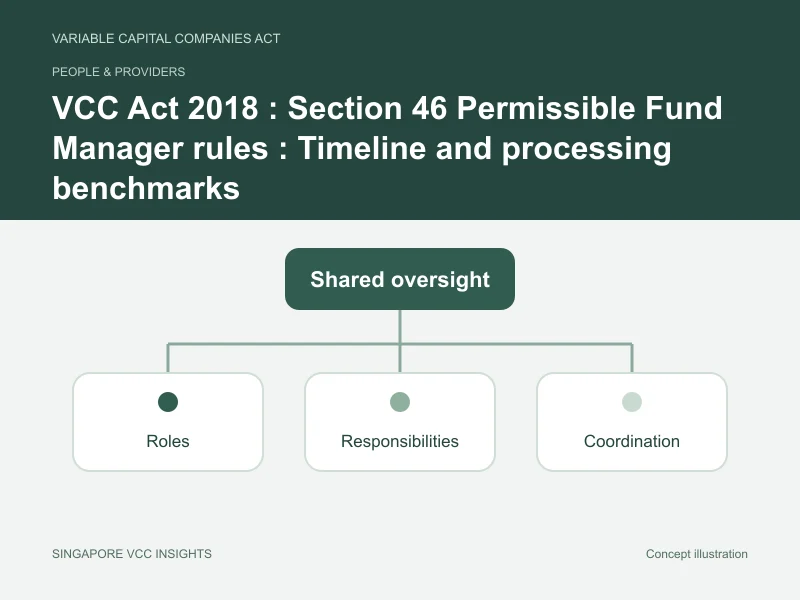
The VCC Act 2018 requires every Variable Capital Company to be managed by a Permissible Fund Manager , it cannot be self-managed like an ordinary company. Section 46 of the Variable Capital Companies Act 2018 defines who qualifies, and it is one of the first eligibility gates any fund sponsor must clear before a VCC can be incorporated.
Raffles Corporate Services works with a panel of corporate and employment law firms; this article is general information, not legal advice.
What a Permissible Fund Manager is
The VCC framework deliberately ties the corporate vehicle to Singapore’s regulated fund-management regime. A VCC must appoint a Permissible Fund Manager to manage its property. Broadly, a Permissible Fund Manager is a Singapore fund manager that is regulated by the Monetary Authority of Singapore , a holder of a Capital Markets Services licence for fund management, a Registered Fund Management Company, or an entity otherwise exempt from holding a licence under the Securities and Futures Act 2001 (for example certain banks, finance companies and insurers).
The requirement is set out in the Variable Capital Companies Act 2018, published on Singapore Statutes Online, and explained in the MAS explainer on the VCC.
Who this affects
This gate matters most to fund sponsors and family offices weighing whether to launch a VCC. If the sponsor is not itself a regulated manager, it must either become one, appoint an external licensed manager, or use a licensed third-party manager platform. The tax incentives that make VCCs attractive are covered in Private banking onboarding for newly licensed CMS holders , Timeline and processing benchmarks, and the account and custody set-up in Singapore bank account opening , DBS, OCBC, UOB, Wise, Aspire , Timeline and processing benchmarks.
Why self-management is not allowed
Unlike a Companies Act company, a VCC cannot manage its own assets. The Permissible Fund Manager requirement ensures that every VCC sits under MAS’s supervisory perimeter, so that anti-money-laundering obligations, conduct rules and capital requirements apply to the party actually making investment decisions. This is central to Singapore’s positioning of the VCC as a credible, well-regulated fund vehicle.
The manager owes duties to the VCC and must have the licences or exemption appropriate to the strategy and investor base , retail schemes attract stricter requirements than those offered only to accredited or institutional investors.
Eligibility checklist
Before incorporating a VCC, confirm: (1) the intended manager holds a Capital Markets Services licence for fund management, is a Registered Fund Management Company, or qualifies for an exemption; (2) the manager’s licence conditions permit the fund’s strategy and target investors; (3) the manager has the substance , key individuals, compliance and risk , that MAS expects; and (4) the management agreement between the VCC and the manager is documented before or at incorporation.
Where a sponsor lacks its own licence, appointing an established external manager is the fastest route to launch.
Cost and timeline
If the manager already holds the right MAS status, appointing it adds little time , the VCC can be incorporated with ACRA once the management agreement is in place. If the sponsor must obtain a fund-management licence first, that is the critical path: a Registered Fund Management Company or Capital Markets Services licence application to MAS typically takes several months and requires minimum base capital, professional indemnity insurance and qualified key personnel.
Budget manager set-up and licensing costs from tens of thousands of Singapore dollars upward, plus ongoing VCC running costs of roughly S$25,000 to S$60,000 a year.
Common mistakes and gotchas
The classic mistake is a family office assuming it can incorporate and self-manage a VCC as it would an ordinary company , it cannot. Another is appointing a manager whose licence does not cover the fund’s strategy or investor type. A third is leaving the management agreement undocumented at incorporation, which stalls the registrar’s process.
Sponsors also underestimate the substance MAS expects of the manager; a licence on paper without genuine Singapore-based decision-making invites scrutiny. The registrar of VCCs is ACRA, working with MAS on the regime. The mechanics of variable capital are explored in VCC Act 2018 , Section 29 sub-fund segregation , Timeline and processing benchmarks.
Step-by-step: satisfying the manager requirement
First, decide whether to use an external licensed manager or become a regulated manager. Second, verify the manager’s MAS status covers the strategy and investors. Third, if licensing is needed, apply to MAS and allow several months. Fourth, execute the management agreement. Fifth, incorporate the VCC with ACRA once the manager is confirmed. The statutory requirement is set out in the VCC Act 2018 on Singapore Statutes Online.
VCC Act 2018: why the Permissible Fund Manager sits at the centre
The VCC Act 2018 was designed to keep every VCC inside Singapore’s regulated fund-management perimeter, and the Permissible Fund Manager requirement is the mechanism. By insisting that a MAS-regulated manager runs the fund, the Act ensures that anti-money-laundering controls, conduct standards and capital requirements bite on the party actually deploying investors’ money. This is a deliberate contrast with ordinary companies, which manage their own affairs.
The manager’s regulation flows from the Securities and Futures Act 2001, which licenses and registers fund managers, while the VCC Act 2018 supplies the corporate vehicle. A sponsor must therefore satisfy two regimes at once: the corporate requirements of the VCC Act and the licensing requirements sitting behind the manager.
Licence categories and which funds they permit
Not every regulated manager can run every fund. A Registered Fund Management Company may manage assets only for a limited number of qualified investors and up to a capped level of assets. A Capital Markets Services licence for fund management is required for larger or retail-facing operations, with the licence conditions defining the permitted investor base and strategy. Certain institutions are exempt from licensing altogether but remain MAS-regulated.
The lesson for a VCC sponsor is to match the manager to the fund before incorporating. A fund intended for retail investors cannot be run by a manager whose permissions extend only to accredited or institutional investors, and discovering the mismatch after incorporation is costly.
Outsourcing management versus building a manager
Sponsors without their own licence face a build-or-buy choice. Buying , appointing an established external licensed manager or using a manager platform , is faster and avoids the multi-month licensing timeline, but cedes day-to-day control and carries ongoing fees. Building , obtaining a Registered Fund Management Company or Capital Markets Services licence , gives control and captures the management economics, but requires minimum base capital, professional indemnity insurance, qualified key individuals and a compliance function.
Family offices launching a single VCC often start by using a licensed manager or the family office’s own exemption where available, and consider building a full manager only once scale justifies the fixed cost.
FAQs
Can a VCC manage its own assets? No. The Variable Capital Companies Act 2018 requires a VCC to be managed by a Permissible Fund Manager; self-management is not permitted.
Who qualifies as a Permissible Fund Manager? Broadly, a MAS-regulated Singapore fund manager , a Capital Markets Services licence holder for fund management, a Registered Fund Management Company, or an entity exempt under the Securities and Futures Act 2001.
What if the sponsor is not licensed? It must either obtain a fund-management licence, appoint an external licensed manager, or use a licensed manager platform before the VCC can operate.
How long does fund-management licensing take? A MAS application for a Registered Fund Management Company or Capital Markets Services licence typically takes several months and requires capital, insurance and qualified personnel.
Does the manager need Singapore substance? Yes. MAS expects genuine Singapore-based key individuals, compliance and risk functions, not a licence in name only.
Related guides
Read more: VCC Act 2018 , Section 29 sub-fund segregation , Timeline and processing benchmarks, Private banking onboarding for newly licensed CMS holders , Timeline and processing benchmarks and Singapore bank account opening , DBS, OCBC, UOB, Wise, Aspire , Timeline and processing benchmarks.
Need help with this? Call, SMS or WhatsApp +65 8501 7133, or email hello@rafflescorporateservices.com. Raffles Corporate Services works with a panel of corporate and employment law firms; this article is general information, not legal advice.