Singapore VCC insights
Sub-fund creation, valuation and ring-fencing mechanics — Timeline and processing benchmarks
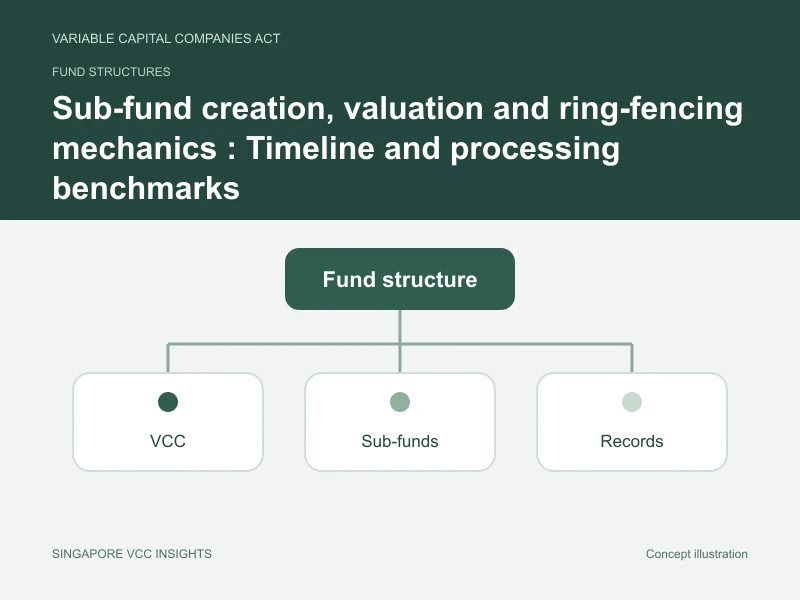
Sub-fund creation, valuation and ring-fencing mechanics are the operational heart of an umbrella Variable Capital Company. Each sub-fund is registered, valued and administered separately while sharing one legal entity, and the Variable Capital Companies Act 2018 protects each sub-fund’s assets from the liabilities of the others.
Raffles Corporate Services works with a panel of corporate and employment law firms; this article is general information, not legal advice.
What sub-fund creation, valuation and ring-fencing mechanics involve
In an umbrella VCC, a sub-fund is a segregated portfolio registered with ACRA under the umbrella entity. Sub-fund creation, valuation and ring-fencing mechanics govern how a new sub-fund is added, how its net asset value is struck, and how its assets and liabilities are kept legally separate from other sub-funds.
The Variable Capital Companies Act 2018 provides that the assets of a sub-fund are to be used only to meet the liabilities of that sub-fund. This segregation is the defining feature of the umbrella and the reason managers can run multiple strategies under one board without cross-contamination of risk.
Creating a new sub-fund
Adding a sub-fund does not require incorporating a new company. The manager registers the sub-fund with ACRA, adopts sub-fund-specific terms within or alongside the VCC constitution, and puts in place the sub-fund’s own bank and custody accounts, offering document and service-provider arrangements.
Because the sub-fund shares the umbrella’s board, secretary and fund manager, launch is faster and cheaper than a standalone fund. Managers designing the platform should also review the standalone-versus-umbrella trade-offs in 13O → 13U transition mechanics , Eligibility and requirements checklist and the wider setup context in VCC vs Cayman Islands SPC: Why Singapore Is the New Fund Domicile.
Valuation and net asset value mechanics
Each sub-fund is valued independently. The manager and administrator strike a net asset value per share class at the frequency set in the offering document, applying a consistent valuation policy for the sub-fund’s assets, whether listed securities, private holdings or a mix. A VCC can issue and redeem shares at net asset value, which is what gives the vehicle its variable capital flexibility.
Robust valuation governance matters because subscriptions and redemptions transact at the struck NAV. Independent administration, clear pricing sources and a documented valuation policy protect investors and reduce disputes. The Variable Capital Companies Act 2018 requires proper accounting records and financial statements for the VCC and its sub-funds.
Ring-fencing, costs and timeline benchmarks
Ring-fencing is preserved by contracting on behalf of the correct sub-fund and keeping assets, records and accounts segregated. Creditors of one sub-fund cannot look to another sub-fund’s assets, provided the segregation has been respected in practice.
Adding a sub-fund typically costs a smaller increment than a full fund launch, often S$5,000 to S$15,000 in professional and administration setup, plus ongoing per-sub-fund administration and audit. Timelines to launch a new sub-fund are commonly 3 to 6 weeks once strategy, offering documents and accounts are ready.
Step-by-step: launching and running a sub-fund
Confirm the strategy and share classes. Register the sub-fund with ACRA under the umbrella. Open dedicated bank and custody accounts. Finalise the sub-fund offering document and valuation policy. Appoint or extend the administrator and auditor. Set the NAV frequency and dealing terms. Contract all agreements expressly on behalf of the sub-fund to preserve ring-fencing.
For the higher-level design decision behind all of this, see the Sub-fund creation, valuation and ring-fencing mechanics , Costs and fees breakdown.
Common mistakes
The most serious error is failing to contract in the name of the specific sub-fund, which can undermine the very ring-fencing the umbrella provides. Others include inconsistent valuation policies across dealing dates and commingling of sub-fund assets or records.
Confirm the governing rules directly with the Monetary Authority of Singapore at mas.gov.sg and ACRA at acra.gov.sg.
FAQs
How is a new sub-fund created?
The manager registers the sub-fund with ACRA under the existing umbrella VCC and puts in place its own accounts, offering document and service providers, without incorporating a new company.
How is a sub-fund valued?
Independently, by striking a net asset value per share class at the frequency set in the offering document, applying a consistent valuation policy for the sub-fund’s assets.
How does ring-fencing work?
Under the Variable Capital Companies Act 2018, a sub-fund’s assets may be used only to meet that sub-fund’s liabilities, provided segregation is respected in accounts and contracts.
How long does it take to add a sub-fund?
Commonly 3 to 6 weeks once the strategy, offering documents and accounts are ready, at a lower cost than a full standalone fund launch.
Related guides
- 13O → 13U transition mechanics , Eligibility and requirements checklist
- VCC vs Cayman Islands SPC: Why Singapore Is the New Fund Domicile
- Sub-fund creation, valuation and ring-fencing mechanics , Costs and fees breakdown
Need help with this? Call, SMS or WhatsApp +65 8501 7133, or email hello@rafflescorporateservices.com. Raffles Corporate Services works with a panel of corporate and employment law firms; this article is general information, not legal advice.