Singapore VCC insights
Standalone VCC vs umbrella VCC — decision framework — Timeline and processing benchmarks
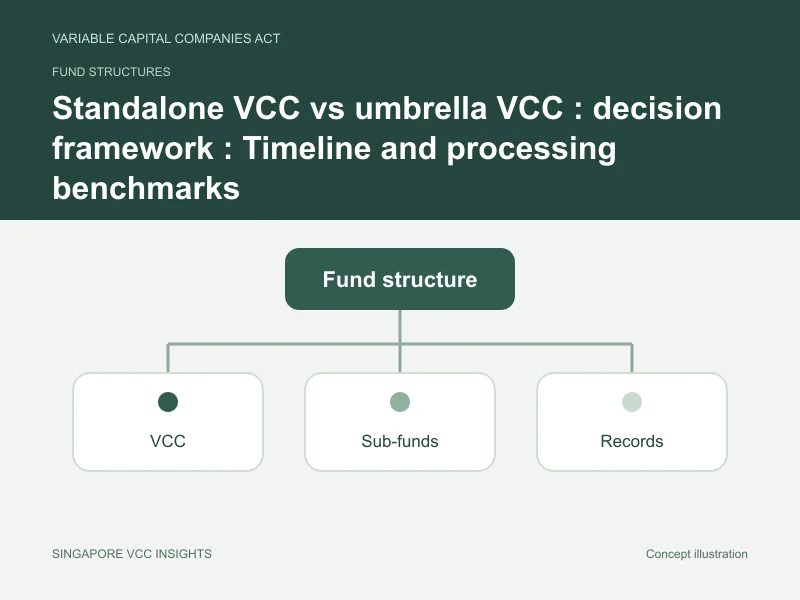
Choosing between a standalone VCC vs umbrella VCC shapes cost, governance and speed to launch for a Singapore fund. A standalone VCC holds one portfolio, while an umbrella VCC houses multiple ring-fenced sub-funds under one entity. This framework explains which structure fits which strategy.
Raffles Corporate Services works with a panel of corporate and employment law firms; this article is general information, not legal advice.
What standalone VCC vs umbrella VCC means
A Variable Capital Company can be incorporated as a standalone vehicle with a single pool of assets, or as an umbrella VCC with two or more sub-funds. The Variable Capital Companies Act 2018 gives the umbrella structure legal segregation, so the assets and liabilities of each sub-fund are ring-fenced from the others.
The choice is strategic. A single-strategy manager launching one fund may prefer the simplicity of a standalone VCC. A manager planning a suite of strategies, share classes or investor pools often chooses an umbrella to add sub-funds efficiently over time under one corporate roof.
Who each structure suits
A standalone VCC suits a manager with one clear strategy, a single investor base, and no near-term plan to launch additional funds. It is the leanest option to govern and administer.
An umbrella VCC suits a manager building a platform: multiple strategies, phased launches, or the wish to offer investors a menu of ring-fenced sub-funds sharing one board and service-provider stack. Managers modelling the wider Singapore setup can review our note on Property Tax for Companies in Singapore (2026): Commercial Property Guide and the incorporation context in VCC vs Cayman Islands SPC: Why Singapore Is the New Fund Domicile.
Governance, ring-fencing and shared services
In an umbrella VCC, the sub-funds are not separate legal persons, but the Variable Capital Companies Act 2018 provides that the assets of a sub-fund may not be used to discharge the liabilities of the umbrella or another sub-fund. This statutory ring-fencing is the core protection investors rely on.
The umbrella shares a single board, company secretary, fund manager arrangement and, often, service providers across sub-funds, which reduces per-fund overhead. However, cross-sub-fund conflicts must be managed carefully, and contracts should be entered clearly on behalf of the correct sub-fund to preserve segregation.
Cost and timeline benchmarks
A standalone VCC typically costs less to establish and run because there is one portfolio to administer. An umbrella carries a higher base cost but a lower marginal cost per additional sub-fund, since each new sub-fund is added without incorporating a new company.
Establishment costs for a first VCC commonly run S$10,000 to S$30,000 in professional and setup fees, with each additional sub-fund adding a smaller increment. Incorporation timelines are broadly similar, often 2 to 6 weeks once the fund manager and governance are in place, with umbrella set-up marginally longer to document sub-fund arrangements.
Step-by-step: choosing and launching
Map your strategy roadmap: one fund or several. If several are likely, favour the umbrella. Confirm the Singapore fund manager and appoint the resident director and secretary. Draft the constitution to reflect standalone or umbrella mechanics, including sub-fund ring-fencing where relevant. Register with ACRA, open bank and custody accounts per sub-fund, and finalise offering documents.
For the mechanics of adding and operating sub-funds inside an umbrella, see the Convert a Standalone VCC Into an Umbrella VCC.
Common mistakes
A common error is defaulting to a standalone VCC for speed, then incurring the cost of a second full structure when the next strategy launches. Another is failing to contract clearly on behalf of a specific sub-fund, which can blur the ring-fencing that the umbrella is designed to provide.
Confirm the current framework directly with the Monetary Authority of Singapore at mas.gov.sg and the statute at acra.gov.sg.
FAQs
What is the main difference between a standalone and umbrella VCC?
A standalone VCC holds a single portfolio, while an umbrella VCC houses multiple sub-funds whose assets and liabilities are legally ring-fenced from one another.
Are sub-funds separate legal entities?
No. Sub-funds are not separate legal persons, but the Variable Capital Companies Act 2018 ring-fences each sub-fund’s assets from the liabilities of other sub-funds and the umbrella.
Which structure is cheaper?
A standalone VCC is usually cheaper to set up and run for a single fund, while an umbrella has a higher base cost but a lower marginal cost per additional sub-fund.
Can I convert a standalone VCC into an umbrella later?
It is possible to restructure, but planning the umbrella from the outset is generally more efficient where multiple strategies are anticipated.
Related guides
- Property Tax for Companies in Singapore (2026): Commercial Property Guide
- VCC vs Cayman Islands SPC: Why Singapore Is the New Fund Domicile
- Convert a Standalone VCC Into an Umbrella VCC
Need help with this? Call, SMS or WhatsApp +65 8501 7133, or email hello@rafflescorporateservices.com. Raffles Corporate Services works with a panel of corporate and employment law firms; this article is general information, not legal advice.