Independent Singapore VCC guidance
Direct answer
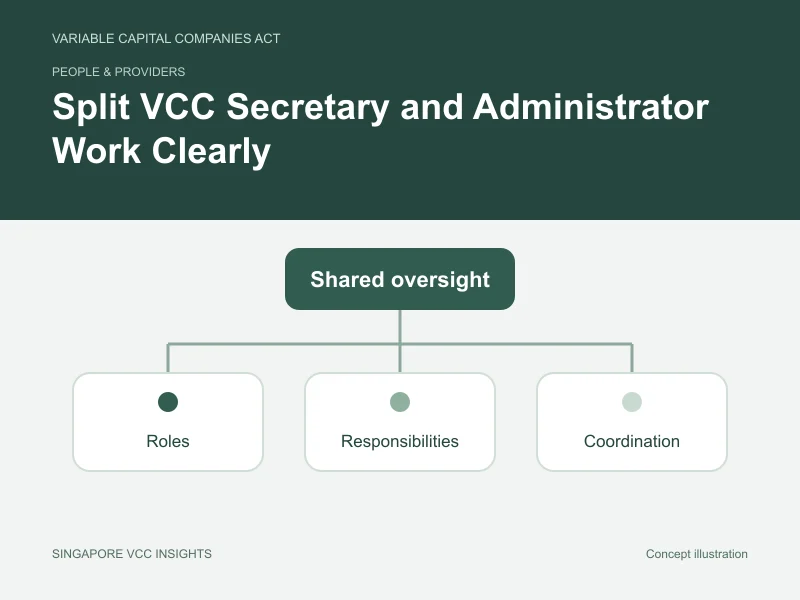
The secretary and administrator should not be treated as interchangeable. Give the secretary ownership of the statutory-governance workflow and official filing coordination; give the administrator ownership of the agreed fund-accounting, valuation and investor-servicing production. Then name the source record, preparer, reviewer and final accountable person for every handoff, especially member data, board approvals and annual-return inputs.
At a glance
- Compare deliverables and source records, not provider labels.
- One party may prepare data while another coordinates the official filing.
- Member, capital and officer records need explicit reconciliation points.
- Directors and the manager retain oversight even when production is outsourced.
- Put exception handling, turnaround and evidence delivery into each statement of work.
Who this is for
- VCC directors and operations teams selecting providers or repairing unclear secretary-administrator responsibilities.
Important exclusions
- A dispute about professional negligence, contractual liability or a live filing failure requiring specific legal advice.
Start with different systems of record
ACRA treats the company secretary as a key VCC officer and provides VCC-specific processes for officers, registers and annual returns. A fund administrator is not simply another name for that office. Its engagement commonly covers operational production such as fund accounting, investor transactions, record maintenance and reporting according to contract. The clean design begins by separating statutory-governance records from fund-operating records, then documenting where information crosses between them.
Sources: ACRA · ACRA · ACRA| Area | Secretary orientation | Administrator orientation | Handoff needed |
|---|---|---|---|
| Entity and officer records | Official registers, resolutions and filing coordination | Supplies operational facts when affected | Approved change and effective date |
| Investor activity | Governance and statutory implications | Processes subscriptions, redemptions and investor data within scope | Authorised transaction and updated member position |
| Accounts and reporting | Board and filing calendar coordination | Books, valuation and reporting production within scope | Final approved financial and supporting records |
| Sub-fund changes | VCC Portal and governance evidence | System setup, accounting and investor-operation readiness | Registered details matched to live systems |
Related guidance: VCC directors, fund managers, auditors and company secretary
Compare work by lifecycle event
Static service lists are difficult to test. Use lifecycle events instead: incorporation, first investor admission, capital movement, officer change, new sub-fund, year end, annual return and provider exit. For each event, identify who starts the process, who owns the source data, who prepares the document, who reviews it, who approves it and who retains final evidence. This turns “secretarial support” and “fund administration” into observable deliverables.
Sources: ACRA · ACRA · MAS| Event | Secretary workstream | Administrator workstream | Director or manager decision |
|---|---|---|---|
| Investor admission | Confirm governance and member-record consequences | Process authorised onboarding, transaction and investor data | Approve exceptions and confirm governing terms |
| New sub-fund | Coordinate resolutions and registry process | Configure books, accounts, valuation and investor operations | Approve launch readiness and mandate |
| Year-end close | Coordinate governance and filing calendar | Close books and prepare agreed reports and support | Review significant judgements and approve outputs |
| Officer or provider change | Update governance records and official process | Change access, data ownership and operating contacts | Approve handover and closure evidence |
| Annual return | Coordinate verified filing information and attachments | Supply reconciled financial and operational inputs | Confirm completeness and authorise filing route |
The matrix should state whether a role is responsible, accountable, consulted or informed, but those labels are not enough by themselves. Add the actual file, system or evidence that moves. A handoff called “send investor list” should identify the controlled source, fields, cut-off, reviewer, encryption route and acknowledgement. This is especially important where the administrator maintains a transfer-agency system while the VCC still needs accurate member and governance records.
Sources: ACRA · MASRelated guidance: VCC launch document ownership matrix
Resolve the member-record handoff
Member information sits at the boundary between investor operations and statutory records. The administrator may process subscriptions, redemptions and transfers under its engagement, while the VCC and its officers need accurate registers and official information. Define which system is the transaction source, when an authorised transaction becomes effective, who checks it against governing documents, how rejected or pending items are represented, and when the secretary receives the final change.
Sources: ACRA · ACRA · MASMember-change handoff
- Authorise the eventConfirm the transaction, governing conditions, investor identity and any approval or exception before changing ownership records.
- Process the transactionRecord cash, units or shares, class, price and effective date in the administrator’s controlled workflow.
- Reconcile the resultCompare transaction evidence, investor statement, member position and cash before releasing the final change record.
- Update connected recordsDeliver the approved change to the secretary and other authorised owners using the defined secure handoff.
- Close the evidenceRetain the final record, review, communication and any exception under one transaction identifier.
Boundary questions
- Which system determines the current member position and who may alter it?
- How are pending, rejected, reversed and corrected transactions represented?
- Who checks class, sub-fund and investor identifiers before the handoff?
- How quickly does the statutory record owner receive an approved change?
- Who compares the member record with investor statements and capital accounts?
- Where is the final reconciled evidence retained and who can retrieve it?
Build the annual-return handshake
ACRA’s current annual-return instructions ask the filer to verify VCC type, registered office, activities, officers, manager and sub-fund details and to prepare the stated financial documents. Those inputs come from several owners. The secretary can coordinate the filing pack, but should not invent or silently correct administrator, manager or director data. The administrator should provide reconciled final inputs in an agreed form, while the accountable VCC decision-makers confirm the filing basis.
Sources: ACRA · ACRA · MAS| Input set | Likely producer | Independent check | Filing-pack owner |
|---|---|---|---|
| Entity, officer and manager information | Secretary from current official and internal records | Directors and relevant role owners | Secretary or appointed filing coordinator |
| Sub-fund information | Secretary and administrator from registered and live records | Manager and operations owner | Secretary or appointed filing coordinator |
| Financial statements and related reports | Administrator, finance and auditor under their engagements | Directors and authorised reviewers | Secretary receives final approved attachments |
| AGM or member-circulation evidence | Secretary from governance records | Chair or responsible director | Secretary or appointed filing coordinator |
Test the statements of work
Read the secretary and administrator engagements side by side. Highlight duplicated deliverables, excluded tasks, undefined data, inconsistent turnaround assumptions and evidence that neither party promises to supply. Pay attention to sub-fund work, member changes, board packs, financial statement support, official filings, portal access, secure transfer, incident notification and provider-exit assistance. A task absent from both agreements needs an owner before launch.
Sources: ACRA · ACRA · MASStatement-of-work acceptance test
- Each deliverable names its preparer, approver, source system and retained evidence.
- Handoffs specify data fields, format, timing, secure channel and acknowledgement.
- Sub-fund and share-class work is explicit rather than assumed from umbrella-level wording.
- Exceptions, corrections and urgent events have escalation contacts and decision owners.
- System access, data export and provider-exit support are included in the operating model.
- Fees and out-of-scope triggers align with the expected transaction and reporting volume.
Do not solve every overlap by assigning the work to both providers. Parallel production can create conflicting records and unclear approval. Choose one production owner, one controlled handoff and one accountable review path. A second provider can perform an independent check where useful, but its purpose and evidence should be stated rather than emerging as duplicate spreadsheets.
Sources: MASRelated guidance: changing a VCC fund administrator · VCC provider directory
Run a monthly boundary review
Use a short boundary review to reconcile member changes, capital activity, officer and manager records, new governance decisions, sub-fund changes, open filings and unresolved exceptions. The meeting should compare controlled evidence rather than status summaries. Repeated late handoffs or manual corrections indicate a design weakness in scope, data or authority and should be escalated to the appropriate governance owner.
Sources: ACRA · ACRA · MASBoundary review evidence
- Member and capital changes reconcile across administrator and VCC records.
- Officer, manager and auditor information matches the current approved position.
- Board and member decisions have been delivered to every affected operating owner.
- Sub-fund and class changes appear consistently in registry, accounting and investor systems.
- Upcoming reports and filings have complete upstream owners and approval windows.
- Exceptions and provider actions have dates, evidence requirements and escalation owners.
The objective is not to turn the secretary into a fund accountant or the administrator into a company officer. It is to make their boundary observable and testable. When every event has a source, handoff, review and final owner, the board receives coherent records and both providers can perform specialist work without relying on informal assumptions.
Sources: ACRA · MASFrequently asked questions
Can one provider supply both secretarial and administration services?
A provider group may offer both, subject to the engagement and applicable arrangements. Keep the role map anyway. Name the team, capacity, source system, review and evidence for each output so that bundling improves coordination without hiding a missed control.
Who should maintain the investor transaction record?
Assign one controlled production system and owner under the operating model. Then define how authorised transactions flow into member, capital, accounting and communication records. The answer should come from the agreed engagement and governance design, not from a generic provider title.
Who should prepare annual-return information?
Different owners usually contribute different inputs. The secretary or filing coordinator can assemble the pack, while the administrator, finance team, auditor, manager and directors supply or approve their respective information. The workflow should state who confirms substance before submission.
How do we prevent duplicate records?
Name the source system for each data domain, restrict who may change it and use governed handoffs to connected records. Independent checks are useful, but parallel uncontrolled spreadsheets create competing truths. Reconcile differences through an exception log rather than quietly overwriting them.
What should happen when providers disagree about ownership?
Pause the affected output, identify the governing document and engagement terms, and escalate to the accountable VCC decision-maker. Record the interim control, final owner, amended procedure and any scope change so the same ambiguity does not return in the next cycle.
Official sources and further reading
Discuss a Singapore VCC structure
For help coordinating a Singapore VCC setup or corporate administration, contact Raffles Corporate Services.
General information only. This article is not legal, tax, regulatory or investment advice and does not imply affiliation with or endorsement by ACRA, MAS or IRAS.