Independent Singapore VCC guidance
Direct answer
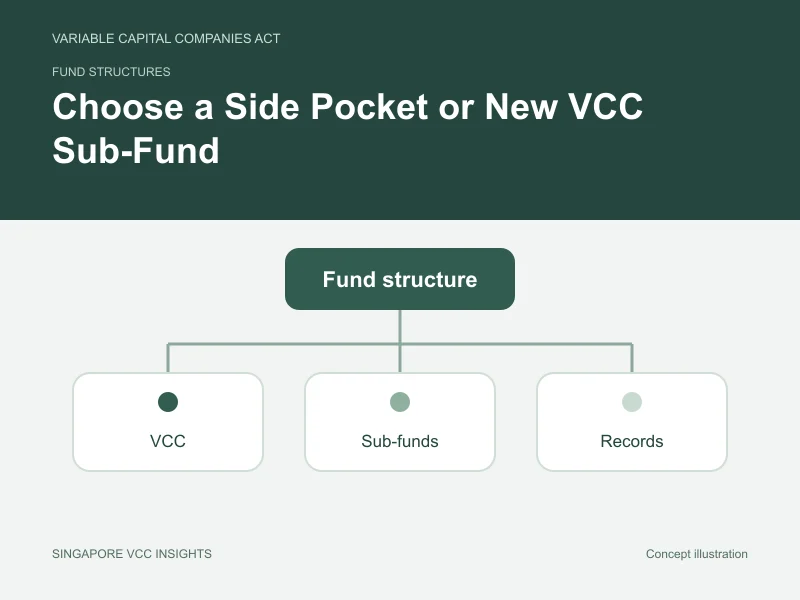
A side pocket is an investor-allocation and liquidity mechanism within the existing fund architecture; a new sub-fund is a separately registered compartment in an umbrella VCC with its own asset-and-liability perimeter. Choose only after deciding which investors should bear the asset, whether legal segregation is needed, how value and fees will be determined, and whether the documents and providers can implement the result. Do not describe a contractual pocket as if it were statutory ring-fencing.
At a glance
- Define the problem before choosing the label.
- Separate investor allocation from legal asset-and-liability segregation.
- Protect valuation and fee decisions from conflicts and hindsight.
- Test subscriptions, redemptions, transfers and reporting under the chosen design.
- Obtain specific legal, regulatory, tax and accounting advice before implementation.
Who this is for
- Managers considering how to handle an illiquid, impaired, suspended or difficult-to-value position in a VCC.
Important exclusions
- A confirmation that a side pocket is permitted by a particular fund document or offer route.
Define the problem without naming the solution
Write the factual problem first: the asset cannot be realised, cannot be valued reliably, cannot support ordinary dealing, is subject to a dispute or should be held only for a defined investor population. Record when the issue arose, which investors were exposed, how current documents treat it and what investor outcome the manager is trying to preserve. A side-pocket proposal and a sub-fund proposal solve different problems. Starting with a preferred label can hide whether the real need is fair allocation, temporary liquidity control, legal segregation, a new strategy or an orderly disposal process.
Sources: MAS · Singapore Statutes OnlineProblem statement
- Affected asset, fund, sub-fund and investor population are identified.
- The valuation, liquidity, legal, operational and disclosure issues are separated.
- Current governing documents and investor communications are assembled.
- Transactions occurring before and after the trigger are mapped.
- Conflicts, related parties and fee incentives are visible to decision-makers.
- The intended end state and exit conditions are stated without promising timing or value.
Compare the legal and economic perimeter
The VCC statute provides the legal architecture for umbrella sub-funds and segregation of their assets and liabilities. A side pocket, by contrast, depends on the fund’s governing and offering arrangements and the way interests are allocated and administered; the label itself does not create the statutory sub-fund perimeter. This difference should be explained plainly to directors and investors. If the objective is protection from liabilities associated with a distinct strategy or contracting set, test the sub-fund route. If the objective is allocating one difficult asset among investors already in the same fund, test whether the existing documents support a pocket mechanism.
Sources: Singapore Statutes Online · ACRA| Question | Side pocket | New sub-fund |
|---|---|---|
| Primary purpose | Allocate and govern a difficult asset within existing architecture | Create a distinct registered fund compartment |
| Legal perimeter | Depends on documents and implementation; not statutory sub-fund segregation | Uses the umbrella VCC sub-fund asset-and-liability framework |
| Investor population | Often tied to exposure at a defined event | Determined by subscriptions, transfers or restructuring steps |
| Operations | Requires class, series, ledger or equivalent allocation capability | Requires separate fund records, identifiers and service setup |
| Exit | Realisation, distribution or reintegration under the approved terms | Continuing operation, transfer, closure or winding-down process |
Related guidance: VCC sub-funds guide
Protect investor allocation from hindsight
The key fairness question is which investors participate in later gains, losses, costs and recoveries. Fix the eligibility record at the approved event using reliable register data and preserve the rationale. Then model investors who subscribe, redeem or transfer around that event. A design that allocates future recovery to new investors or leaves departing investors bearing unrelated costs may contradict the intended result. Do not adjust the population after valuation outcomes become clearer without a separately authorised basis. The record should show the source data, exclusions, corrections and treatment of pending transactions.
Sources: MAS · Singapore Statutes OnlineAllocation test
- FreezeCapture the investor and transaction population at the approved event using controlled register records.
- ModelCalculate interests under ordinary, adverse and recovery scenarios without changing assumptions after outcomes emerge.
- ChallengeTest subscriptions, redemptions, transfers, side arrangements and pending instructions around the event boundary.
- ApproveRecord the allocation rule, correction process, decision authority and implementation conditions before changing operational records.
- ReconcileCompare the implemented register and reporting outputs with the approved population and calculations.
Related guidance: VCC redemption control checklist
Govern valuation, fees and expenses separately
An illiquid or disputed asset can make valuation and fee incentives more acute. Define the valuation method, source hierarchy, frequency, uncertainty disclosure, override authority and challenge process. Then decide which fees and expenses attach to the asset, the pocket, the continuing liquid pool or a new sub-fund. Keep management remuneration decisions separate from the valuation conclusion and disclose conflicts. A new sub-fund does not solve a weak valuation process, and a side pocket does not justify an arbitrary value. Both designs require traceable inputs, approval and investor reporting.
Sources: MAS · Singapore Statutes Online| Decision | Evidence | Conflict check |
|---|---|---|
| Valuation basis | Sources, method, uncertainty and approval | Who benefits from the selected value or timing? |
| Fee treatment | Governing term and calculation examples | Does remuneration influence classification or exit? |
| Expense allocation | Causation rule, invoices and approvals | Are continuing investors subsidising a separate problem? |
| Recovery distribution | Population, waterfall and reconciliation | Can discretion shift value between investor groups? |
Related guidance: VCC sub-fund expense allocation controls
Test documents and offer-route consequences
Review the constitution, offering document, subscriptions, side arrangements, valuation policy, liquidity provisions, manager authority and service-provider agreements together. Determine whether the proposed action needs amendment, investor action, a regulatory update or a new sub-fund registration. For a restricted scheme, CISNet provides functions for notifications and updates, but the actual transaction depends on the scheme facts and current instructions. Do not assume that operational feasibility establishes legal authority, or that a processed portal transaction validates the fund terms.
Sources: MAS · Singapore Statutes Online · MASRun an end-to-end implementation rehearsal
Before changing live records, rehearse the event with a copy of the investor register and representative asset, cash, fee and reporting data. For a side pocket, test allocation, ordinary-fund dealing, valuation, statements, recovery and correction. For a new sub-fund, test registration status, contracts, bank and custody identifiers, opening records, asset movement, investor admission and reporting. Include a failed valuation, disputed investor population and late transaction. Present the results, unresolved advice and rollback plan to the approving body, then reconcile the first live cycle against the rehearsal.
Sources: Singapore Statutes Online · ACRA · MASGo or no-go evidence
- Authority and required investor or regulatory actions are documented.
- The investor population and event boundary are reproducible.
- Valuation, fees, expenses and conflicts have separate approval records.
- Administrator, bank, custodian, auditor and reporting systems can represent the design.
- Normal and exception scenarios produce consistent register, cash and reporting outputs.
- The closure, recovery or continuing-operation path has named owners and records.
Related guidance: new VCC sub-fund registration workflow
Frequently asked questions
Is a side pocket the same as a VCC sub-fund?
No. A sub-fund is part of the umbrella VCC’s statutory compartment structure. A side pocket is a term used for an allocation and liquidity mechanism that depends on the governing documents and operational design. Calling something a pocket does not give it the legal segregation associated with a registered sub-fund.
Can a manager create a side pocket after an asset becomes illiquid?
That depends on the existing documents, authority, offer route, investor rights and facts. The timing creates heightened fairness and hindsight concerns, so the manager should preserve the event record, affected population, valuation evidence and conflicts. Obtain specific advice before changing rights, allocations, dealing or disclosures.
Does moving an asset to a new sub-fund solve valuation uncertainty?
No. A new compartment changes the structural perimeter but does not create a reliable value. The manager still needs an appropriate valuation method, inputs, challenge, approval, uncertainty disclosure and correction process. Transfer mechanics may also raise legal, accounting, tax, consent and operational questions that require separate analysis.
Which investors should receive a later recovery?
Use the allocation rule validly established under the governing records and preserve the investor population at the relevant event. Pending subscriptions, redemptions, transfers and corrections need explicit treatment. Do not decide the population after the recovery outcome is known simply because one allocation now appears commercially preferable.
When is neither option ready?
Neither is ready when authority is uncertain, the investor population cannot be reproduced, valuation or fees are conflicted, providers cannot represent the design, or regulatory and tax consequences remain unresolved. Contain the immediate liquidity or dealing risk through the available authorised process while obtaining advice and completing the decision record.
Official sources and further reading
Discuss a Singapore VCC structure
For help coordinating a Singapore VCC setup or corporate administration, contact Raffles Corporate Services.
General information only. This article is not legal, tax, regulatory or investment advice and does not imply affiliation with or endorsement by ACRA, MAS or IRAS.