Independent Singapore VCC guidance
Direct answer
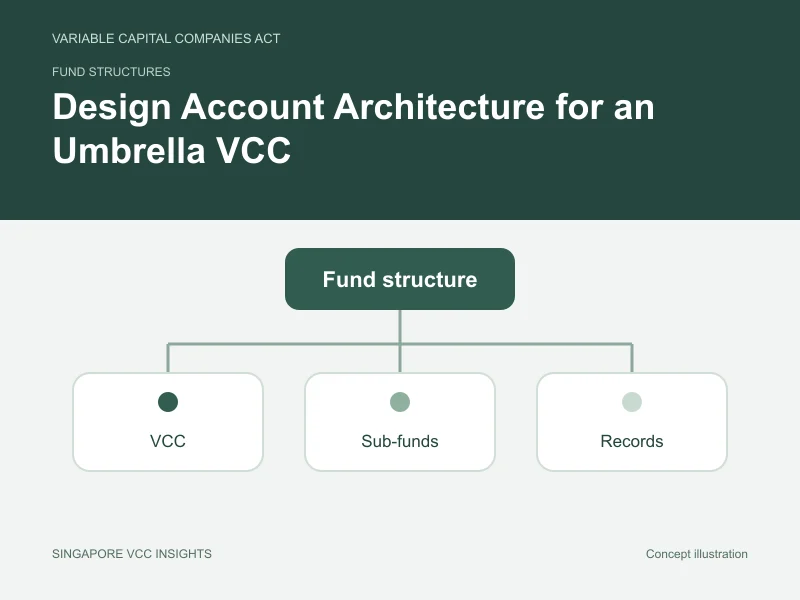
Design the account architecture from the sub-fund outward. Give every bank, custody and accounting record an unambiguous link to the umbrella VCC and the sub-fund it serves; define permitted cash flows, initiators, approvers and reconciliation owners before money moves. Shared operating accounts should be exceptional, documented and supported by a prompt allocation process. The goal is an evidence chain from legal document to account name, transaction instruction, ledger entry and reviewed reconciliation.
At a glance
- Use a master account inventory that maps every account to one legal and economic purpose.
- Make sub-fund identity visible in account records, instructions and supporting documents.
- Separate payment authority from reconciliation and exception approval.
- Treat shared cash as a controlled exception with documented allocation and settlement.
Who this is for
- Umbrella VCCs designing or repairing bank, custody, treasury and accounting records across multiple sub-funds.
Important exclusions
- Bank-specific onboarding advice, custody recommendations or a conclusion that one account design suits every strategy.
Map the legal and economic perimeter
An umbrella VCC is the corporate vehicle, while its sub-funds are compartments whose assets and liabilities are kept apart. The operating map should therefore identify the umbrella, each registered sub-fund, each strategy, each investor pool and every provider record that carries balances or transaction authority. Do not begin with the bank’s product menu; begin with the structure, documents and expected cash flows.
Sources: Singapore Statutes Online · ACRA · IRAS| Layer | Primary purpose | Control question |
|---|---|---|
| Umbrella corporate layer | Corporate expenses and obligations that genuinely belong to the umbrella | Which document authorises the expense and how will any recovery be allocated? |
| Sub-fund operating cash | Subscriptions, redemptions, investments and operating payments for one sub-fund | Can the account and payment record identify the correct sub-fund without inference? |
| Sub-fund custody | Safekeeping and settlement records for one portfolio | Do custody statements and the administrator ledger use the same sub-fund identifier? |
| Temporary collection or transit | Short-lived receipt or payment processing | Who clears suspense items and how quickly are they attributed? |
Related guidance: VCC sub-funds guide · standalone versus umbrella VCC decision guide
Create one authoritative account inventory
The inventory should cover bank accounts, custody accounts, broker accounts, payment platforms, administrator ledgers and any suspense or transit accounts. Record the institution, account name, masked identifier, currency, purpose, linked sub-fund, opening approval, authorised users, signing rule, reconciliation frequency, statement recipient and closure status. The inventory becomes the common reference for board approvals, provider onboarding, access reviews and audit support.
Sources: ACRA · Singapore Statutes Online- Use the registered umbrella and sub-fund names consistently across provider records.
- Assign a stable internal code to each sub-fund and prohibit reuse after closure.
- Identify the exact ledger and bank or custody statement that should reconcile.
- Record who can view, initiate, approve, release and amend standing instructions.
- Document the approval and evidence needed before an account becomes active.
Design authority around transaction risk
Avoid copying the same access group across every account merely because the umbrella shares a board or service provider. Authority should reflect the account’s purpose, strategy, currency, payment type and operating hours. Separate preparation from release where feasible, restrict changes to beneficiaries and standing data, and require independent review of urgent or unusual payments. A person who reconciles the account should not quietly clear their own unresolved payment exception.
Sources: ACRA · Singapore Statutes Online| Activity | Minimum evidence | Independent control |
|---|---|---|
| Open or close account | Approved account purpose and provider documentation | Confirm the account inventory and downstream systems were updated |
| Add user or entitlement | Named role, scope and approval | Recertify access against current responsibilities |
| Create beneficiary or standing instruction | Verified counterparty and documented purpose | Second-person verification through an independent channel |
| Release payment | Complete instruction and supporting document | Approval under the account’s authority rule |
| Clear reconciliation exception | Matched evidence and explanation | Reviewer who did not originate the unresolved item |
Related guidance: change VCC bank mandates without access gaps
Reconcile the architecture, not only the balance
A zero difference at account level can still hide wrong sub-fund attribution. Reconciliation should compare account ownership, sub-fund code, currency, valuation date, transaction reference and ledger destination. Review aged suspense items, cross-account transfers, fees deducted by providers, rejected transactions and stale accounts. When a bank or provider changes an account label or identifier, update the inventory and every dependent instruction before relying on the new record.
Sources: Singapore Statutes Online · ACRA- Match statement balance to the designated sub-fund ledger.
- Confirm every transfer has a same-purpose origin and destination.
- Investigate entries posted to umbrella or suspense codes without a final owner.
- Review provider fees and tax entries for correct sub-fund attribution.
- Close inactive accounts and revoke access across all connected systems.
Run a pre-live account rehearsal
- Document testCompare registered names, account titles, custody records, offering documents and administrator codes for consistent sub-fund identity.
- Access testHave each role demonstrate only the viewing, initiation, approval and release rights intended for that account.
- Transaction testWalk a subscription, investment settlement, expense, redemption and rejected payment through the complete evidence chain.
- Reconciliation testProduce statements and ledger extracts, create a deliberate exception and show that it reaches the named reviewer.
- Closure testConfirm that account deactivation would also revoke users, remove templates, preserve statements and update the inventory.
Related guidance: build a counterparty pack for each sub-fund
Frequently asked questions
Does every sub-fund need the same account pattern?
No. The control principles should be consistent, but the practical pattern can differ with strategy, currencies, brokers, custody model and transaction volume. Document why each variation exists and keep the mapping between account, ledger and sub-fund unambiguous.
Can an umbrella VCC use a shared expense account?
A shared account may be workable for genuine umbrella expenses or controlled processing, but it creates an allocation dependency. Define what may pass through it, who approves the allocation, how balances are settled and how aged or disputed items are escalated.
Who should own the account inventory?
Give one function responsibility for the authoritative inventory, while account opening, user approval, transaction release and reconciliation remain with their respective owners. The inventory owner should receive confirmed changes rather than discovering them from a statement or audit request.
What is the biggest naming risk?
The most common operational danger is an account or template that identifies only the umbrella, forcing staff to infer the sub-fund from context. Use provider-supported names, stable sub-fund codes and linked records so the economic owner remains clear throughout processing.
How should a dormant account be handled?
Do not leave it outside the control environment. Decide whether it remains necessary, restrict access, reconcile any balance, preserve statements and close it when its purpose has ended. Update templates and connected systems so payments cannot continue to route there.
Official sources and further reading
- Variable Capital Companies Act 2018 (Singapore Statutes Online)
- Understanding VCC features, eligibility and requirements (ACRA)
- Overview of managing a variable capital company (ACRA)
- Registering a variable capital company (ACRA)
- Legal obligations of a VCC director (ACRA)
- Tax Framework for Variable Capital Companies (IRAS)
Discuss a Singapore VCC structure
For help coordinating a Singapore VCC setup or corporate administration, contact Raffles Corporate Services.
General information only. This article is not legal, tax, regulatory or investment advice and does not imply affiliation with or endorsement by ACRA, MAS or IRAS.