Independent Singapore VCC guidance
Direct answer
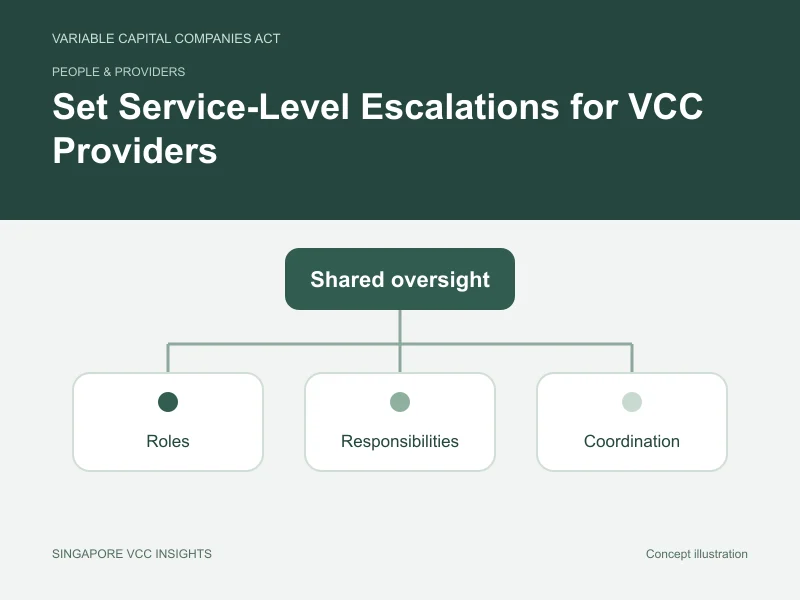
Create one escalation matrix across the fund manager, administrator, company secretary, auditor, bank, custodian, tax adviser and other critical providers. For each deliverable, define the evidence of completion, dependency, internal owner, warning trigger, breach trigger, response route, decision authority and board-notification rule. Measure outcomes rather than email speed. Link repeat failures to remediation, fee review, renewal or exit planning, while keeping the VCC board's retained responsibilities visible throughout the process.
At a glance
- Translate contract wording into measurable operating events and evidence.
- Track hand-offs between providers, not only each provider in isolation.
- Separate warning, breach, incident and board-escalation thresholds.
- Use repeat failures to drive remediation and exit readiness.
Who this is for
- VCC directors, operating officers and fund sponsors overseeing several external providers.
Important exclusions
- A replacement for legal review of contracts, regulatory notifications or incident-specific advice.
Inventory deliverables and dependencies
Start with the VCC's legal and operating calendar, then map who prepares, reviews, approves, files, instructs or retains each output. Include NAV packs, investor dealing, financial statements, tax data, corporate filings, bank instructions, custody records, compliance reports and board materials as relevant. A provider may meet its own deadline while a downstream filing still fails because a hand-off was late or incomplete. The service map therefore needs both the deliverable owner and the receiving party.
Sources: Accounting and Corporate Regulatory Authority · Accounting and Corporate Regulatory Authority · Monetary Authority of Singapore| Deliverable | Producer | Receiver | Evidence of complete hand-off |
|---|---|---|---|
| Valuation or NAV pack | Administrator under the agreed operating model | Fund manager, board or investor-reporting owner | Approved pack, exception log and delivery record |
| Corporate filing input | Relevant officer, administrator or adviser | Company secretary or authorised filer | Complete data set, approval and filing acknowledgement |
| Cash instruction support | Investment, finance or administration owner | Authorised bank or custody signatories | Instruction pack, approvals and execution confirmation |
| Financial and tax records | Administrator, auditor and tax workstreams | VCC finance owner and board | Reconciled schedules, issues list and retained final documents |
Related guidance: VCC provider directory · VCC director and provider responsibility guide
Define measures that prove completion
A useful service level specifies what complete means. A report is not complete if required source data is missing, exceptions are hidden, approval status is unclear or the receiving party cannot use it. Define timeliness from an agreed input cut-off, data quality through reconciliation and exception criteria, and responsiveness through a decision-ready answer rather than an acknowledgement. When a provider depends on another party, the measure should record the dependency and whether it was escalated promptly.
Sources: Monetary Authority of Singapore · Inland Revenue Authority of SingaporeService-level specification
- Deliverable name, scope, format, source data, frequency and receiving party.
- Input cut-off, due point, quality checks and explicit completion evidence.
- Known dependencies, assumptions and route for incomplete or disputed inputs.
- Warning trigger, breach trigger and severity factors for investor, financial or regulatory impact.
- Named operational owner, executive decision owner and board-notification rule.
- Remediation evidence, closure approval and repeat-failure treatment.
Create a tiered escalation path
Use tiers that reflect consequence and urgency, not the seniority of the person who complained. A warning can address a recoverable delay before impact. A breach records failure against the agreed deliverable. An incident covers actual or credible investor, financial, legal, data or regulatory impact. A critical event requires immediate decision authority, containment and board visibility under the approved framework. The matrix should also state when legal, compliance, insurer, regulator or affected counterparty input may be needed.
Sources: Monetary Authority of Singapore · Accounting and Corporate Regulatory Authority| Tier | Trigger | Immediate action | Closure evidence |
|---|---|---|---|
| Warning | Delivery at risk but impact remains avoidable | Confirm owner, missing input and recovery plan | Completed deliverable and cause note |
| Breach | Agreed outcome, quality or due point missed | Log breach, assess impact and approve remediation | Corrected output, root cause and control action |
| Incident | Actual or credible investor, financial, legal, data or regulatory impact | Contain, preserve evidence and convene decision owners | Impact assessment, actions, notifications and approval |
| Critical event | Operations cannot continue safely or a material obligation is threatened | Activate continuity or exit plan and notify the board promptly | Board-approved resolution and verified operating recovery |
Run incidents through one control record
Open one record for the event and link every provider thread to it. Capture discovery time, affected VCC or sub-fund, facts known, decisions pending, evidence preserved, investor or filing impact, containment, owner and next review point. Avoid parallel email chains with different versions of the truth. The incident owner should distinguish confirmed facts from assumptions and recommendations, and the decision maker should record why the chosen action was proportionate.
Sources: Monetary Authority of Singapore · Inland Revenue Authority of SingaporeIncident workflow
- TriageConfirm the affected entity, deliverable, due point, known facts, immediate risk and accountable incident owner.
- ContainStop unreliable data or instructions from moving downstream and preserve relevant files, approvals and communications.
- DecidePresent options, consequences, required authority and any specialist advice to the designated decision maker.
- CommunicateUse the approved route for board, investor, counterparty or authority communications where the facts require it.
- CloseVerify the corrected outcome, root cause, control change, owner and evidence before closing the incident.
Use performance history at renewal
A renewal decision should use the full service history, not only a recent presentation. Summarise deliverables, warnings, breaches, incidents, root causes, remediation age, recurring dependencies, data portability and cooperation during problems. Distinguish provider-caused failures from missing sponsor inputs, but do not let ambiguous ownership persist. If the VCC cannot retrieve usable records, operate during staff absence or transfer data to a replacement, the relationship has an exit-readiness weakness even when routine service appears acceptable.
Sources: Monetary Authority of Singapore · Accounting and Corporate Regulatory Authority · Inland Revenue Authority of SingaporeRenew, remediate or exit
- RenewUse when service outcomes are reliable, controls are evidenced and the provider remains suitable for the operating model.
- RemediateSet owners, evidence and review points when failures are material but the recovery plan is credible and controlled.
- RescopeMove or clarify tasks when persistent gaps come from ambiguous boundaries or an unsuitable division of responsibilities.
- ExitActivate transition planning when failures, control weakness or poor cooperation create unacceptable ongoing risk.
Related guidance: evidence-based VCC provider review · switch VCC administrators without data gaps
Frequently asked questions
Which VCC providers belong in the escalation matrix?
Include every provider whose delay, error or unavailability can affect investors, assets, records, filings or board decisions. This commonly includes the fund manager, administrator, company secretary, auditor, bank, custodian and tax or compliance workstreams.
Is response time a sufficient service level?
No. A quick acknowledgement may not solve the issue. Measure usable outcomes: complete data, reconciled figures, clear exceptions, required approvals and evidence that the receiving party can act before the relevant due point.
When should a provider issue reach the board?
Use an approved rule based on consequence, urgency, legal responsibility and decision authority. Material investor, financial, legal, data or regulatory impact, and threats to safe continuity, should not remain only in an operational email chain.
How should cross-provider disputes be handled?
Assign one incident owner, preserve a common fact record and identify the failed hand-off. The VCC should decide the required outcome and authority path instead of allowing providers to exchange incompatible explanations without closure.
What evidence supports a provider exit decision?
Use the service history, unresolved remediation, repeat root causes, control impact, data portability, transition cooperation and the suitability of the provider for the future operating model. Keep the board decision and transition controls together.
Official sources and further reading
- Overview of Managing a Variable Capital Company (Accounting and Corporate Regulatory Authority)
- Choosing Directors and Key Officers for a VCC (Accounting and Corporate Regulatory Authority)
- Legal Obligations of a VCC Director (Accounting and Corporate Regulatory Authority)
- Governance and Management of Variable Capital Companies (Monetary Authority of Singapore)
- Record Keeping Requirements (Inland Revenue Authority of Singapore)
Discuss a Singapore VCC structure
For help coordinating a Singapore VCC setup or corporate administration, contact Raffles Corporate Services.
General information only. This article is not legal, tax, regulatory or investment advice and does not imply affiliation with or endorsement by ACRA, MAS or IRAS.