Independent Singapore VCC guidance
Direct answer
Use a family branch as the organising principle only when that branch has a genuinely distinct investor group, mandate, risk budget and decision path. Use an investment strategy when several family members share the same economic exposure but need assets, liabilities, valuation and reporting kept apart from other strategies. If neither difference is durable, keep the arrangement at share-class, mandate or reporting level instead of creating another sub-fund. Test the design against governance, liquidity, contracts, tax analysis and provider capability before approval.
At a glance
- Organise around a durable operating difference, not a family label alone.
- Separate legal ownership, economic participation and decision authority in the design map.
- Model shared services and evidence before assuming an umbrella is simpler.
- Set redesign triggers so temporary differences do not become permanent clutter.
Who this is for
- Families and advisers choosing how an umbrella VCC should organise investment pools and investor groups.
Important exclusions
- Estate, matrimonial, trust, tax or investor-rights advice for a particular family, or a promise that a branch-based design achieves succession outcomes.
Start with the operating difference
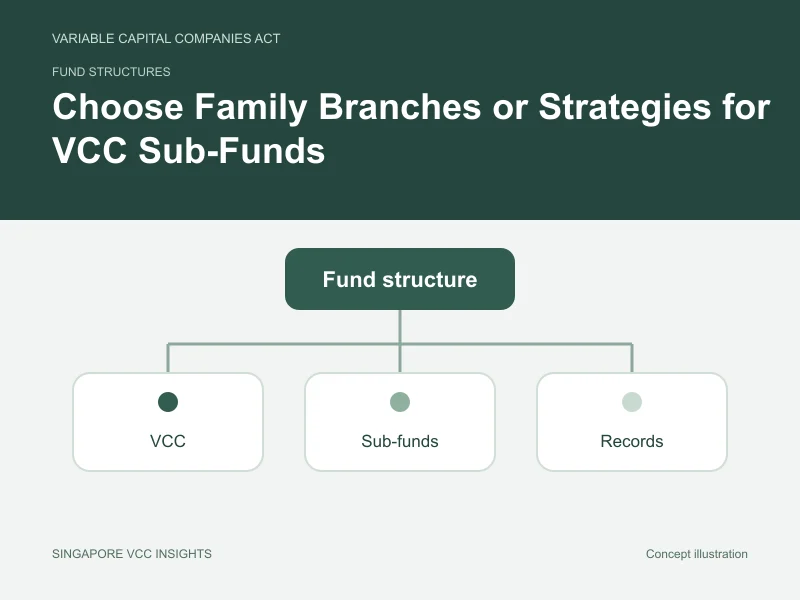
An umbrella VCC can contain multiple sub-funds, and the framework keeps each sub-fund’s assets and liabilities separate from the others. That capability is useful only when the proposed boundary corresponds to a real operating need. Start with the reason for separation: different investors, mandates, liquidity, liabilities, service arrangements or wind-down paths. “One branch, one sub-fund” is a naming convention, not a complete design case.
Sources: Accounting and Corporate Regulatory Authority · Accounting and Corporate Regulatory Authority| Principle | Use when | Main test |
|---|---|---|
| Family branch | A stable investor group has its own mandate, governance path and economic participation. | Will the branch remain coherent after births, deaths, transfers and disagreements? |
| Investment strategy | Investors share exposure but assets, risks, valuation and liquidity differ from other strategies. | Can providers and records attribute every transaction and obligation to the right strategy? |
| Liquidity profile | Open-ended and closed-ended assets need different dealing and cash controls. | Are redemption, valuation and funding terms internally consistent? |
| Temporary project | A transaction or co-investment needs focused tracking for a limited period. | Does the benefit justify a new compartment and a later closure process? |
Related guidance: umbrella VCC and sub-fund guide
Separate ownership from allocation
Draw the structure in layers. The shareholders own shares in the VCC; the umbrella holds the legal relationships through which sub-fund assets and liabilities are attributed; directors govern the VCC; the appointed manager performs the agreed fund-management role; and family bodies may express ownership preferences only through documented rights. Putting a family name on a sub-fund does not by itself transfer corporate authority or create a separate company.
Sources: Accounting and Corporate Regulatory Authority · Monetary Authority of Singapore- Different investors and different mandateA separate sub-fund may provide a clear operating perimeter if documents, manager authority and provider records can support it.
- Same investors but different strategy riskA strategy sub-fund may fit when assets, liabilities, liquidity and valuation need independent treatment.
- Same strategy but different economicsTest whether share classes or documented allocation rules solve the difference with less operating complexity.
- Difference is only personal preferenceKeep the preference in family governance or reporting unless it creates a durable fund-level right or obligation.
Create a rights matrix next to the structure chart. For every proposed group, record who subscribes, who may redeem or transfer, who receives information, what decisions are reserved, how conflicts are handled and what happens when a person changes family role. This exposes designs that look neat on a diagram but cannot be administered without repeated exceptions.
Sources: Monetary Authority of Singapore · Accounting and Corporate Regulatory AuthorityRelated guidance: VCC guide for family offices · VCC share classes or sub-funds decision · family VCC ownership and authority map
Score the operational burden
Every added sub-fund creates another attribution problem across contracts, bank or custody records, ledger dimensions, valuation, expenses, investor reporting, audit evidence and eventual closure. Some infrastructure can be shared at umbrella level, but shared infrastructure increases the need for explicit allocation rules and reconciliations. Ask providers to demonstrate the output, not merely confirm that their system “supports umbrella funds”.
Sources: Accounting and Corporate Regulatory Authority · Monetary Authority of Singapore · Inland Revenue Authority of Singapore| Dimension | Question | Red flag |
|---|---|---|
| Assets and liabilities | Can every balance and obligation be attributed without a manual guess? | Contracts or accounts omit the sub-fund identity. |
| Investors and terms | Do rights and dealing rules match the intended participant group? | Family labels substitute for documented rights. |
| Valuation and liquidity | Can each pool be valued and funded on its own terms? | One liquid pool is expected to support another. |
| Shared expenses | Is the allocation basis documented, consistent and reviewable? | Costs follow whichever pool has cash. |
| Exit path | Can the pool be closed without destabilising the rest of the umbrella? | No owner has mapped contracts, investors and residual balances. |
Price the architecture using work drivers rather than a single headline quote. Relevant drivers include transaction volume, asset complexity, valuation frequency, investor count, bespoke reporting, bank and custody accounts, audit schedules, tax analyses and shared-cost reconciliations. The best design is the lowest-complexity arrangement that still preserves the genuine boundaries the family needs.
Sources: Monetary Authority of Singapore · Inland Revenue Authority of SingaporeRelated guidance: shared sub-fund cost allocation controls
Work through a family scenario
Consider a hypothetical family with two adult branches and three strategies: liquid public markets, private companies and long-duration credit. Both branches want exposure to public markets, one branch funds most private-company investments, and liquidity expectations differ. A branch-only design would duplicate the liquid strategy and complicate manager execution. A strategy-only design would simplify investments but would need clear participation, information and redemption rights for each branch.
Sources: Accounting and Corporate Regulatory Authority · Monetary Authority of Singapore| Design | Advantage | Control needed |
|---|---|---|
| Two branch sub-funds | Family participation is easy to see at a high level. | Duplicate strategy execution, valuation and cost allocation must be justified. |
| Three strategy sub-funds | Assets and liquidity are grouped by how they are actually managed. | Branch participation and information rights need precise share and reporting records. |
| Hybrid with one co-investment pool | A distinct private transaction can have its own economics without duplicating every strategy. | The temporary pool needs entry, funding, conflict and closure rules from the start. |
The scenario points to a strategy-led architecture with documented branch participation and a tightly scoped co-investment pool. That is not a universal answer. It is the result of matching the fund boundary to the durable investment and liquidity differences, while handling family identity through ownership, information and governance records instead of names alone.
Sources: Monetary Authority of SingaporeApprove and revisit the architecture
- Write a one-sentence purpose for every proposed sub-fund and reject any purpose based only on a person’s name or generation.
- Attach an investor-rights map, mandate, liquidity profile, asset and liability perimeter, provider workflow and shared-cost rule to each proposal.
- Obtain legal and tax analysis for the actual ownership, transfer, income, transaction and cross-border facts before implementation.
- Record who can approve changes, subscriptions, redemptions, transfers, related-party activity, cross-investment and closure.
- Set review triggers for family changes, strategy changes, persistent low activity, repeated exceptions, provider limits and planned succession events.
Review the architecture when facts change, not merely once a year. A branch split, new generation, transfer, new investor, strategy merger, illiquid asset, financing arrangement or repeated shared-cost exception may change the best answer. The review should compare the current structure with simpler alternatives and preserve a record of why each compartment still earns its place.
Sources: Monetary Authority of Singapore · Inland Revenue Authority of SingaporeFrequently asked questions
Should every family branch receive its own VCC sub-fund?
No. A branch-based sub-fund is useful only when a stable investor group has distinct economics, mandate, governance and operating records. If the difference is mainly reporting preference or family identity, share classes, governance documents or tailored reports may solve it with less complexity.
Is a sub-fund a separate company?
No. A sub-fund sits within the umbrella VCC framework and is not a separate body corporate. The assets and liabilities are attributed separately, but the team still needs clear contracts, records, approvals and provider workflows to preserve that boundary in practice.
When is a strategy-based design usually clearer?
It is often clearer when asset classes have different liquidity, valuation, financing, custody, risk or closure characteristics while investors participate across several strategies. The design still needs accurate participation records and must not use one strategy’s cash or records to mask another’s obligations.
Can a temporary co-investment justify a new sub-fund?
Sometimes, if the transaction has distinct investors, economics, risks and evidence needs that cannot be handled cleanly within an existing mandate. The proposal should include funding, conflicts, valuation, reporting, residual balance and closure rules before the pool is launched.
What should trigger a family VCC architecture review?
Review after changes in family participation, investor rights, strategy, liquidity, financing, providers, tax position, ownership or planned succession. Repeated manual allocations, dormant compartments and unclear contracts are also signals that the current architecture may no longer be the simplest reliable answer.
Official sources and further reading
- Understanding VCC features, eligibility and requirements (Accounting and Corporate Regulatory Authority)
- Post-registration guide for variable capital companies (Accounting and Corporate Regulatory Authority)
- Governance and Management of Variable Capital Companies (Monetary Authority of Singapore)
- Tax Framework for Variable Capital Companies (Inland Revenue Authority of Singapore)
Discuss a Singapore VCC structure
For help coordinating a Singapore VCC setup or corporate administration, contact Raffles Corporate Services.
General information only. This article is not legal, tax, regulatory or investment advice and does not imply affiliation with or endorsement by ACRA, MAS or IRAS.