Singapore VCC insights
VCC Act 2018 — Section 24 variable capital and share redemption — Eligibility and requirements checklist
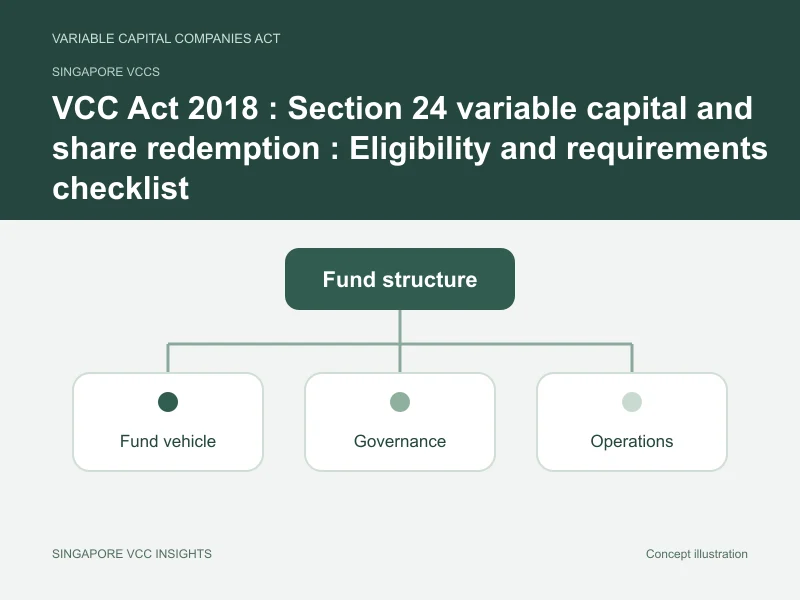
The VCC Act 2018 lets a Variable Capital Company vary its capital freely and redeem shares out of capital, which is what makes it an open-ended fund vehicle. This guide explains how Section 24 variable capital and share redemption works, the eligibility and requirements, the documents involved and the practical mechanics for fund managers in 2026.
This article is general information and not legal advice. Raffles Corporate Services works with a panel of corporate and employment law firms.
What the VCC Act 2018 says on Section 24 variable capital and share redemption
Section 24 of the Variable Capital Companies Act 2018 (the VCC Act 2018) provides that the shares of a VCC have no par value and that its capital is always equal to its net asset value. This is the defining feature of the VCC: unlike an ordinary company, a VCC can issue and redeem shares, and pay dividends, out of capital, so investors can subscribe and redeem at NAV without the capital-maintenance restrictions that bind a normal Singapore company.
This variable-capital mechanism is what allows the VCC to function as an open-ended fund, matching subscriptions and redemptions to NAV on each dealing day.
Eligibility and the capital framework
Because a VCC’s paid-up capital always equals its net assets, there is no concept of authorised or reduced capital as in an ordinary company, and no separate solvency-based capital reduction procedure is needed simply to return capital to redeeming investors. The VCC’s constitution and offering documents set the dealing frequency, notice periods and any gates or deferrals on redemptions.
Distributions are governed by the VCC Act 2018: a VCC may pay dividends out of capital, but Section 33 of the Variable Capital Companies Act 2018 requires that any such payment does not cause the VCC to be unable to pay its debts, so a solvency check underpins distributions and redemptions.
Documents and mechanics of redemption
The practical documents are: the constitution setting the redemption mechanics; the offering memorandum and subscription agreement; the redemption request form; and the administrator’s NAV calculation and dealing records. The fund administrator processes redemptions at the NAV per share for the relevant dealing day, applying any notice period, lock-up or redemption gate specified in the fund documents.
Records must evidence the solvency position at the point of each distribution. Our companion note on VCC Act 2018 Sections 32 to 33 distribution out of capital explains the distribution mechanics in detail.
Timeline and processing benchmarks
Redemption timelines are set by the fund, not by statute. Typical open-ended VCCs offer monthly or quarterly dealing with 30 to 90 days’ notice, and settle redemption proceeds within a stated number of business days after the dealing date. The absence of a statutory capital-reduction procedure means redemptions can be processed operationally, which is a significant efficiency advantage over ordinary companies.
Where the VCC also claims a tax incentive, the interaction with distributions should be checked with advisers, and fund incentives are administered with the Monetary Authority of Singapore and lodged with ACRA.
Common mistakes and gotchas
The frequent errors are treating VCC redemptions like an ordinary company’s capital reduction, overlooking the solvency requirement behind distributions, and drafting redemption gates or notice periods that conflict between the constitution and the offering memorandum. Managers should ensure the administrator’s dealing procedures match the constitutional terms exactly.
For the wider structuring and tax context, see our notes on the Section 13D offshore fund scheme and on Singapore Pte Ltd registration for foreigners where a corporate holding layer is used.
Step-by-step process
- Set the dealing frequency, notice periods and any gates in the VCC constitution and offering memorandum, keeping them consistent.
- Appoint a fund administrator to calculate NAV per share for each dealing day.
- Receive redemption requests on the prescribed form and apply the notice period and any lock-up.
- Confirm the solvency position before any distribution or redemption out of capital.
- Process the redemption at NAV for the relevant dealing day without a separate capital-reduction procedure.
- Settle redemption proceeds within the stated number of business days.
- Keep dealing records and solvency evidence for each distribution.
FAQs
Can a VCC redeem shares out of capital?
Yes. Under the VCC Act 2018 a VCC’s capital always equals its net asset value and it may redeem shares and pay dividends out of capital, subject to a solvency requirement, which is what makes it an open-ended fund vehicle.
Is a statutory capital reduction needed to process redemptions?
No. Because a VCC has variable capital with no par value, redemptions are processed at NAV operationally, without the separate solvency-based capital reduction procedure required of an ordinary company.
What protects creditors if a VCC pays out of capital?
Distributions and redemptions are subject to a solvency requirement under the VCC Act 2018, so a VCC may not make a payment out of capital that would leave it unable to pay its debts as they fall due.
Need help with this? Call, SMS or WhatsApp +65 8501 7133, or email hello@rafflescorporateservices.com. Raffles Corporate Services works with a panel of corporate and employment law firms; this article is general information, not legal advice.