Singapore VCC insights
VCC Act 2018 — Section 29 sub-fund segregation — Eligibility and requirements checklist
Raffles Corporate Services works with a panel of corporate and employment law firms; this article is general information, not legal advice.
VCC Act 2018 sub-fund segregation is the statutory ring-fencing that keeps the assets and liabilities of each sub-fund of a Variable Capital Company separate from the others. Directors and counsel readying an umbrella VCC should hold sub-fund constitutive documents, clear asset-attribution records and counterparty notices before trading any sub-fund.
What VCC Act 2018 sub-fund segregation means
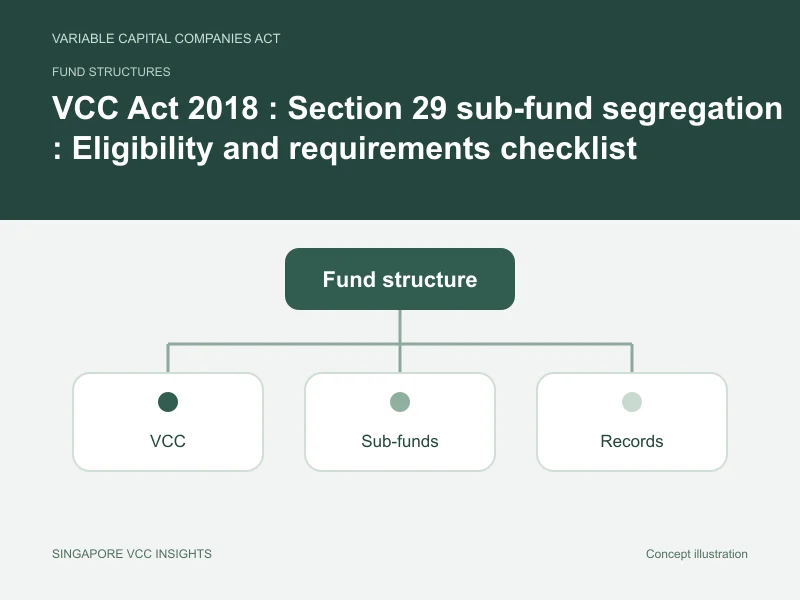
A Variable Capital Company can be a standalone fund or an umbrella with multiple sub-funds. Under the VCC Act 2018, each sub-fund’s assets and liabilities are segregated so that the assets of one sub-fund are not available to meet the liabilities of another. Section 29 of the Variable Capital Companies Act 2018 establishes this segregation of the assets and liabilities of an umbrella VCC’s sub-funds, while the VCC itself has a single legal personality recognised under Section 17 of the Variable Capital Companies Act 2018. In effect, the sub-fund is not a separate legal person, but its estate is protected by statute. See the Variable Capital Companies Act 2018 on the official legislation portal.
Who this is for
Segregation matters most to umbrella VCC promoters running several strategies under one entity, to directors signing sub-fund contracts, and to counsel advising on cross-sub-fund exposure. Fund managers migrating offshore umbrella structures into Singapore rely on this ring-fencing to reassure investors. Where the tax treatment of each strategy differs, our group guide to Section 13D offshore fund scheme , Documents required and templates on the Section 13D offshore fund scheme is a useful companion.
Documents and records you should hold
Each sub-fund needs its own sub-fund constitutive terms within the VCC constitution, a distinct register of members, separate books and records, and clear asset-attribution so that every asset and liability is booked to the correct sub-fund. Counterparties should be put on notice that they are contracting with a specific sub-fund. Auditors will test whether segregation is operationally real, not merely stated. Distributions from a sub-fund should follow clean board resolutions, consistent with the standard our group note on Declaring Dividends in Singapore: What Directors Need to Know (2026) describes.
Cost and timeline benchmarks
Adding a sub-fund to an existing umbrella VCC typically costs S$3,000 to S$8,000 in legal and administrative fees, with ACRA sub-fund registration processed through its VCC portal. Standing up a new umbrella VCC with an initial sub-fund generally runs S$8,000 to S$15,000 before manager and audit fees. Sub-fund registration is usually processed within one to two weeks once documents are in order, though fund licensing and bank onboarding add time.
Step-by-step: launching a segregated sub-fund
Confirm the umbrella VCC constitution permits sub-funds and that a permissible fund manager is appointed. Draft the sub-fund’s constitutive terms and investment policy. Register the sub-fund with ACRA. Open sub-fund-specific bank and custody accounts to keep assets attributable. Put counterparties on notice of the contracting sub-fund. Maintain separate books from day one. Our own Test VCC Sub-Fund Contract Labels Before Signing sub-fund contract checklist helps directors test labels before signing.
Common mistakes
The gravest error is operational commingling, where segregation is stated in the constitution but bank accounts and records mix sub-fund assets, undermining the statutory protection. Others include failing to notify counterparties which sub-fund they face, and assuming a sub-fund can sue or be sued as a separate legal person, which it cannot.
Making segregation operationally real
Statutory ring-fencing only protects investors if the operations match the constitution. That means separate bank and custody accounts per sub-fund, books that attribute every asset and liability to a named sub-fund, and NAV struck for each sub-fund independently. Auditors and prime brokers will test this, and counterparties should be told which sub-fund they face so that, in a dispute, the estate of the correct sub-fund is engaged. A shared expense, such as an umbrella-level audit fee, should be allocated across sub-funds on a documented and consistent basis.
Cross sub-fund investments, where one sub-fund invests in another, are sometimes permitted but should be governed by clear policy, since they can blur the very segregation the structure is designed to preserve.
Why promoters choose the umbrella model
The umbrella VCC lets a manager run several strategies or share classes under one legal entity, sharing a board, a fund manager and service providers while keeping each strategy’s economics ring-fenced. This reduces set-up and running cost per strategy compared with separate standalone funds, and it speeds the launch of a new strategy to the time needed to register a further sub-fund. The trade-off is the operational discipline segregation demands, which is why administration and audit quality matter more in an umbrella than in a single fund.
Fees, timelines and thresholds at a glance
- Add a sub-fund to an umbrella VCC: S$3,000 to S$8,000
- New umbrella VCC with first sub-fund: S$8,000 to S$15,000
- Sub-fund registration: typically 1 to 2 weeks once documents are ready
- Legal basis: Section 29 segregation; Section 17 legal personality
FAQs
Is a sub-fund a separate legal entity?
No. The VCC has a single legal personality under Section 17 of the Variable Capital Companies Act 2018. The sub-fund's assets and liabilities are segregated by Section 29, but the sub-fund is not itself a legal person.
Can one sub-fund's creditors reach another sub-fund's assets?
No, provided segregation is properly maintained. Section 29 ring-fences each sub-fund's assets from the liabilities of the others.
What breaks segregation in practice?
Operational commingling, such as shared bank accounts or books that do not attribute assets to a specific sub-fund, which can undermine the statutory protection.
How long does adding a sub-fund take?
Usually one to two weeks for ACRA registration once documents are ready, with bank onboarding adding time.
Related guides across the Raffles group
- Section 13D offshore fund scheme , Documents required and templates
- Declaring Dividends in Singapore: What Directors Need to Know (2026)
- Test VCC Sub-Fund Contract Labels Before Signing
Authoritative sources: the Variable Capital Companies Act 2018; the Accounting and Corporate Regulatory Authority; the MAS explainer on the VCC.
Need help with this? Call, SMS or WhatsApp +65 8501 7133, or email hello@rafflescorporateservices.com. Raffles Corporate Services works with a panel of corporate and employment law firms; this article is general information, not legal advice.