Independent Singapore VCC guidance
Direct answer
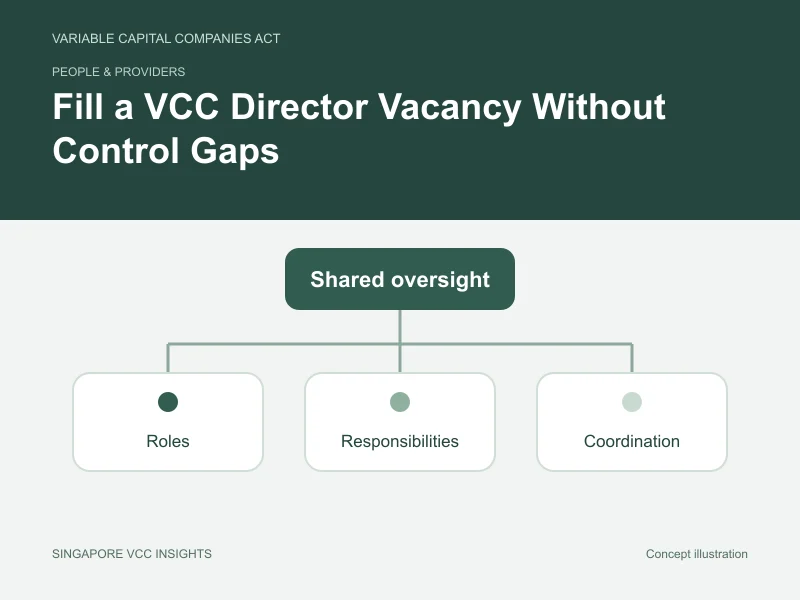
Treat a director departure as a capacity and authority event, not just an officer filing. Identify whether the departing person supplies local residency, the required link to the fund manager, committee membership, bank authority, provider approvals or unique knowledge. Confirm what the remaining board may decide, contain access and instruction risks, verify the successor against current official criteria, and reconcile resolutions, registers, provider mandates and handover evidence before closing the vacancy record.
At a glance
- Identify every capacity and authority attached to the departing person.
- Keep interim decisions inside the powers of the remaining board.
- Verify the exact successor before appointment and access activation.
- Reconcile corporate records, provider mandates and operational systems.
- Close only when the handover is evidenced and tested.
Who this is for
- Chairs, directors and company secretaries managing an expected or sudden vacancy on a Singapore VCC board.
Important exclusions
- A legal opinion on disputed resignation, disqualification, removal, insolvency or the validity of a particular board decision.
Identify the capacity that is disappearing
Begin with the exact legal entity and role. A director may also be the person who satisfies the local-residency element, connects the board to the appointed fund manager, chairs a committee, holds a bank mandate or approves administrator outputs. ACRA sets out the current composition and eligibility criteria, while its director guidance places responsibility for the VCC's affairs on the board. Record each capacity separately because one replacement may not be able to assume them all.
Sources: Accounting and Corporate Regulatory Authority · Accounting and Corporate Regulatory Authority| Capacity lost | Question for the remaining board | Evidence |
|---|---|---|
| Board composition | Which current criterion did this person satisfy and who satisfies it after departure? | Board register, official criteria and verified successor record |
| Decision authority | Which reserved matters, committees and signing limits named this person? | Constitution, resolutions, committee terms and delegation schedule |
| Operational access | Which banks, portals, provider platforms and distribution lists remain open? | Access export, mandate list and disablement confirmations |
| Knowledge and relationships | Which open matters or external contacts rely on the departing director? | Handover index, issue log and named new owner |
Related guidance: VCC directors and key-officer guide
Stabilise decisions and access
Create a dated interim authority note before the next material decision or instruction. It should list the remaining directors, quorum assumptions, reserved matters, committee gaps, payment and dealing authorities, provider contacts and matters held pending advice. The aim is not to invent substitute powers. It is to stop an ordinary workflow from silently relying on an officer who no longer acts and to make every temporary control visible to the board.
Sources: Accounting and Corporate Regulatory Authority · Monetary Authority of Singapore- Confirm the effective departure facts and preserve the original notice, correspondence and board acknowledgement.
- Freeze or reassign credentials, tokens, signature images, distribution lists and physical records through named system owners.
- Identify board and committee meetings that need revised attendance, quorum analysis, papers or decision sequencing.
- Tell banks, custodians, administrators, the secretary and other affected providers which instructions remain valid and who may issue them.
- Keep unresolved legal or governance questions in an exception log with an owner, advice route and next decision point.
Apply the interim controls by function and sub-fund. A bank signer, investment committee member and board director may appear in the same person but operate under different documents. Revoking one system credential does not amend a corporate delegation, and appointing a successor does not automatically update a bank or provider platform. Maintain a reconciliation until the legal, documentary and technical layers agree.
Sources: Monetary Authority of Singapore · Accounting and Corporate Regulatory AuthorityRelated guidance: manager-authorisation loss response
Verify and appoint the successor
Build the successor specification from the vacancy map. Test current eligibility, independence where relevant, availability, conflicts, fund and strategy understanding, manager relationship, information-security needs and the actual time required for meetings and escalations. Use the exact manager entity in the MAS directory when the candidate relies on a manager-linked capacity. Commercial familiarity should not replace identity, status or conflict checks.
Sources: Accounting and Corporate Regulatory Authority · Monetary Authority of Singapore · Monetary Authority of Singapore- Define the required capacitiesConvert the departure map into mandatory, preferred and separately assignable responsibilities for the replacement process.
- Verify candidate evidenceCheck identity, current criteria, manager connection, conflicts, availability and the documents needed for valid appointment.
- Approve the appointmentSequence board action, consent, effective date, committee appointments, delegations and provider notices through the proper owners.
- Activate only approved accessProvision bank, portal, administrator and document-room permissions from the final authority schedule, then test them.
- Complete the inductionGive the successor the constitution, offering documents, board history, open risks, provider map and upcoming decision calendar.
A strong appointment record explains why the person fits the required capacity and where other responsibilities have gone. If the same successor cannot take every role, record the split explicitly. For example, another existing director may take a committee chair while the new director supplies the manager link. That clarity prevents biographies, board minutes and operational access lists from describing different governance models.
Sources: Accounting and Corporate Regulatory Authority · Monetary Authority of SingaporeRelated guidance: VCC board effectiveness review
Reconcile filings, registers and provider mandates
ACRA states that changes to VCC officers are reported within 14 days. Treat that deadline as one item in a wider effective-date reconciliation. The company secretary should align the officer update, electronic registers, resolutions and consent records. Operational owners should separately align bank mandates, custodian and administrator records, insurance schedules, committee lists, data-room permissions and authorised-contact registers.
Sources: Accounting and Corporate Regulatory Authority · Accounting and Corporate Regulatory Authority| Record | Owner | Closure test |
|---|---|---|
| Corporate filing and registers | Company secretary | Names, capacities and effective dates agree with approved documents |
| Bank and custody mandates | Treasury or operations | Former access is removed and replacement authority works as approved |
| Provider instruction lists | Provider relationship owners | Each provider confirms the current authorised contacts and escalation route |
| Board and committee records | Board secretary | Calendars, terms, distribution lists and open actions show the new model |
| Handover and incident file | Chair or delegated owner | Missing items, accepted risks and post-appointment tests are documented |
Do not close the task merely because ACRA accepted an update. Closure means the remaining and incoming directors can obtain the right information, make decisions through valid processes and send instructions through tested channels. Keep any late handover, disputed item or unavailable record open with an owner rather than hiding it inside a completed appointment checklist.
Sources: Accounting and Corporate Regulatory Authority · Monetary Authority of SingaporeRelated guidance: VCC change-control calendar
Frequently asked questions
Can one departing director create several different gaps?
Yes. One person may supply board composition, a manager connection, committee leadership, bank authority and practical knowledge. Map each capacity independently so that appointment, delegation, access and handover actions do not get collapsed into one filing.
Should every decision pause until a replacement is appointed?
Not automatically. The remaining board should confirm its authority, quorum and information for each matter, obtain advice where needed, and defer only those decisions that cannot be taken safely or validly under the current governance arrangements.
Can the successor use the former director's access profile?
Access should be provisioned from the successor's approved role and current authority schedule. Copying an old profile can preserve obsolete powers, hidden conflicts or unnecessary data access, so each platform owner should approve and test the new permissions.
What evidence should the chair retain?
Keep the departure facts, capacity map, interim authority note, candidate verification, approvals, filing acknowledgement, register updates, provider confirmations, access changes, induction materials, test results and an explicit record of any residual issue.
Official sources and further reading
- Choosing directors and key officers for a VCC (Accounting and Corporate Regulatory Authority)
- Legal obligations of a VCC director (Accounting and Corporate Regulatory Authority)
- Updating VCC information and officers (Accounting and Corporate Regulatory Authority)
- Overview of managing a variable capital company (Accounting and Corporate Regulatory Authority)
- Governance and Management of Variable Capital Companies (Monetary Authority of Singapore)
- Financial Institutions Directory (Monetary Authority of Singapore)
Discuss a Singapore VCC structure
For help coordinating a Singapore VCC setup or corporate administration, contact Raffles Corporate Services.
General information only. This article is not legal, tax, regulatory or investment advice and does not imply affiliation with or endorsement by ACRA, MAS or IRAS.