Singapore VCC insights
Standalone VCC vs umbrella VCC — decision framework — Eligibility and requirements checklist
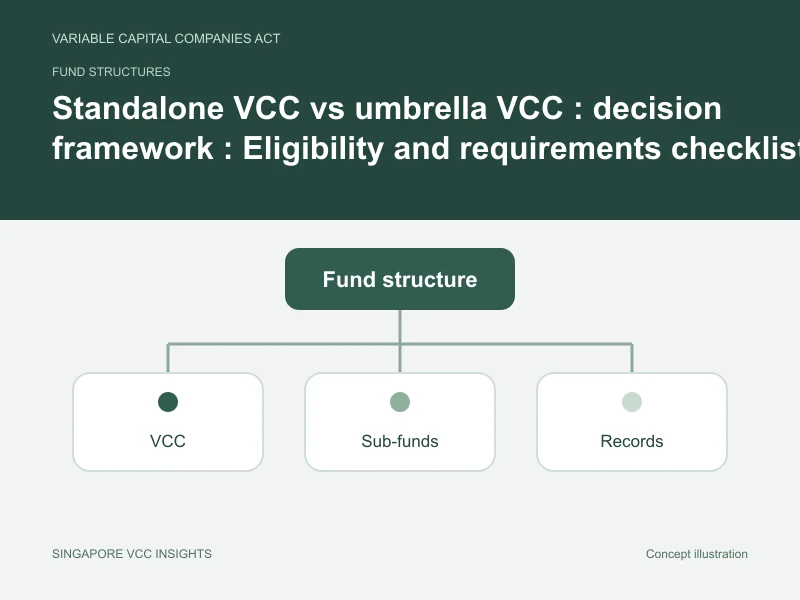
Standalone VCC vs umbrella VCC is the first structural decision a fund manager makes under the VCC Act, and it drives cost, governance and speed to launch. This decision framework sets out the eligibility and requirements for each so managers can pick the right form before incorporating.
Raffles Corporate Services works with a panel of corporate and employment law firms; this article is general information, not legal advice.
What standalone VCC vs umbrella VCC means
A standalone VCC is a single fund in one corporate vehicle. An umbrella VCC holds multiple sub-funds under one entity, each with segregated assets and liabilities. Section 29 of the Variable Capital Companies Act 2018 provides that the assets and liabilities of a sub-fund are segregated and not available to meet the liabilities of another sub-fund, which is the legal foundation of the umbrella model. Choosing between the two is about how many strategies you will run and how you want to share cost and governance across them.
Who needs this framework
Fund managers launching their first Singapore fund, multi-strategy managers planning several products, and family offices deciding whether to consolidate are the audience. Advisers and administrators scoping the operating model also use it, because the choice affects audit, tax filing and board composition.
Eligibility and requirements
Both forms require incorporation under the VCC Act, a permitted fund manager, at least one Singapore-resident director, and proper administration. The umbrella adds per sub-fund record-keeping and separate audits, but shares one board and one set of corporate infrastructure. A standalone is simpler to run but does not spread fixed costs across strategies. For tax, the umbrella is treated as a single entity while segregation is preserved, and the sub-fund segregation mechanics are set out in our on-site guide to VCC Act 2018 section 29 sub-fund segregation.
Cost and timeline
Incorporation timelines are similar for both, running a few weeks through a registered filing agent once the manager and directors are in place. The cost difference is ongoing: a standalone carries one set of administration and audit, while an umbrella carries shared corporate costs plus per sub-fund accounting and audit. As a rule of thumb, an umbrella becomes economical once you plan two or more sub-funds, because the shared board and infrastructure offset the incremental per sub-fund cost.
Step-by-step: choosing the structure
Count the strategies you will run now and within two years. If one, a standalone is usually simplest. If two or more, model the umbrella’s shared costs against separate standalone vehicles. Confirm the fund manager and Singapore-resident director for either form. Decide governance: one board for the umbrella versus separate boards for multiple standalones. Plan audit and tax accordingly. Incorporate. Managers establishing an onshore operating entity should also weigh corporate forms such as a sole proprietorship, LLP and private limited company, while incentive conditions are addressed in family office MAS approval, annual review and audit.
Common mistakes and gotchas
Managers sometimes launch multiple standalones and later wish they had used an umbrella, incurring duplicate infrastructure. Others pick an umbrella for a single strategy and pay for unused segregation machinery. A frequent oversight is assuming segregation protects against all cross-liabilities without maintaining the records and contracts that make it effective. Board composition and resident-director requirements are also underestimated.
Authority references
The VCC Act is at Singapore Statutes Online, the framework is explained by the Monetary Authority of Singapore, and incorporation is administered by ACRA.
Worked example: when to pick an umbrella over standalones
Suppose a manager is certain about one strategy today but expects to add a second and third within two years. Three separate standalone VCCs would mean three boards, three administrators and three audits, a triplication of fixed cost. A single umbrella VCC with three sub-funds shares one board and one set of corporate infrastructure, adding only the incremental per sub-fund accounting and audit. As a rule of thumb, the umbrella becomes economical at two or more sub-funds, which is why a manager with a clear multi-strategy roadmap usually starts with an umbrella even if only the first sub-fund launches at incorporation.
The opposite error is real too: choosing an umbrella for a single, permanent strategy pays for segregation machinery that will never be used. And segregation is only as strong as the records behind it, so a manager relying on section 29 must still keep sub-fund accounts, contracts and custody genuinely separate for the protection to hold.
FAQs
When is an umbrella VCC better? Generally once you plan two or more sub-funds, because shared infrastructure offsets per sub-fund cost.
Is sub-fund segregation automatic? The Act provides segregation, but it must be supported by proper records, contracts and custody to be effective.
Do both forms need a resident director? Yes. Both require at least one Singapore-resident director and a permitted fund manager.
Can a standalone convert to an umbrella later? Restructuring is possible but adds cost, which is why the initial choice matters.
Need help with this? Call, SMS or WhatsApp +65 8501 7133, or email hello@rafflescorporateservices.com. Raffles Corporate Services works with a panel of corporate and employment law firms; this article is general information, not legal advice.