Independent Singapore VCC guidance
Direct answer
Open a failed trade as an exception for the exact VCC or sub-fund that contracted for it. Freeze the trade economics, expected settlement route, cash or securities obligation and current status. Reconcile broker, custodian and administrator records before choosing a remedy. Keep temporary funding and accounting adjustments within the correct pool, record every instruction and reassess valuation or investor effects. Close the exception only when settlement, cash, positions and fund books agree.
At a glance
- Identify the legal and operational pool before anyone moves cash or securities.
- Use one exception record across broker, custodian, manager and administrator teams.
- Separate the original trade terms from later repair instructions and charges.
- Assess NAV, liquidity and investor effects before treating settlement as complete.
- Close on reconciled evidence, not a verbal confirmation or broker status alone.
Who this is for
- Operations, fund accounting, treasury and oversight teams handling listed, OTC or privately settled assets for a VCC.
Important exclusions
- A substitute for market-specific settlement rules, legal advice, counterparty documentation or the fund manager’s incident policy.
Open the exception against the correct pool
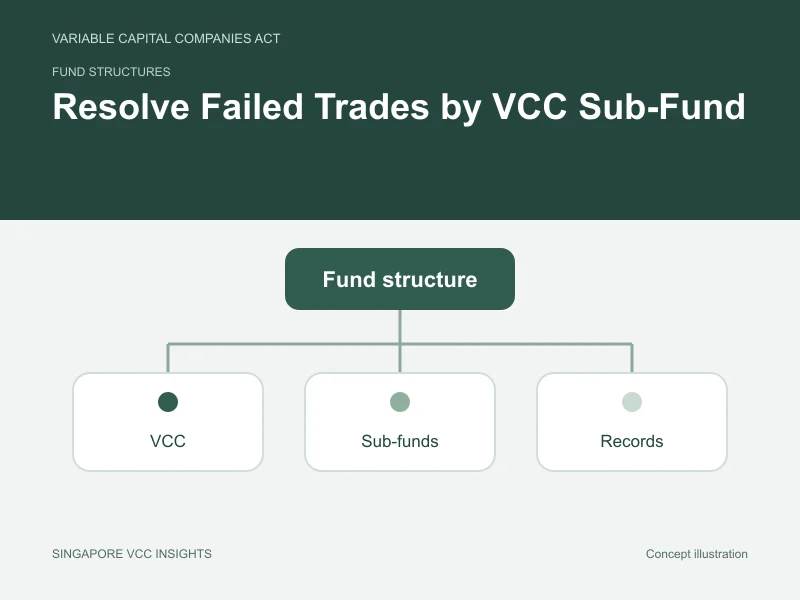
Begin with identity, not with the repair. Capture the VCC name, registered sub-fund where relevant, account, trade date, intended settlement date, instrument, quantity, currency, counterparty, broker reference and administrator identifier. An umbrella structure depends on clear separation between its sub-funds, so a consolidated platform view cannot justify using another pool’s cash or securities. Record which document created the obligation and which account was expected to deliver. This first record becomes the shared reference for every later instruction, adjustment and review.
Sources: Accounting and Corporate Regulatory Authority · Accounting and Corporate Regulatory Authority| Field | Control question | Evidence |
|---|---|---|
| Pool identity | Which VCC or sub-fund contracted for the trade? | Executed order, confirmation and account mapping |
| Settlement terms | What was due, where and when? | Broker confirmation and settlement instruction |
| Current status | Which party shows the fail and why? | Broker, custodian and administrator status |
| Economic exposure | What cash, security or market risk remains? | Position, cash and exposure reports |
| Decision owner | Who may approve the chosen repair? | Current authority and escalation map |
Do not overwrite the original instruction when the trade is amended, cancelled or rebooked. Preserve the initial terms, the time each party identified the exception and every subsequent version. A failed delivery, unmatched instruction, insufficient cash, blocked security, incorrect standing settlement instruction and counterparty dispute are different problems even when they appear under one status code. Accurate classification prevents a team from solving the visible symptom while leaving the source data or authority defect in place.
Sources: Accounting and Corporate Regulatory Authority · Monetary Authority of SingaporeRelated guidance: VCC sub-fund segregation and operating controls
Triage cause, exposure and urgency
Reconcile the same trade across the order record, broker confirmation, custodian instruction and fund ledger. Mark each field as matched, missing or inconsistent. Then identify whether the exception is documentary, operational, funding-related, asset-related, counterparty-driven or caused by a market event. Urgency should reflect the remaining exposure and downstream dependencies rather than the age of the item alone. A recent fail that blocks a redemption, margin movement or portfolio hedge may deserve faster escalation than an older low-impact fee difference.
Sources: Accounting and Corporate Regulatory Authority · Monetary Authority of Singapore- Instruction mismatchCorrect the authorised settlement detail and retain evidence of both the rejected and accepted versions.
- Cash or security shortfallConfirm the owning pool, available resources and decision authority before arranging any funding or cover.
- Counterparty disputeFreeze disputed economics, preserve communications and route the issue through the contractual escalation path.
- Market or asset restrictionAssess whether settlement can resume, requires a different route or changes the investment and valuation conclusion.
Create a plain-language exposure note beside the technical status. State what the VCC currently owns or owes, whether price or currency risk continues, what cash is blocked, which investor or NAV process may be affected and the next irreversible step. This note lets decision-makers act without guessing from settlement codes. It also helps operations distinguish a true economic exposure from a record mismatch where the external settlement completed but the administrator has not yet reflected it.
Sources: Accounting and Corporate Regulatory Authority · Monetary Authority of SingaporeChoose and authorise the repair
A repair can involve correcting an instruction, obtaining cash, sourcing securities, cancelling and rebooking, accepting a delayed settlement, negotiating a claim or unwinding the trade. Compare the available routes against the original mandate, counterparty documents, liquidity position and the authority map. The person who identifies the fail should not silently create new economics to make it disappear. Record the selected route, alternatives rejected, expected cost, affected accounts, approval and any condition that would force the decision back for review.
Sources: Accounting and Corporate Regulatory Authority · Accounting and Corporate Regulatory Authority · Monetary Authority of Singapore- StabiliseStop duplicate or contradictory instructions and tell each operating party which record is controlling.
- EvaluateCompare lawful and operational repair routes, including their cash, market, accounting and investor consequences.
- ApproveObtain authority for the exact action, amount, account, counterparty and period rather than a broad verbal permission.
- ExecuteIssue the repair through the approved channel and capture acceptance, rejection or pending status from the recipient.
- ReassessReturn for a new decision if price, amount, settlement date, counterparty position or affected pool changes.
Treat fees, claims, buy-ins, overdraft interest and foreign-exchange differences as separate consequences. They should not be buried inside a corrected trade price unless the governing evidence supports that result. Attribute each amount to the pool that incurred it, identify whether a provider or counterparty may reimburse it and keep recovery status separate from settlement status. The trade can settle while a compensation claim remains open, but both records should link to one incident identifier.
Sources: Accounting and Corporate Regulatory Authority · Accounting and Corporate Regulatory AuthorityRelated guidance: VCC trade allocation and correction controls
Close the incident and prevent recurrence
Close the failed trade when broker, custodian and administrator evidence agrees on the final settlement, the correct pool holds the resulting cash or position, accounting consequences are resolved or separately tracked, and the authorised reviewer accepts the record. Keep recovery claims open under linked identifiers if they remain outstanding. A daily exception report should distinguish operational closure from financial recovery so that a completed delivery does not hide an unpaid claim or stale suspense balance.
Sources: Accounting and Corporate Regulatory Authority · Monetary Authority of Singapore- ConfirmObtain final external settlement evidence and match it to the authorised repair instruction.
- ReconcileTie cash, positions, charges and ledger entries to the same VCC or sub-fund population.
- ReviewAssess NAV, liquidity, reporting and investor consequences and document any remaining open item.
- LearnClassify the root cause and decide whether data, authority, provider or workflow controls need change.
- VerifyTest the changed control on a later sample instead of closing solely on a promised improvement.
Related guidance: VCC compliance checklist
Frequently asked questions
Who should own a failed VCC trade?
Use one accountable incident owner, normally in operations, while preserving separate decision rights for the manager, treasury, valuation, accounting and directors. Ownership means coordinating the record and closure. It should not allow the incident owner to approve new economics, move another sub-fund’s assets or override the authorised settlement route.
Can another sub-fund temporarily fund the settlement?
Do not assume that it can. First establish the legal, contractual, tax, accounting and governance basis for any movement between pools and obtain the required professional advice and authority. The safer default is to solve the exception inside the pool that incurred the obligation and keep umbrella-level convenience from obscuring attribution.
Does a broker confirmation prove that the fail is closed?
No. It proves only one part of the chain. Match the broker status to custodian cash or position evidence and the administrator ledger. Then review charges, claims, valuation and investor effects. Closure should rest on consistent evidence across the systems that record ownership, settlement and fund accounting.
Should failed trades be reported to investors?
That depends on the fund documents, materiality, investor impact and applicable professional advice. The operating team should identify the affected population and preserve a decision-ready incident record. The authorised manager, directors and advisers can then determine whether, when and how any communication is appropriate.
What is the best recurring metric?
Avoid relying on a simple count. Track age, value, affected pool, cause, economic exposure, downstream process, repair status, financial recovery and recurrence. A small recent fail can be more important than an old administrative item if it blocks dealing, creates market exposure or threatens a time-sensitive obligation.
Official sources and further reading
- Understanding VCC features, eligibility and requirements (Accounting and Corporate Regulatory Authority)
- Overview of managing a variable capital company (Accounting and Corporate Regulatory Authority)
- Choosing directors and key officers for a VCC (Accounting and Corporate Regulatory Authority)
- Financial Institutions Directory: fund management (Monetary Authority of Singapore)
Discuss a Singapore VCC structure
For help coordinating a Singapore VCC setup or corporate administration, contact Raffles Corporate Services.
General information only. This article is not legal, tax, regulatory or investment advice and does not imply affiliation with or endorsement by ACRA, MAS or IRAS.