Independent Singapore VCC guidance
Direct answer
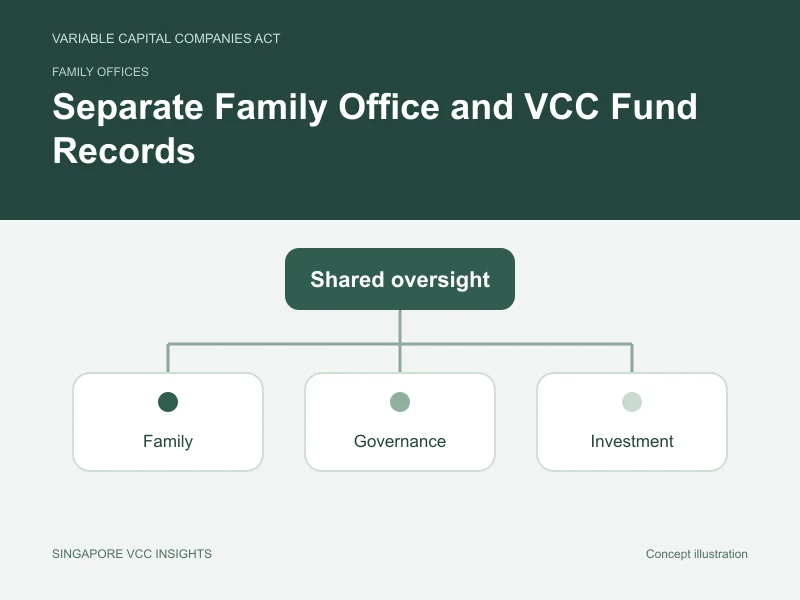
Separate records according to the decision and legal capacity they evidence. Personal and family-governance material belongs in the family repository; employment and vendor administration belongs to the family-office entity; investment-management judgement belongs to the authorised manager; and constitutional, board, investor, accounting and fund-operation records belong to the VCC or its appointed record owner. Shared staff may support several lanes, but each item needs one authoritative location, access owner, retention rule and retrieval path.
At a glance
- Classify records by capacity, decision owner and authoritative use rather than by staff member.
- Use links and controlled transfers between repositories instead of uncontrolled duplicate files.
- Route principal instructions through documented VCC and manager authority before action.
- Test retrieval and provider exit so the boundary survives personnel and vendor changes.
Who this is for
- Single-family offices, multi-family office relationships and family-linked VCCs using shared people or providers
Important exclusions
- Deciding privilege, data-protection rights or mandatory retention for a particular matter without advice
Name the capacities before naming the folders
A family principal, family-office entity, fund manager, VCC, umbrella sub-fund and service provider can involve overlapping people while carrying different responsibilities. Begin with an entity-and-capacity map that shows who makes personal, employment, investment, board, investor and provider decisions. ACRA describes the VCC as an investment-fund structure with its own officers and ongoing requirements, while EDB treats the single family office as an organisation designed around the family mandate. The records model should respect that difference.
Sources: Accounting and Corporate Regulatory Authority · Singapore Economic Development Board · Monetary Authority of SingaporeCapacity map questions
- Who is acting: family member, office employee, manager delegate, director or provider?
- Which entity receives the benefit, bears the obligation or owns the decision?
- Is the item personal guidance, corporate administration, investment judgement or fund evidence?
- Which repository is authoritative if the same information appears elsewhere?
- Who can grant access, approve transfer and confirm final retention?
Related guidance: VCC for family offices hub
Use a four-lane ownership matrix
| Lane | Typical authoritative records | Primary owner | Boundary risk |
|---|---|---|---|
| Family | Family mandate, succession discussions and personal correspondence | Family governance owner | Personal wishes treated as a fund instruction |
| Family-office entity | Employment, vendor, office budget and operational administration | Family-office operations lead | Office records substituted for manager or VCC evidence |
| Fund manager | Research, portfolio decisions, mandate monitoring and risk actions | Authorised manager | Investment judgement buried in personal communications |
| VCC and sub-fund | Constitutional, board, investor, accounting and provider-oversight records | VCC or appointed record owner | Fund evidence fragmented across unrelated family folders |
The matrix should identify the authoritative copy, not forbid all references across lanes. A VCC board paper may summarise a family objective, and a family-office dashboard may show an approved fund result. The summary should link to the source without becoming a competing version. If confidential detail cannot move, record the approved conclusion, the source owner and a controlled retrieval route.
Sources: Monetary Authority of Singapore · Accounting and Corporate Regulatory AuthorityRelated guidance: family VCC investment committee pack
Route principal requests into the right decision lane
Principal request routing tree
- Is the request purely personal or family-governance related?Keep it in the family lane unless and until it creates an authorised instruction to another entity.
- Does it ask the manager to change an investment decision?Route it through mandate, authority, conflict and portfolio-decision controls before any transaction or commitment.
- Does it ask the VCC to pay, distribute or contract?Require the VCC or sub-fund approval path and preserve the legal capacity in the final record.
- Does it affect several entities?Split the request into separate decisions with linked references rather than one broad approval message.
- Is authority unclear or the request inconsistent with documents?Pause execution, record the issue and obtain a formal governance or professional conclusion.
A principal message can start a review without becoming the approval itself. Capture the request faithfully, identify the capacity in which the principal is speaking, and create the required manager, board or entity decision record. The final response should state what was approved, declined or referred and where the authoritative decision sits. This protects both family intent and fund accountability.
Sources: Monetary Authority of Singapore · Accounting and Corporate Regulatory AuthorityRelated guidance: family principal request routing guide
Control access, copying and external sharing
Define access by role, entity and need, then apply additional controls to investor identities, beneficial ownership, personal family information, portfolio data, security records and legal advice. Avoid broad shared drives where a convenient search result can expose the wrong entity record. When a document is copied for a board, provider or adviser, mark its purpose, source version and recipient restrictions. Revoke temporary access when the task closes and keep a record of external transfers.
Sources: Monetary Authority of Singapore · Accounting and Corporate Regulatory AuthorityAccess boundary checks
- Every repository has a named business owner and system administrator.
- Joiner, mover and leaver events update all entity roles, not only the family-office account.
- Exports and email attachments have a defined purpose and recipient group.
- Board and manager access is sufficient for oversight without exposing unrelated family material.
- Sensitive source records can be retrieved through a tested escalation path.
Test retrieval and provider exit
Select a real decision from each lane and ask a person who did not create it to retrieve the source, authority, approvals, final output and later follow-up. The test should reveal broken links, duplicated versions and records held only in personal mailboxes. Repeat the exercise when a provider or senior employee is leaving. A sound boundary is useful only if the VCC and manager can continue operating while the family office preserves its own confidential history.
Sources: Monetary Authority of Singapore · Accounting and Corporate Regulatory Authority · Singapore Economic Development BoardBoundary assurance test
- SampleChoose one family request, office contract, manager decision and VCC governance action with linked downstream effects.
- RetrieveLocate the authoritative source, access approval, decision owner, issued output and any later amendment without creator assistance.
- CompareIdentify duplicate copies, conflicting versions, unauthorised access and references that no longer reach the source record.
- RepairMove authority to the correct lane, replace copies with controlled links and document any unavoidable cross-entity transfer.
- ReperformHave an independent reviewer repeat retrieval and confirm that provider or personnel exit would not break continuity.
Related guidance: related-party VCC provider appointment review
Frequently asked questions
Can one document repository serve both the family office and VCC?
A single technology platform may host several repositories, but the logical boundaries should remain explicit. Use separate permissions, owners, retention settings and authoritative locations for each entity and capacity. Convenience should not give every family-office user access to investor, board or manager records, or leave VCC evidence dependent on a personal family folder.
Where should investment committee papers sit?
Place the authoritative paper with the body that made the decision. A manager investment decision belongs in the manager lane; a family advisory discussion belongs in the family lane; and a VCC board approval belongs in the VCC record. Linked copies may be provided for context, but they should identify the source and not become competing versions.
May a family principal instruct the VCC directly?
A principal may communicate a request, but execution should follow the authority in the VCC, manager and fund documents. Record the capacity in which the principal acts, test mandate and conflicts, and obtain the required manager or board decision. The final record should distinguish family preference from the authorised fund action.
How should shared employees record their work?
They should select the entity and capacity at the start of the task, use the correct repository and identify the output owner. Time, expense and approval records should follow the service arrangement. If one activity serves several entities, split the outputs or use a documented allocation and hand-off rather than filing everything under the employee home team.
What is the clearest sign that the boundary is failing?
A common warning is that reviewers can find a document but cannot say which copy is authoritative, who approved it or in what capacity the author acted. Other signs include personal mailboxes as the only source, broad shared-drive access, principal messages treated as approvals and provider reports that replace manager or board conclusions.
Official sources and further reading
- Guide to Setting Up a Single Family Office in Singapore (Singapore Economic Development Board)
- Understanding VCC Features, Eligibility and Requirements (Accounting and Corporate Regulatory Authority)
- Governance and Management of Variable Capital Companies (Monetary Authority of Singapore)
- Legal Obligations of a VCC Director (Accounting and Corporate Regulatory Authority)
Discuss a Singapore VCC structure
For help coordinating a Singapore VCC setup or corporate administration, contact Raffles Corporate Services.
General information only. This article is not legal, tax, regulatory or investment advice and does not imply affiliation with or endorsement by ACRA, MAS or IRAS.