Independent Singapore VCC guidance
Direct answer
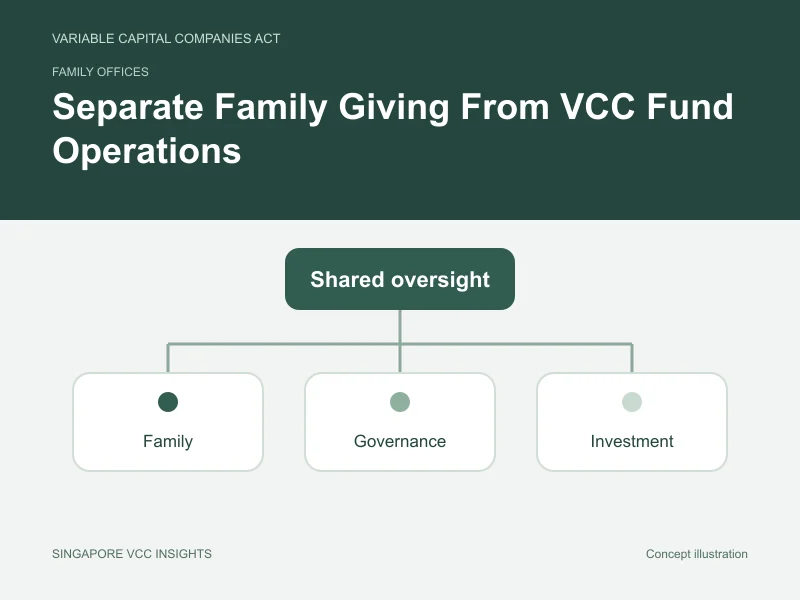
Start with purpose and return expectation. A commercial or impact investment made under the VCC’s mandate may remain a fund transaction; an irrevocable grant or donation generally belongs in a separate giving process and often a separate vehicle or intermediary. Do not label a sub-fund “philanthropic” and assume the boundary is solved. Route each proposal through legal, tax, mandate and governance review, then keep cash, contracts, approvals and reporting distinct.
At a glance
- Classify the transaction before choosing the entity or sub-fund.
- Separate investment return from charitable purpose and grant control.
- Give each route its own approving body, bank path and evidence file.
- Allocate shared family-office support transparently without blending records.
Who this is for
- Family offices deciding how proposed grants, donations, catalytic capital or impact investments interact with an existing VCC
Important exclusions
- Choosing a charity, obtaining tax deductions, creating a foundation or donor-advised fund, or determining foreign-law treatment
Classify purpose before selecting a vehicle
EDB’s philanthropy handbook describes distinct pathways and entity choices for giving, while ACRA describes the VCC as an investment-fund structure. Begin with a written proposal: intended beneficiary, social objective, expected financial return, repayment rights, control, time horizon, restrictions, reporting and exit. The word “impact” is not enough. A market-return investment, concessionary investment, recoverable grant, ordinary grant and donation can require different governance and records even when they support the same cause.
Sources: Singapore Economic Development Board · Singapore Economic Development Board · Accounting and Corporate Regulatory Authority| Transaction | Primary expectation | Initial route |
|---|---|---|
| Commercial impact investment | Risk-adjusted financial return plus measured impact | Test against the VCC investment mandate |
| Catalytic investment | Below-market or risk-bearing capital with possible recovery | Specialist legal, tax and mandate review |
| Recoverable grant | Mission-first funding with contingent repayment | Giving-vehicle and accounting analysis |
| Ordinary grant | No ownership or repayment right | Separate philanthropic approval and payment route |
| Donation through an intermediary | Irrevocable support administered by another body | Intermediary diligence and giving record |
Related guidance: VCC for family offices hub
Compare the operating boundaries
A VCC route begins with the fund mandate, investor interests, manager process, valuation and investment records. A separate giving route begins with charitable purpose, donor intent, recipient or intermediary diligence, grant restrictions and impact reporting. A donor-advised fund or other philanthropic tool may support administration, but its suitability depends on the family’s objectives and provider terms. Use the comparison to identify questions, not to select a structure without legal and tax advice.
Sources: Singapore Economic Development Board · Singapore Economic Development Board · Accounting and Corporate Regulatory Authority| Control area | VCC investment route | Separate giving route |
|---|---|---|
| Decision basis | Fund mandate and investment analysis | Giving strategy and charitable purpose |
| Capital record | Portfolio, custody, valuation and NAV records | Grant, donation or philanthropic account records |
| Counterparty review | Investee and transaction diligence | Recipient or intermediary diligence |
| Return and exit | Financial return, liquidity and disposal plan | Mission outcomes and any permitted restrictions |
| Reporting | Board, manager and investor reporting | Family, donor and impact reporting |
Related guidance: family assets outside a VCC decision
Use a decision tree for mixed-purpose proposals
Mixed-purpose proposals create the greatest risk of blurred authority. Ask whether the VCC receives a legally enforceable financial instrument, whether expected return and risk fit the approved mandate, whether the manager can value and monitor it, whether any private benefit or related-party issue exists, and whether the social restrictions alter exit or enforcement. If the proposal functions principally as a grant, move it to the giving route. If classification remains uncertain, stop and obtain specialist advice before any commitment.
Sources: Monetary Authority of Singapore · Accounting and Corporate Regulatory Authority · Singapore Economic Development Board- Clear investmentProceed through the VCC mandate, manager diligence, valuation, approval, custody and portfolio-monitoring process.
- Clear grant or donationUse the separate philanthropic approval, recipient diligence, payment and impact-reporting process.
- Catalytic or recoverable capitalCommission legal, tax, accounting and mandate analysis before choosing either route or committing family capital.
- Related family interestAdd conflict review and independent evidence before either the VCC or giving body decides.
Related guidance: family investment policy to VCC mandate
Separate approvals, cash and contracts
The family council may set an overall giving policy, but the VCC board and permissible fund manager retain their own roles for fund activity. A giving entity, donor-advised fund sponsor or other intermediary has a different authority chain. Maintain separate bank instructions, signatory lists, contracts, general-ledger codes, document folders and reporting calendars. If the family office supplies staff to both routes, document scope, confidentiality, allocation and supervision so one team does not silently combine legal records.
Sources: Accounting and Corporate Regulatory Authority · Accounting and Corporate Regulatory Authority · Singapore Economic Development Board · Monetary Authority of Singapore- The paying entity and bank account are identified before approval.
- The contract names the correct investment or giving counterparty and purpose.
- Approvers act under the authority of the selected route.
- Accounting codes and document folders prevent cross-posting.
- Shared staff time and service costs follow an approved allocation method.
Related guidance: family consent and VCC approval boundary
Diligence recipients and impact without importing fund controls blindly
Investment diligence tests ownership, economics, governance, downside, liquidity and enforceability. Philanthropic diligence tests mission fit, recipient capability, permitted use, safeguarding, monitoring and how unused funds are handled. Some controls overlap, such as identity, conflicts, sanctions and documentation, but the conclusion is different. Build route-specific checklists and a shared risk escalation channel. Do not force a charity into a fund-investee template or accept a commercial investee on the strength of social-impact claims alone.
Sources: Singapore Economic Development Board · Singapore Economic Development Board · Monetary Authority of Singapore- ScreenConfirm identity, purpose, conflicts and the proposed legal relationship before detailed diligence begins.
- ClassifyChoose the investment, giving or mixed-purpose route and record the assumptions supporting that choice.
- DiligenceApply the route-specific financial, operational, governance and impact questions with named owners.
- Approve and monitorUse the correct authority, payment path, reporting indicators and exception process for the selected route.
Reconcile family reporting without blending legal records
The family may want one dashboard for investment performance, impact and giving. Build it as a reporting layer, not a merged ledger. Tag each item by legal owner, route, capital type, approval body, valuation method and reporting basis. Show investment return and philanthropic outcomes in separate columns, and explain any mixed-purpose measure. Reconcile dashboard totals back to the VCC administrator and the giving records independently before presenting them to the family council.
Sources: Singapore Economic Development Board · Singapore Economic Development Board · Accounting and Corporate Regulatory AuthorityFrequently asked questions
Can an umbrella VCC create a philanthropic sub-fund?
A label does not decide legal or tax treatment. First determine whether the proposed activity is genuinely an investment within the VCC mandate or a grant, donation or other giving activity. Obtain structure-specific advice before using a sub-fund.
Is every impact investment suitable for a VCC?
No. Expected return, instrument rights, valuation, liquidity, mandate fit, manager capability and conflicts all matter. A mission-first transaction with weak repayment or ownership features may require a different giving or catalytic-capital route.
What is the role of a donor-advised fund?
EDB materials describe donor-advised funds among the philanthropic tools available in Singapore. The family should compare provider terms, control, timing, reporting and giving objectives with other routes and obtain advice before committing assets.
Can the family office team support both routes?
Yes, if authority, confidentiality, scope, time, cost allocation, systems and supervision are clear. Shared people do not justify shared bank accounts, contracts or ledgers. Each transaction should remain traceable to its legal owner and approval chain.
Should investments and grants appear in one family dashboard?
They may appear in one reporting view, but the dashboard should preserve separate legal owners, capital types, valuation methods and outcome measures. Reconcile investment data and giving data independently before combining the presentation.
Official sources and further reading
- Philanthropy Handbook: Giving Effectively from Singapore to Asia Pacific (Singapore Economic Development Board)
- Design Your Giving to Maximise Your Impact: A Focus on Donor-Advised Funds (Singapore Economic Development Board)
- Family Offices in Singapore (Singapore Economic Development Board)
- Understanding VCC Features, Eligibility and Requirements (Accounting and Corporate Regulatory Authority)
- Choosing Directors and Key Officers for a VCC (Accounting and Corporate Regulatory Authority)
- Legal Obligations of a VCC Director (Accounting and Corporate Regulatory Authority)
- Governance and Management of Variable Capital Companies (Monetary Authority of Singapore)
- Overview of Managing a VCC (Accounting and Corporate Regulatory Authority)
Discuss a Singapore VCC structure
For help coordinating a Singapore VCC setup or corporate administration, contact Raffles Corporate Services.
General information only. This article is not legal, tax, regulatory or investment advice and does not imply affiliation with or endorsement by ACRA, MAS or IRAS.