Independent Singapore VCC guidance
Direct answer
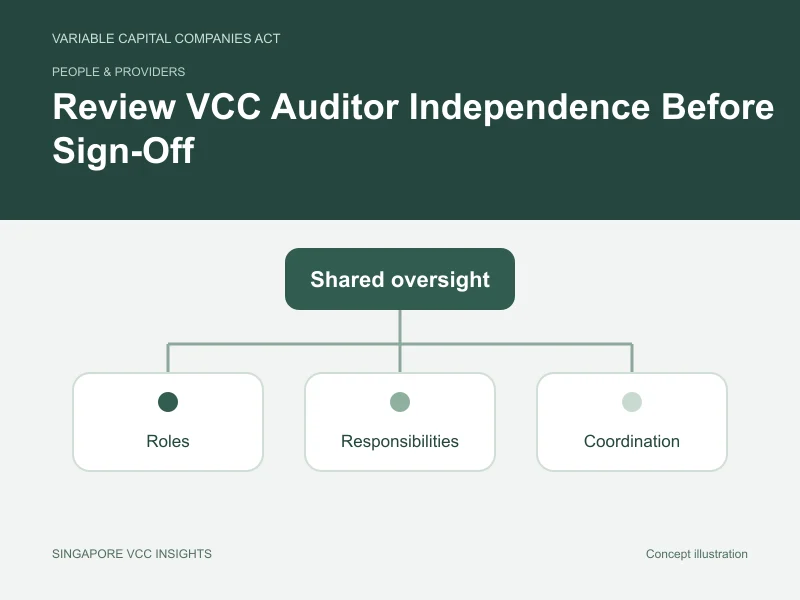
Before approving a VCC audit, directors should reconcile every audit and non-audit fee, identify the services delivered by the audit firm and its network, assess threats created by each service and by the combined relationship, and record why safeguards are sufficient or why another provider is needed. The review is a governance decision, not a percentage-only calculation. It should end with a clear owner, conclusion, conditions and follow-up evidence.
At a glance
- Calculate the VCC-specific non-audit fee ratio from a complete firm and network inventory.
- Assess self-review, management, advocacy, familiarity and financial-dependence threats separately.
- Do not treat a threshold crossing as either automatic approval or automatic disqualification.
- Record safeguards, dissent, conditions and the final board conclusion before sign-off.
Who this is for
- Directors and company secretaries preparing a VCC audit independence review.
Important exclusions
- A substitute for the auditor firm's own professional ethics assessment or VCC-specific legal advice.
Build the complete fee and service population
Start with the full financial-year population, not the audit engagement letter alone. Obtain invoices, credit notes, accruals and unpaid work from the auditor and every relevant network firm. Classify statutory audit, tax compliance, tax advice, accounting assistance, valuation support, systems work, agreed-upon procedures and other assurance separately. Reconcile the population to the ledger and ask the auditor to confirm completeness. The VCC Regulations set a review trigger when non-audit fees exceed half of total auditor fees for the financial year, so missing an affiliate invoice can change whether the formal review is required.
Sources: Singapore Statutes Online · Singapore Statutes Online| Field | Evidence | Decision use |
|---|---|---|
| Provider and network relationship | Contracting entity, engagement partner and network confirmation | Establishes which services belong in the assessment |
| Service and period | Executed scope, deliverables, invoice and service dates | Shows whether audit work may review the provider's own output |
| Fee classification | Audit, assurance, tax, advisory or other non-audit category | Supports the ratio and the threat analysis |
| Management involvement | Named VCC decision owner and retained judgement | Tests whether the provider assumed a management role |
| Safeguard evidence | Separate teams, external review or different provider | Shows how an identified threat was addressed |
Related guidance: umbrella VCC audit PBC tracker
Calculate the trigger without distorting the conclusion
Use the rule's denominator carefully: total fees paid to the auditor in the financial year, not only the statutory audit invoice. Compare total non-audit fees with that complete total and preserve the calculation workbook. If the non-audit amount is S$60,000 and total fees are S$100,000, the ratio is 60% and the VCC review trigger is crossed. That result starts the governance review. It does not by itself prove that independence is impaired, and falling below the threshold does not eliminate the need to consider a prohibited service or an acute self-review threat.
Sources: Singapore Statutes Online · Singapore Statutes Online · Ministry of FinanceAssess threats service by service
For each engagement, identify what the audit team will later test and who made the underlying judgement. A self-review threat is sharper when the firm created a valuation, accounting record, control design or tax position that feeds the financial statements. A management threat arises when the provider selected policy, authorised a transaction, directed staff or accepted responsibility that belonged to the VCC. Advocacy, familiarity, intimidation and financial dependence can arise in different ways. The professional ethics framework requires the firm to identify, evaluate and address threats, while the VCC board should independently understand the same facts before relying on the firm's conclusion.
Sources: Singapore Statutes Online · Monetary Authority of Singapore- Define the financial-statement line, disclosure or control affected by each service.
- Name the VCC director or manager who retained judgement and approved the outcome.
- Check whether the same personnel produced the work and will audit it.
- Aggregate related services instead of assessing several small engagements in isolation.
- Record any personal, commercial or fee dependency that could influence objectivity.
Related guidance: VCC board effectiveness review
Choose safeguards that change the risk
A safeguard should alter who performs, reviews or takes responsibility for the work. Examples include using professionals outside the audit team, commissioning an independent review, moving the non-audit engagement to a different firm, narrowing the scope, or having the VCC recreate and approve the underlying judgement with competent personnel. A statement that separate teams were used is not enough unless the board understands the reporting lines, information barriers and review performed. If no safeguard can reduce the threat to an acceptable level, the VCC should stop or reassign the service and consider the implications for the audit appointment.
Sources: Singapore Statutes Online · Monetary Authority of Singapore- EliminateStop or move a service when its nature creates a threat that cannot be reduced credibly.
- SeparateUse distinct personnel, reporting lines and access controls where team separation addresses the identified risk.
- ReviewAppoint an appropriately qualified reviewer who did not create the work or perform the affected audit procedure.
- ReperformHave the VCC or another provider independently reproduce the key judgement and retain responsibility for it.
- MonitorSet conditions, owners and evidence dates so safeguards remain effective through completion of the audit.
Related guidance: replace a VCC auditor after resignation
Write a board conclusion that can be tested
The board paper should state the population reviewed, ratio, services presenting the strongest threats, auditor representations, safeguards, unresolved matters and proposed conclusion. The resolution should not merely say that independence is satisfactory. It should explain the decisive reasons, identify any service that must stop, and require confirmation before the audit report is released. Keep the underlying fee reconciliation, contracts, auditor communications and safeguard evidence with the annual audit file. Where the conclusion remains uncertain, pause sign-off and obtain independent professional advice rather than using the reporting timetable as the decision rule.
Sources: Singapore Statutes Online · Singapore Statutes Online · Monetary Authority of Singapore- Complete fee reconciliation and signed auditor confirmation.
- Service-by-service and combined-threat assessment.
- Documented safeguards with accountable owners.
- Board questions, conflicts, dissent and conditions.
- Final independence conclusion and release gate for the audit report.
Related guidance: VCC compliance checklist
Frequently asked questions
Does a non-audit fee ratio above 50% automatically disqualify the auditor?
No. The VCC rule makes that level a prescribed circumstance requiring an independence review. Directors must still assess the nature of the services, threats and safeguards. A service can be unacceptable below the ratio, while a crossed ratio requires analysis rather than a mechanical conclusion.
Should unpaid non-audit work be included in the review?
The board should reconcile invoices, accruals and work performed so the population reflects the financial year accurately. The precise legal fee calculation should be confirmed with the auditor or adviser, but excluding known unpaid work from the governance inventory would obscure the relationship being assessed.
Can separate engagement teams solve every independence concern?
No. Separate teams may reduce some familiarity or self-review risks, but they do not cure a service where the firm assumed management responsibility or where no effective independent review is possible. The safeguard must match the specific threat and change the practical risk.
Who should approve the final VCC independence conclusion?
The VCC board should reach and record its own conclusion, informed by the auditor's professional assessment and any independent advice. Management, the fund manager and the company secretary can prepare evidence, but the paper should preserve accountable director judgement.
What should happen if a conflict is discovered late in the audit?
Contain the affected work, obtain the auditor's written analysis, assess whether another firm must review or reperform it, and stop sign-off until the board understands the effect. Also examine how the service escaped pre-approval so the control failure is corrected.
Official sources and further reading
- Variable Capital Companies Regulations 2020 (Singapore Statutes Online)
- Accountants (Prescribed Standards and Code of Professional Conduct and Ethics) Order 2023 (Singapore Statutes Online)
- The Public Accountants Board Issues Rules on Auditor Independence (Ministry of Finance)
- Governance and Management of Variable Capital Companies (Monetary Authority of Singapore)
Discuss a Singapore VCC structure
For help coordinating a Singapore VCC setup or corporate administration, contact Raffles Corporate Services.
General information only. This article is not legal, tax, regulatory or investment advice and does not imply affiliation with or endorsement by ACRA, MAS or IRAS.