Raffles Corporate Services works with a panel of corporate and employment law firms; this article is general information, not legal advice.
Key Take-aways
- A feeder VCC collects accredited-investor capital and invests it into a master fund.
- Restricting the offer to accredited investors narrows prospectus and licensing obligations.
- A MAS-regulated Permissible Fund Manager is mandatory.
- ACRA incorporation fee is S$8,000; running costs commonly S$20,000–S$60,000.
- Section 13O or 13U incentives under the Income Tax Act 1947 may exempt qualifying income.
In This Article
What an accredited-investor feeder VCC is
A feeder fund, incorporated as a Variable Capital Company under the Variable Capital Companies Act 2018, aggregates capital from investors and invests substantially all of it into a single master fund. Structuring the feeder for accredited investors only means the offer can rely on exemptions from the full prospectus requirements of the Securities and Futures Act 2001, simplifying the offer documents.
The master fund may be a Singapore VCC or an offshore vehicle; the feeder gives Singapore and regional accredited investors a local, regulated access point to the master strategy.
Who it is for
This suits managers raising from high-net-worth and institutional accredited investors, and global managers wanting a Singapore feeder into an existing offshore master. It is not suitable for retail distribution, which triggers heavier authorisation and prospectus obligations.
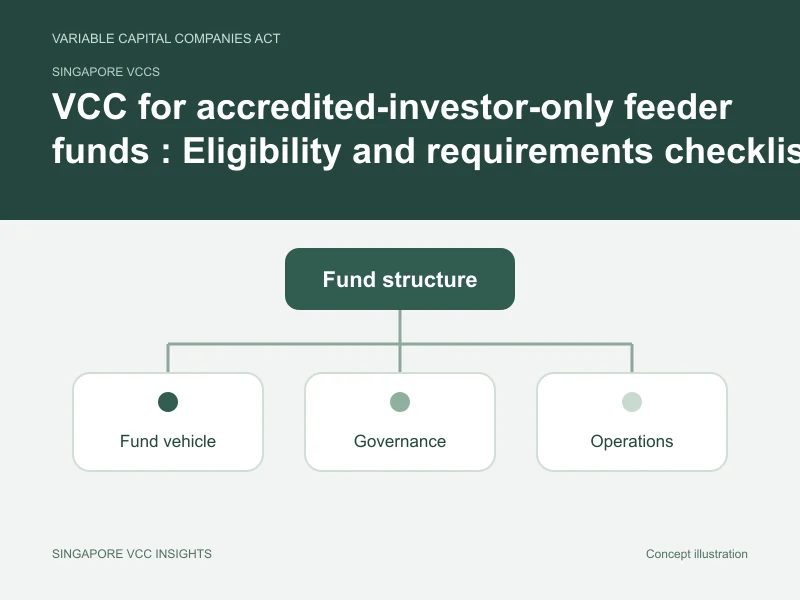
Eligibility and requirements checklist
The requirements are: a Permissible Fund Manager regulated by the Monetary Authority of Singapore; at least one Singapore-resident director; a company secretary; an auditor; a fund administrator; a registered office; and an anti-money-laundering framework aligned to MAS Notice VCC-N01. The offer documents must clearly restrict subscription to accredited investors as defined in the Securities and Futures Act 2001, and the manager must verify investor status.
Where the feeder targets a tax incentive, section 13O or section 13U under the Income Tax Act 1947 may apply, subject to the assets-under-management, spend and headcount conditions assessed by the Monetary Authority of Singapore.
Cost and timeline
Incorporating a VCC with the Accounting and Corporate Regulatory Authority carries a registration fee of S$8,000 for a new VCC, materially higher than the S$300 for an ordinary private limited company, reflecting the fund-vehicle status. Name application is S$15. A single-fund (non-umbrella) VCC can typically be incorporated within 14 to 60 days once the fund manager, directors and anti-money-laundering documentation are in order, because ACRA refers applications to the Monetary Authority of Singapore for review.
Ongoing costs include the mandatory fund administrator, the auditor, the company secretary and the Singapore-based directors. Annual running costs for a straightforward VCC commonly range from S$20,000 to S$60,000 depending on the number of sub-funds, the audit scope and whether a tax-incentive application is maintained. Where a section 13O or section 13U incentive under the Income Tax Act 1947 is sought, budget additional professional fees and a longer MAS lead time.
Step-by-step process
First, appoint a Permissible Fund Manager, since the Variable Capital Companies Act 2018 requires every VCC to be managed by a fund manager regulated by the Monetary Authority of Singapore. Second, appoint at least one Singapore-resident director who is also a director or qualified representative of the fund manager, and appoint the company secretary and auditor. Third, prepare the constitution and the anti-money-laundering framework aligned to MAS Notice VCC-N01. Fourth, lodge the incorporation with ACRA, which refers the application to MAS. Fifth, open the fund bank and custody accounts and, if applicable, apply for the section 13O or section 13U tax incentive.
For the tax framing that usually sits alongside this structure, see our guide to Singapore holding company tax optimisation, and for the corporate-secretarial and incorporation groundwork see opening Singapore fund and corporate bank accounts. For a closely related fund type, compare our checklist on a VCC for real asset and infrastructure funds.
Common mistakes and gotchas
The most common error is assuming a VCC can be self-managed; it cannot, as a Permissible Fund Manager is mandatory. A second is underestimating the S$8,000 incorporation fee and the ongoing administrator and audit costs, which make a VCC uneconomic below a certain asset size. A third is treating sub-funds as fully independent legal persons; while the Variable Capital Companies Act 2018 segregates the assets and liabilities of each sub-fund, the umbrella VCC remains a single legal entity. A fourth is applying for a tax incentive without the economic substance the Monetary Authority of Singapore expects, such as local spend and professionals.
Talk to us
Need help with this? Call, SMS or WhatsApp +65 8501 7133, or email hello@rafflescorporateservices.com. Raffles Corporate Services works with a panel of corporate and employment law firms; this article is general information, not legal advice.
Frequently Asked Questions
What is a feeder fund?
A fund that pools investor capital and invests it into a master fund, rather than investing directly itself.
Why restrict to accredited investors?
Offers limited to accredited investors can rely on exemptions from the full prospectus requirements of the Securities and Futures Act 2001, simplifying the offer.
Can the master fund be offshore?
Yes. A Singapore feeder VCC can invest into an offshore master, giving local investors a regulated access point.
Is a fund manager required?
Yes. A Permissible Fund Manager regulated by the Monetary Authority of Singapore must manage the VCC.
What does it cost?
ACRA incorporation of S$8,000 plus annual running costs commonly between S$20,000 and S$60,000.
Related Guides
Singapore holding company tax optimisation
Efficient pooling of income for Singapore structures.
Singapore bank account opening
Documents fund vehicles need to open accounts.
VCC for real asset and infrastructure funds
Checklist for real-asset and infrastructure VCCs.
VCC foreign-sourced income exemption test
Testing the FSIE for a VCC's foreign income.
Related Singapore Resources
- Raffles Corporate Services for Singapore corporate structuring, fund administration support and family office advisory.
- Singapore Secretary Services for corporate secretary and statutory compliance support for VCCs and fund managers.
- Pros and cons of incorporating a VCC in Singapore.
- Employment agency licensing and manpower compliance resource.
Useful References
Speak to a Singapore VCC Adviser
For Singapore VCC, family office or fund structuring advice, contact +65 8501 7133 by call, SMS or WhatsApp.
You may also review Raffles Corporate Services and Singapore Secretary Services for related Singapore corporate services support.