Independent Singapore VCC guidance
Direct answer
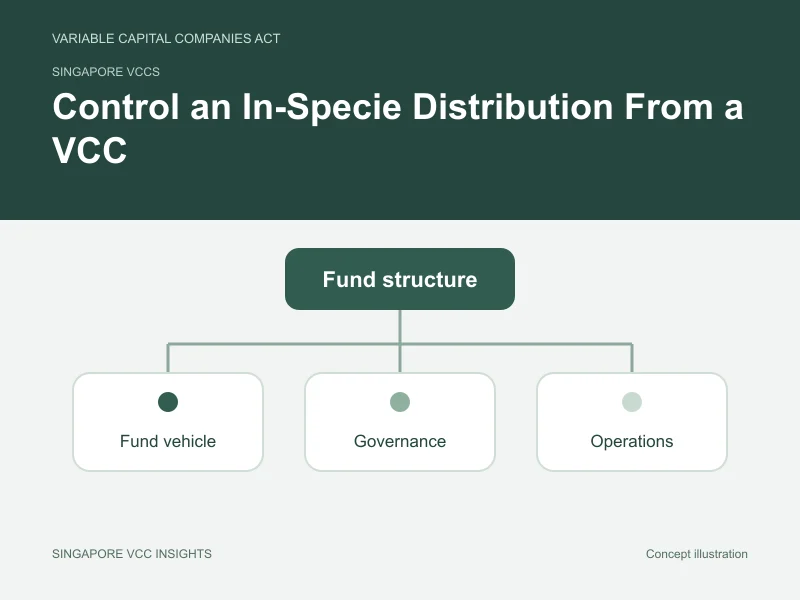
A VCC should distribute an asset in specie only after confirming that the constitution and offering terms permit it, the correct board or delegated authority approves it, the selected asset can be legally and operationally transferred, and valuation and allocation are fair under the fund documents. Complete tax, stamp-duty, custody, consent and restriction checks before release, then reconcile title, books, ownership records and investor statements to one effective distribution event.
At a glance
- Treat non-cash settlement as a new decision, not a cash distribution with a different payment method.
- Verify authority, investor rights, asset title, transfer restrictions and valuation before approval.
- Assess tax and stamp duty for the actual instrument and asset rather than relying on a generic label.
- Close only when legal title, custody, accounting and investor records use the same effective event.
Who this is for
- VCC directors, managers and administrators considering a distribution of securities or other investment assets.
Important exclusions
- A legal, tax or valuation opinion for a particular asset, investor, jurisdiction or transfer instrument.
Start with authority and purpose
Define why assets rather than cash are proposed. Possible reasons include a wind-down, redemption, investor election, liquidity constraint, portfolio separation or contractual entitlement. The reason affects consent, fairness and execution. Read the VCC constitution, offering document, class or sub-fund supplement, subscription terms, side arrangements and distribution policy as one rule set. Confirm whether non-cash distributions are permitted, optional or mandatory; which investors may receive them; who selects assets; which valuation method applies; and whether the investor may refuse. A VCC's flexible capital features do not displace its own documents or the need for a properly authorised decision.
Sources: Accounting and Corporate Regulatory Authority · Singapore Statutes Online- Documents prohibit or are unclearDo not proceed. Obtain legal advice and use cash or a properly approved amendment route if available.
- Investor election is requiredIssue balanced information, record a valid election and preserve a cash alternative if the documents require one.
- Manager selects assetsApply the mandate, conflicts policy, valuation method and board oversight before identifying a parcel.
- Wind-down distributionCoordinate liquidator or closure authority, creditor protection, title transfer and residual-value treatment as one plan.
Related guidance: VCC distribution-from-capital approval
Test the asset before selecting the recipient
Build an asset eligibility file before matching the asset to an investor. Verify legal and beneficial title, correct sub-fund attribution, custody location, encumbrances, transfer restrictions, investor eligibility, minimum holding rules, sanctions or market restrictions, required issuer or lender consent, settlement venue and documentary form. Identify accrued income, pending corporate actions, unsettled trades and tax lots. For an umbrella VCC, do not use an asset of one sub-fund to satisfy an obligation of another. A transferable security may still be unsuitable if the recipient cannot hold it, custody it, value it or receive it by the required date.
Sources: Accounting and Corporate Regulatory Authority · Singapore Statutes Online| Gate | Evidence | Stop condition |
|---|---|---|
| Ownership and attribution | Custody statement, contract, ledger and sub-fund records | Title or pool attribution is uncertain |
| Transferability | Issuer terms, market rules, consents and legal review | Transfer is prohibited or consent is missing |
| Recipient eligibility | Investor representations, account and jurisdiction checks | Recipient cannot lawfully or operationally hold the asset |
| Valuation | Policy, source data, challenge and approved effective time | Reliable value cannot be established |
| Settlement | Custodian instruction, receiving details and matched timetable | No controlled delivery path exists |
Related guidance: in-specie VCC subscription control
Value the distribution and test fairness
Fix the valuation point and method before seeing which investor benefits from a particular parcel. Use the fund's valuation policy and the terms governing redemptions or distributions. Consider accrued income, liquidity discounts, transaction costs, taxes, odd lots, currency, pending events and the difference between accounting value and transferable value. For several recipients, define a rounding and residual-cash rule. If the asset is hard to value or connected to the manager, obtain independent challenge appropriate to the risk. The aim is not to make every recipient hold the same asset; it is to apply the agreed economic rule consistently and explain any difference.
Sources: Singapore Statutes Online · Monetary Authority of Singapore- Lock the valuation date, time, currency, pricing source and hierarchy before allocation.
- Record accrued income, fees, taxes, transfer costs and residual-cash treatment separately.
- Identify related parties, illiquid assets and manager-selected estimates for enhanced review.
- Compare the result with cash treatment and other investors receiving distributions at the same event.
- Obtain the approval required by the valuation policy and governing distribution terms.
Complete tax and instrument checks
Map the actual transaction, asset and instrument before deciding tax or duty. IRAS explains that a VCC is treated as a company for stamp-duty purposes and that sub-funds of an umbrella VCC are treated separately for that purpose. Transfers involving Singapore immovable property, shares or interests in property-holding entities can create specific duty questions. The distribution label does not answer them. Identify who transfers what to whom, where the instrument is executed, when it is received in Singapore, the consideration or distribution value and whether any intra-umbrella rule is relevant. Obtain advice for income tax, withholding, foreign taxes and investor reporting in each affected jurisdiction.
Sources: Inland Revenue Authority of Singapore · Accounting and Corporate Regulatory AuthorityRelated guidance: intra-umbrella stamp-duty notice
Approve one complete transaction pack
The approval paper should identify the VCC, sub-fund, class, investor, entitlement, selected asset, valuation, conflicts, costs, taxes, consents, settlement route and alternatives considered. Attach the governing extracts and all unresolved conditions. The resolution should authorise specific people to issue transfer and custody instructions, specify the effective time and state what happens if a consent or settlement condition fails. If several investors are affected, include the complete allocation schedule rather than approving each parcel in isolation. Do not allow a provider to substitute another asset or alter the effective value without returning to the authorised exception process.
Sources: Singapore Statutes Online · Monetary Authority of Singapore- PrepareAssemble authority, entitlement, asset, valuation, tax, consent, conflict and settlement evidence in one indexed pack.
- ChallengeTest fairness, deliverability, alternatives and failure scenarios before the final decision-maker receives the proposal.
- ApproveRecord the asset, value, recipient, effective time, named instructing officers and any conditions that must be cleared.
- ReleaseSend one controlled instruction to the custodian and administrator only after every precondition is evidenced.
Related guidance: sub-fund contract identification checklist
Settle and reconcile the same event
Use matched delivery instructions and independently verified receiving details. Monitor rejection, partial delivery, market closure, consent delay and corporate-action changes. Do not derecognise the asset or mark the distribution complete merely because an instruction was sent. On settlement, reconcile the custodian, investment ledger, general ledger, NAV records, distribution entitlement, investor capital account and ownership record. Confirm which party received any income or event entitlement around the transfer date. Issue the investor statement from the final settled facts. Keep a residual-items log for cash balancing, fractions, failed parcels, taxes and costs until each item is resolved.
Sources: Singapore Statutes Online · Accounting and Corporate Regulatory Authority| Record | Expected evidence | Exception to investigate |
|---|---|---|
| Custody | Delivered asset, quantity, date and receiving account | Rejected, partial or unmatched delivery |
| Fund books | Derecognition and realised or distribution entries | Book date or value differs from approval |
| Investor account | Entitlement, value, costs and residual cash | Statement does not match settled asset |
| Ownership and reporting | Updated holdings and required tax records | Legal or reporting position remains open |
| Governance file | Approval, instructions, confirmations and closure memo | Condition was waived without authority |
Related guidance: VCC sub-funds guide
Frequently asked questions
Can every VCC make an in-specie distribution?
No general operational assumption is safe. The constitution, offering and class or sub-fund terms must permit the transaction and identify the relevant authority, valuation and investor rights. The selected asset must also be transferable to the recipient. Obtain legal and tax advice where the documents or asset restrictions are unclear.
Does the investor have to consent?
That depends on the governing documents, the type of distribution and the investor's existing rights. Some terms may allow manager selection, some may require an election and others may preserve a cash alternative. Record the applicable rule and any valid consent before committing the VCC to transfer the asset.
Which value should be used for the asset?
Use the valuation method and effective point required by the fund documents and valuation policy, with appropriate challenge for illiquid or connected assets. Address accrued income, costs, taxes, currency and residual fractions. Do not choose a convenient price after the recipient or parcel has already been selected.
Is stamp duty irrelevant because no cash is paid?
No. IRAS looks at the instrument and underlying asset, not only whether cash consideration is paid. Transfers involving certain property, shares or property-holding interests can require specific analysis. Have the actual transaction reviewed before execution and meet any applicable filing and payment timetable.
When is the distribution complete?
Treat completion as the point when required title or custody transfer has settled and the custodian, books, investor entitlement, ownership records and statements all agree. A sent instruction or signed resolution is not enough. Keep failed parcels, residual cash, taxes and costs open until reconciled.
Official sources and further reading
- Understanding VCC Features, Eligibility and Requirements (Accounting and Corporate Regulatory Authority)
- Stamp Duty for Variable Capital Companies (Inland Revenue Authority of Singapore)
- Variable Capital Companies Act 2018 (Singapore Statutes Online)
- Governance and Management of Variable Capital Companies (Monetary Authority of Singapore)
Discuss a Singapore VCC structure
For help coordinating a Singapore VCC setup or corporate administration, contact Raffles Corporate Services.
General information only. This article is not legal, tax, regulatory or investment advice and does not imply affiliation with or endorsement by ACRA, MAS or IRAS.