Independent Singapore VCC guidance
Direct answer
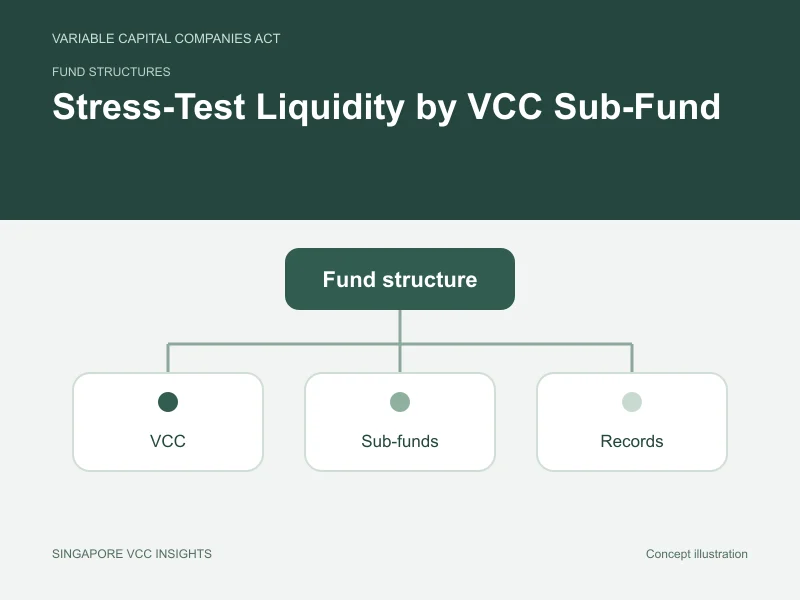
Run the test separately for each sub-fund, using its own investor terms, cash obligations, financing, collateral, asset-sale capacity and operational constraints. Apply a small set of severe but plausible scenarios, challenge every material assumption, and convert the result into a decision trigger rather than a decorative ratio. Aggregate only after each pool is understood, and retain the inputs, approvals, actions and rerun evidence.
At a glance
- Do not let umbrella totals hide a weak sub-fund.
- Model cash needs and asset conversion together.
- Challenge settlement, pricing, market-depth and investor-behaviour assumptions.
- Link each threshold to an owner, action and rerun requirement.
Who this is for
- Umbrella VCC managers, directors, risk teams and administrators designing or reviewing liquidity stress tests.
Important exclusions
- A prescribed regulatory model, investment recommendation or automatic instruction to gate, suspend or sell assets.
Define the tested liquidity perimeter
Start with the legal and operational pool that can actually meet an obligation. For each sub-fund, list available cash, settlement receivables, credit facilities, collateral calls, operating expenses, investor dealing terms and assets that may be converted to cash. The umbrella view is a roll-up for oversight, not permission to assume that one sub-fund can fund another. ACRA describes umbrella sub-funds as separate pools with their own assets and liabilities.
Sources: Accounting and Corporate Regulatory Authority · Accounting and Corporate Regulatory AuthorityPopulation controls
- Bank, custody and financing balances mapped to the correct sub-fund.
- Investor redemption or distribution terms taken from current executed documents.
- Known collateral, expense and capital-call obligations included on their expected dates.
- Restricted, pledged, suspended or operationally inaccessible assets identified separately.
- Intercompany or umbrella amounts excluded unless a valid, documented route exists.
Related guidance: VCC cash counterparty limits · VCC sub-funds guide
Build scenarios from real failure paths
A useful scenario combines liability pressure with weaker asset conversion. Test investor outflows or funding needs alongside wider bid-offer spreads, delayed settlement, lower market depth, valuation uncertainty and unavailable credit. Use the sub-fund mandate and investor profile to decide which drivers matter. Avoid one uniform shock across every strategy when the portfolios, dealing frequencies and funding structures differ.
Sources: Monetary Authority of Singapore| Scenario | Liability pressure | Asset and operational pressure |
|---|---|---|
| Concentrated redemption | A material investor requests liquidity within the permitted dealing terms. | The most liquid assets sell first, changing the remaining portfolio mix. |
| Market closure | Ordinary payments and margin needs continue. | A key market or pricing source becomes unavailable for part of the portfolio. |
| Collateral squeeze | Calls arrive while cash buffers are already committed. | Eligible collateral is narrower and settlement takes longer than normal. |
| Provider disruption | Investor and financing dates remain unchanged. | Dealing, instruction or reconciliation capacity is temporarily constrained. |
Related guidance: sub-fund margin-call workflow
Work through one sub-fund scenario
Assume a private-credit sub-fund receives a concentrated redemption that is valid under its documents while a borrower payment is delayed. The team first fixes the redemption amount and date, then removes cash that is restricted for known obligations. It ranks assets by executable conversion route rather than accounting label, applies stressed timing and proceeds assumptions, and records where valuation uncertainty makes the result unreliable. The outcome is a dated cash ladder and an exception list, not a single liquidity percentage.
Sources: Monetary Authority of SingaporeWorked decision sequence
- Lock liabilitiesConfirm valid investor, financing, collateral and operating cash needs within the scenario horizon.
- Haircut availabilityRemove restricted cash and adjust asset proceeds and timing for stressed execution conditions.
- Locate the breakIdentify the earliest date on which available liquidity no longer covers required cash.
- Select an actionRoute permitted management options through the authority and document checks for the sub-fund.
- RerunApply the approved action to the same controlled model and retain the before-and-after result.
Challenge assumptions before accepting output
Independent challenge should ask whether the scenario uses current investor terms, whether sale capacity reflects actual market depth, whether credit can be drawn under stress, and whether the administrator and custodian can execute the assumed steps. Compare assumptions with recent exceptions and provider evidence. Where a result depends on a fragile assumption, show the sensitivity and place the item on the decision list rather than smoothing it away.
Sources: Monetary Authority of SingaporeAssumption challenge route
- Evidence is current and independentUse the assumption and retain its source, date and owner with the model.
- Evidence is stale or manager-supplied onlyApply a more conservative alternative and seek independent support before closure of the model review.
- The assumption cannot be supportedTreat the result as unreliable, escalate the gap and rerun after a defensible input is chosen.
Turn results into governed actions
Predefine which result requires monitoring, management action or formal escalation. The trigger should identify the affected sub-fund, the authority that may act, investor-document constraints and the evidence needed to resume ordinary operation. Do not turn a stress test into an automatic dealing suspension or asset-sale instruction. It is an input to a governed decision that must consider the actual documents, conditions and investor fairness.
Sources: Monetary Authority of SingaporeEvidence lifecycle
- PrepareFreeze the population, assumptions, scenario owner and controlled version before any calculation begins.
- ChallengeRecord questions, alternative inputs, unresolved weaknesses and the approved final assumptions for every sub-fund.
- DecideLink threshold outcomes to named owners, permitted management options and documented escalation records.
- RerunShow whether an approved action restores the cash ladder without creating a new sub-fund problem.
- LearnFeed actual redemption, settlement and provider experience into the next scenario set.
Related guidance: VCC liquidity escalation dashboard
Frequently asked questions
Can an umbrella VCC use one combined liquidity test?
It may use an umbrella summary for oversight, but the calculation should preserve each sub-fund's assets, liabilities, investor terms and operational constraints. Aggregation can otherwise hide a shortfall or imply access to another pool that is not available.
Does a stress test need to predict the next crisis?
No. Its purpose is to expose decision weaknesses under severe but plausible combinations of events. The test is useful when assumptions are transparent, challenged and connected to actions, even though the exact future event will differ.
Should every sub-fund use the same scenarios?
Use a common governance framework, then tailor the drivers. A liquid public-markets sub-fund, a private-credit pool and a leveraged strategy can face very different settlement, valuation, collateral and investor-behaviour pressures.
What makes an asset liquid in the model?
Use executable access, expected stressed timing, likely proceeds, settlement and operational capacity. An accounting classification or normal-market observation is not enough if the asset is pledged, restricted, difficult to price or slow to settle.
When is the test complete?
Complete it only after inputs and assumptions are approved, exceptions are recorded, trigger outcomes have owners, selected actions are rerun and the final evidence can be reproduced. A calculated ratio without a decision trail is incomplete.
Official sources and further reading
- Choosing a VCC Type and Financial Year End (Accounting and Corporate Regulatory Authority)
- Risk Management Practices for Fund Management Companies (Monetary Authority of Singapore)
- Understanding VCC Features, Eligibility and Requirements (Accounting and Corporate Regulatory Authority)
Discuss a Singapore VCC structure
For help coordinating a Singapore VCC setup or corporate administration, contact Raffles Corporate Services.
General information only. This article is not legal, tax, regulatory or investment advice and does not imply affiliation with or endorsement by ACRA, MAS or IRAS.