Independent Singapore VCC guidance
Direct answer
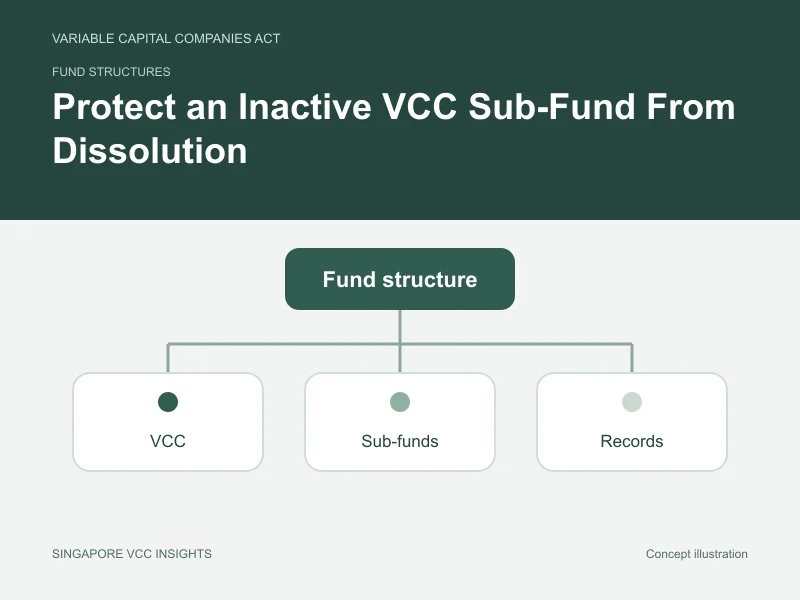
An umbrella VCC should treat an inactive sub-fund as a governed status decision, not leave it in an undefined middle state. Confirm whether the sub-fund still carries on genuine fund activity, preserve evidence, answer any Registrar correspondence through an accountable route, and decide whether to reactivate, maintain for a documented reason, or close it formally. If the facts do not support continuing operation, voluntary closure is usually safer than manufacturing activity.
At a glance
- Create one factual status file for the sub-fund before responding.
- Do not ignore registered correspondence or rely on nominal transactions.
- Separate a temporary launch delay from a genuinely defunct sub-fund.
- Use a board-approved path for remediation, continued operation or formal closure.
Who this is for
- Directors, managers and company secretaries of umbrella VCCs with inactive or uncertain sub-funds.
Important exclusions
- An insolvency or liquidation opinion where the sub-fund has unsettled debts, claims or investor disputes.
Understand the current dissolution signal
Section 33A of the Variable Capital Companies Act gives the Registrar power to dissolve defunct sub-funds. The current VCC Regulations identify two circumstances relevant to whether an umbrella VCC is not carrying on business for a sub-fund: failure to respond to required registered correspondence and credible information indicating that business is not being carried on. These are regulatory signals, not a licence to create a token transaction. The correct response is to establish the true status, preserve the communication trail and make an accountable decision about the sub-fund's future.
Sources: Singapore Statutes Online · Singapore Statutes Online · Accounting and Corporate Regulatory AuthorityRelated guidance: VCC compliance checklist
Build a factual sub-fund status file
Assemble the constitution and sub-fund terms, registration record, manager mandate, investor register, bank and custody records, portfolio positions, liabilities, contracts, accounting ledger, audit status, tax status, unresolved claims and recent board decisions. Reconcile these records to a single cut-off date. The file should distinguish no current investments from no business at all. A sub-fund may be between transactions while still administering assets, liabilities or an orderly exit, but that conclusion needs evidence. Conversely, an empty registration with no investors, mandate, activity or credible launch plan may be better treated as a closure candidate.
Sources: Accounting and Corporate Regulatory Authority · Accounting and Corporate Regulatory Authority · Monetary Authority of Singapore| Status area | Evidence | Question |
|---|---|---|
| Purpose | Current mandate, approved strategy and launch or exit plan | Is there a real fund task still being carried on? |
| Investors | Register, commitments, notices and unresolved obligations | Does any investor relationship remain open? |
| Assets and liabilities | Custody, bank, ledger, contracts and claims | What must be administered or settled? |
| Providers | Manager and service-provider scopes, invoices and open work | Who is actively responsible for the sub-fund? |
| Governance | Board decisions, correspondence log and action owners | Can the VCC explain and evidence its chosen status? |
Related guidance: VCC sub-funds guide
Control every regulatory communication
Route registered mail, portal messages and emails through a named company-secretary owner with a deputy. Log the received date, requested response, evidence owner, draft approver and proof of submission. Directors should see the exact question and the evidence supporting the answer. A generic statement that the sub-fund remains active is weak if the underlying file shows no operations. If more time is needed, seek advice promptly and communicate through the proper channel rather than allowing a response date to pass while providers debate ownership.
Sources: Singapore Statutes Online · Accounting and Corporate Regulatory Authority · Monetary Authority of Singapore- Receive and preserveSave the envelope, message, attachments and portal record, then fix the official received date.
- Assign and scopeName a director sponsor, response owner and evidence contributors, and identify the exact facts requested.
- Reconcile statusCompare manager, administrator, custody, bank, investor and company-secretarial records to one cut-off.
- Approve the answerHave directors review material inconsistencies, the proposed status and any closure or remediation commitment.
- Submit and retainUse the required channel, retain proof of submission and track every promised follow-up to completion.
Related guidance: VCC investment mandate breach response
Choose remediation or formal closure
Continue the sub-fund only where there is a documented fund purpose and a credible operating plan supported by current providers and governance. A delayed launch needs dated dependencies, decision points and a stop rule. An orderly exit needs a complete asset, liability, investor and claim map. Where the sub-fund is no longer active and has no sound reason to remain open, ACRA provides an application route to dissolve it. Before choosing that route, determine whether debts, claims, assets, investor rights or winding-up issues require a different process and obtain professional advice for unresolved cases.
Sources: Accounting and Corporate Regulatory Authority · Accounting and Corporate Regulatory Authority · Singapore Statutes Online- Real activity continuesMaintain the sub-fund, close evidence gaps and set a scheduled board review of its operating status.
- Launch or exit is temporarily delayedApprove a bounded remediation plan with dependencies, owners, evidence dates and a closure trigger.
- No activity and no continuing purposeAssess voluntary dissolution after confirming assets, liabilities, investors, providers and disputes are resolved.
- Debt, claim or insolvency issue existsStop the simple closure path and obtain advice on the appropriate winding-up or dispute process.
Related guidance: VCC provider exit and handover plan
Frequently asked questions
Does an empty portfolio automatically mean a sub-fund is defunct?
Not necessarily. A sub-fund may be between investments, launching, distributing proceeds or administering residual obligations. Directors should prove the current purpose and real activity with records. An empty shell with no credible plan, providers or obligations presents a different risk.
Can the board simply state that the sub-fund will launch later?
A statement alone is weak. Use a dated launch plan showing approved strategy, manager readiness, service-provider dependencies, investor work and stop conditions. If the plan repeatedly slips without evidence of progress, the board should reconsider whether continued registration is justified.
What if registered correspondence was sent to an old service address?
Escalate immediately, preserve when and how the issue was discovered, correct the communication route and obtain advice on the response. The VCC should also test registered-office, director and company-secretary contact controls so the same failure cannot recur.
Should an inactive sub-fund be closed even if the umbrella remains active?
It may be appropriate because sub-funds can be closed individually, but the correct route depends on assets, liabilities, investors, claims and any winding-up considerations. The umbrella's continued operation does not by itself resolve the inactive sub-fund's status.
Who should own the sub-fund status decision?
The board should own the decision, supported by the fund manager, administrator, company secretary and other providers. Each contributor supplies evidence from its records, while directors resolve inconsistencies and approve the continuing-operation, remediation or closure path.
Official sources and further reading
- Variable Capital Companies Act 2018, Part 4 (Singapore Statutes Online)
- Variable Capital Companies Regulations 2020 (Singapore Statutes Online)
- Closing a Variable Capital Company Sub-Fund (Accounting and Corporate Regulatory Authority)
- Understanding VCC Features, Eligibility and Requirements (Accounting and Corporate Regulatory Authority)
- Overview of Managing a Variable Capital Company (Accounting and Corporate Regulatory Authority)
- Governance and Management of Variable Capital Companies (Monetary Authority of Singapore)
Discuss a Singapore VCC structure
For help coordinating a Singapore VCC setup or corporate administration, contact Raffles Corporate Services.
General information only. This article is not legal, tax, regulatory or investment advice and does not imply affiliation with or endorsement by ACRA, MAS or IRAS.