Independent Singapore VCC guidance
Direct answer
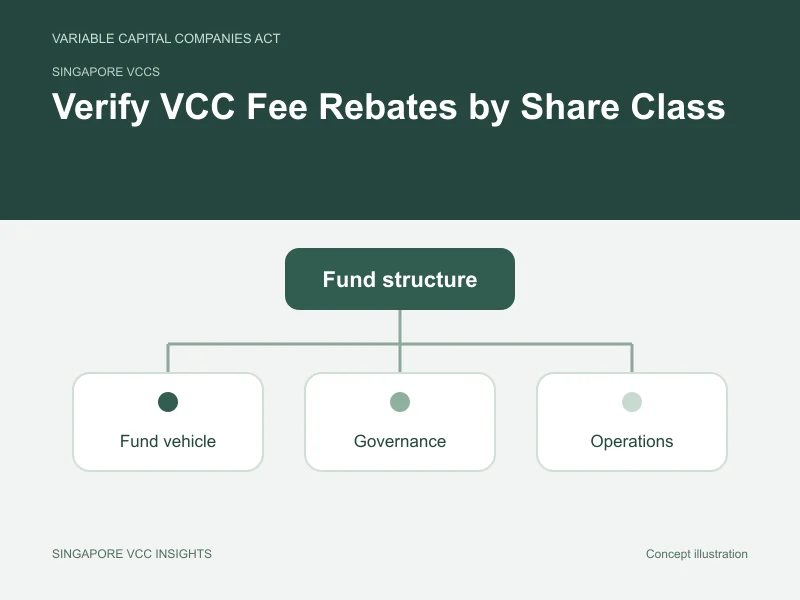
Verify a VCC fee rebate by tracing it from the governing term or approved agreement to the eligible investor or class, calculation base, effective period, accrual, NAV output, invoice or credit, cash settlement and investor statement. Keep a class-wide fee waiver separate from an investor-specific rebate. Do not net an expected rebate against expense merely because it is commercially anticipated; the record should show the approved basis and current accounting treatment.
At a glance
- Identify the document and authority that creates each fee variation.
- Map the term to the exact class or investor and effective period.
- Recalculate the gross fee before testing any rebate or waiver.
- Keep accrual, receivable, credit note and cash settlement distinct.
- Reconcile NAV, invoice and investor reporting to one approved schedule.
Who this is for
- Management-fee rebates, waivers or class-specific rates affecting a standalone VCC or a share class within a sub-fund.
Important exclusions
- A recommendation on fee levels, tax deductibility, accounting recognition or whether a particular investor should receive preferential terms.
Create a complete fee-terms register
List every current management-fee rate, waiver, rebate, breakpoint, founder term and investor-specific arrangement. For each entry, capture the source document, approval, beneficiary, class, sub-fund, calculation base, start and end condition, payment method and amendment history. A marketing summary or email should not silently override executed terms. Where documents appear inconsistent, hold the exception for interpretation before changing the NAV calculation.
Sources: Monetary Authority of Singapore · MoneySense · Monetary Authority of Singapore- Record the exact VCC, sub-fund, class and investor to which each term applies.
- Identify whether the variation changes the fee rate, creates a later rebate or waives an amount entirely.
- Capture the calculation base, day-count or period convention and any breakpoint or cap.
- Link the approval and effective version without deleting superseded terms.
- Assign an owner to resolve conflicts between offering documents, agreements and administrator setup.
Related guidance: VCC provider directory
Recalculate the gross fee first
Start from the gross fee that would apply before a rebate. Confirm the valuation base, applicable class NAV or other defined measure, period, accrual frequency, investor movements and currency conversion. Reconcile the rate and base to administrator configuration and independent source data. This creates a transparent control point. If the process begins with a net amount, reviewers may not see whether the fee or the rebate caused the difference.
Sources: MoneySense · Monetary Authority of Singapore · Monetary Authority of Singapore| Layer | Control question | Evidence |
|---|---|---|
| Gross contractual fee | What amount follows the standard rate and approved calculation base? | Rate source, NAV base, period and independent recalculation. |
| Class variation | Does the entire class have a different rate or waiver? | Class terms, effective date and administrator parameter. |
| Investor-specific rebate | Which holder qualifies and how is the amount delivered? | Executed term, holding history, calculation and approval. |
| Accounting entry | Is the variation recorded as reduced expense, payable, receivable or another treatment? | Accounting policy and period-end reconciliation. |
| Settlement and reporting | Did cash, credit and investor statements match the approved amount? | Bank record, invoice, credit note and statement tie-out. |
Test eligibility and timing
Rebates often depend on a holder, class, commitment, balance, launch cohort or negotiated agreement. Build an eligibility population from controlled investor and holding records for each accrual period. Decide how transfers, subscriptions, redemptions, switches, partial periods and class changes affect the calculation under the actual terms. Avoid manually carrying a former holder’s rebate to a transferee unless the agreement supports it. Record ambiguities before NAV approval so the same issue is not decided differently each month.
Sources: Monetary Authority of Singapore · Monetary Authority of Singapore · Accounting and Corporate Regulatory Authority- Define the populationExtract eligible investors and classes from approved records for the exact accrual period and fund.
- Apply movement rulesTest subscriptions, redemptions, transfers, switches and partial periods against the documented effective terms.
- Calculate independentlyReperform gross fee and rebate calculations using controlled holdings, rates, bases and currency inputs.
- Resolve exceptionsEscalate missing agreements, ambiguous dates, stale rates or unmatched investors before final NAV approval.
Approve, report and retain the evidence
The reviewer pack should contain the terms register, population, gross fee, rebate calculation, exceptions, accounting treatment, billing tie-out and cash status. Separate preparation, review and approval. Trend overrides and late credits because repeated manual fixes can indicate weak contract capture or administrator setup. When terms change, use controlled change instructions and test the first affected NAV. Retain prior terms and calculations so later financial, tax or investor queries can reconstruct the amount.
Sources: Monetary Authority of Singapore · Monetary Authority of Singapore · Inland Revenue Authority of SingaporeUse the management-fee invoice guide for provider billing, the shared-expense guide for costs that belong across sub-funds, and the NAV oversight comparison to assign preparation and independent review responsibilities.
Sources: Monetary Authority of Singapore · Accounting and Corporate Regulatory AuthorityRelated guidance: management-fee invoice validation · shared sub-fund expense allocation
Frequently asked questions
Is a fee waiver the same as a fee rebate?
Not always. A waiver may reduce or remove a charge before it becomes payable, while a rebate may return an amount after a gross fee is calculated. The executed terms and accounting treatment should determine the route.
Can an investor-specific rebate reduce the class NAV expense?
That depends on the approved arrangement and accounting treatment. Do not reduce expense for every class investor merely because one holder has a separate commercial term. Preserve the beneficiary and settlement route.
What happens when the eligible investor transfers its shares?
Test the transfer date and rebate agreement. A personal or investor-specific right should not automatically follow the shares unless the terms support that result and the required approval is completed.
Should an expected credit note be treated as received?
No. Keep estimated accrual, agreed credit, issued credit note and cash settlement as separate statuses. The financial treatment should follow the evidence and approved accounting policy, not the expected commercial outcome.
What is the strongest monthly control?
Recalculate the gross fee independently, derive the eligible population from controlled records, test the rebate under approved terms and tie the result to NAV, billing, cash and investor statements.
Official sources and further reading
- Understanding VCC Features, Eligibility and Requirements (Accounting and Corporate Regulatory Authority)
- Overview of Managing a Variable Capital Company (Accounting and Corporate Regulatory Authority)
- Valuation Practices for Fund Management Companies (Monetary Authority of Singapore)
- Governance and Management of Variable Capital Companies (Monetary Authority of Singapore)
- Current Singapore Prospectus With Dealing Procedures (Monetary Authority of Singapore)
- Tax Framework for Variable Capital Companies (Inland Revenue Authority of Singapore)
- Unit Trusts: Guide to Pricing and Fees (MoneySense)
Discuss a Singapore VCC structure
For help coordinating a Singapore VCC setup or corporate administration, contact Raffles Corporate Services.
General information only. This article is not legal, tax, regulatory or investment advice and does not imply affiliation with or endorsement by ACRA, MAS or IRAS.