Independent Singapore VCC guidance
Direct answer
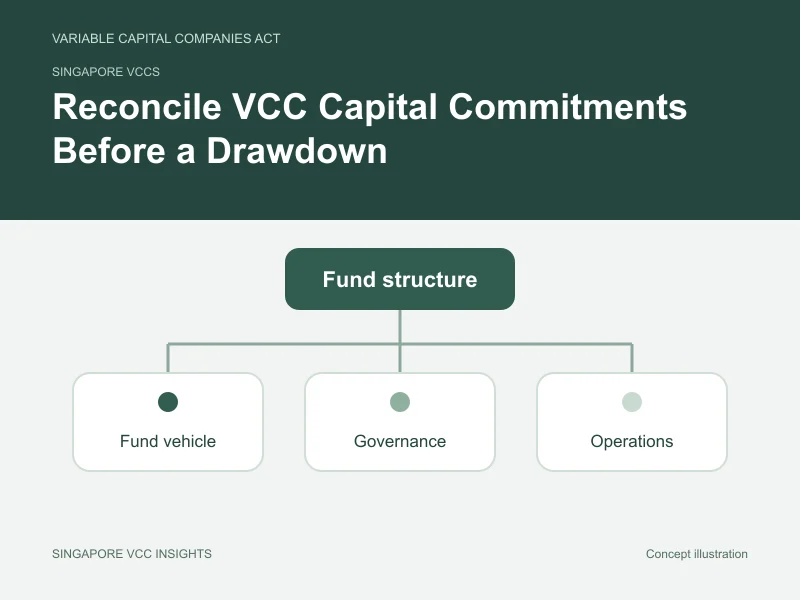
Before issuing a VCC drawdown, reconcile each investor’s executed commitment from opening balance to current undrawn amount. Separate capital previously called, cash funded, amounts cancelled or recalled, transfers, equalisation and unresolved defaults. Then compare the proposed call with the governing terms, investor-specific arrangements, approved purpose and available undrawn balance. Release notices only when the investor ledger, administrator records, bank evidence and approval schedule produce the same population and amount.
At a glance
- Use executed investor terms as the commitment authority, not a marketing summary.
- Keep called, due, funded, recallable and undrawn amounts as separate fields.
- Reconcile transfers and subsequent closings before calculating a new call.
- Hold investors with unresolved data, currency or authority exceptions.
- Bridge the final call through cash receipt and capital-account reporting.
Who this is for
- Closed-ended or hybrid VCCs using investor commitments and periodic capital calls for investments, fees or approved fund expenses.
Important exclusions
- A universal capital-call formula, interpretation of specific fund terms, or authority to call capital for an undocumented purpose.
Build the commitment authority file
Start with executed documents and accepted amendments for each investor: subscription terms, commitment amount and currency, closing date, transfer or novation records, side arrangements, excuse or exclusion rights and any approved commitment changes. A VCC is a corporate fund structure whose shareholders own shares, but the economic drawdown method depends on the effective fund and investor terms. Record the controlling clause or document reference for each schedule field so an operator does not convert convention into authority.
Sources: Accounting and Corporate Regulatory Authority · Accounting and Corporate Regulatory Authority · Monetary Authority of Singapore OPERA- Confirm the legal investor name, VCC, sub-fund, class, commitment currency and executed commitment amount.
- Capture the effective closing, transfer, increase, decrease and investor-specific terms from approved documents.
- Identify excuse, exclusion, concentration or purpose restrictions that may change participation in a call.
- Link every manual adjustment to a named approval and preserved supporting record.
- Freeze the authority file version used for the proposed drawdown population.
Related guidance: VCC sub-funds guide
Bridge the opening commitment to undrawn balance
Use a movement bridge rather than subtracting one lifetime-called figure from commitment. Separate amounts called, due, funded, cancelled, returned as recallable capital, transferred and written off under authorised terms. A call can be issued but not yet due, due but unpaid, or funded with a bank timing difference. Those states have different operational consequences. Keep both transaction currency and commitment currency where conversion applies, with the approved rate source and date visible.
Sources: Accounting and Corporate Regulatory Authority · Accounting and Corporate Regulatory Authority · Monetary Authority of Singapore OPERA| Field | Meaning | Primary evidence | Common error |
|---|---|---|---|
| Executed commitment | Current approved commitment after accepted amendments. | Subscription and amendment documents | Using a pipeline or CRM amount |
| Cumulative called | Notices validly issued under the effective terms. | Approved call register and notices | Treating every draft as issued |
| Cumulative funded | Accepted cash allocated to the investor. | Bank receipts and administrator ledger | Using due amounts as cash received |
| Recallable amount | Capital returned and available to call again only where terms permit. | Distribution and recall records | Assuming every distribution restores capacity |
| Transfers and changes | Commitment moved or amended through approved documents. | Transfer, novation or amendment file | Updating one investor without the counter-entry |
| Current undrawn | Remaining callable capacity after the approved bridge. | Reconciled commitment schedule | Plugging the balance to match a target call |
Related guidance: subsequent closing equalisation workflow
Calculate the proposed call from purpose to investor
Begin with the approved use of funds and total cash requirement, then apply the governing allocation method to the eligible investor population. Separate investment cost, fund expense, management fee, reserve and equalisation components where the terms treat them differently. Test investor-specific exclusions and caps before rounding. The total of investor notices should reconcile to the approved call requirement, currency funding plan and expected VCC bank receipt without a hidden balancing amount.
Sources: Accounting and Corporate Regulatory Authority · Accounting and Corporate Regulatory Authority · Accounting and Corporate Regulatory Authority- Approve the purposeDocument the investment, expense, reserve or other authorised reason and the required funding date.
- Set the eligible populationApply investor, class, closing, excuse, exclusion and transfer terms before calculating percentages.
- Calculate componentsSeparate each economic component, currency conversion and rounding result so the notice can be reproduced.
- Test available capacityConfirm the proposed amount does not exceed each investor current undrawn balance under the approved bridge.
- Reconcile the totalTie all notices to the approved requirement, bank plan, administrator register and governance approval.
Hold exceptions before notice release
Create an exception register for missing documents, disputed commitment, transfer mismatch, stale bank details, currency ambiguity, pending excuse decision, prior default or unexplained difference between the administrator and internal schedule. Do not issue a notice and plan to correct it later merely to meet an internal timetable. Resolve the affected investor or obtain an authorised population-level decision while preserving equal treatment and the fund-specific terms.
Sources: Accounting and Corporate Regulatory Authority · Accounting and Corporate Regulatory Authority · Accounting and Corporate Regulatory Authority- Records agree and capacity is sufficientInclude the investor and retain the calculation and review evidence used for the notice.
- A transfer is incompleteUse the currently effective holder and terms unless an authorised legal conclusion establishes another result.
- Prior cash is unmatchedResolve the bank and ledger difference before changing cumulative funded or undrawn amounts.
- An exclusion may applyHold the affected allocation until the authorised fund-specific decision is documented.
- The proposed call exceeds capacityReduce, reallocate only where terms permit, or seek an authorised alternative funding decision.
Related guidance: defaulting investor capital-call response
Reconcile notices through funding and reporting
After approval, generate notices from the locked schedule and verify investor, amount, currency, due date and approved bank instruction before release. Track delivery, receipt and exceptions without overwriting the issued population. Match cash by investor and value date, then update called, funded and undrawn fields through controlled entries. Reconcile the result to bank balances, the investor ledger, the VCC capital account statement and the investment or expense funding purpose that initiated the call.
Sources: Accounting and Corporate Regulatory Authority · Accounting and Corporate Regulatory Authority · Monetary Authority of Singapore OPERARelated guidance: VCC investor capital account statement
Frequently asked questions
Is undrawn commitment simply commitment minus cash received?
Not always. The bridge may need to distinguish calls issued, amounts due, cash funded, cancelled calls, permitted recalls, transfers and commitment amendments. Use the effective fund terms and reconciled records.
Can a returned distribution increase undrawn commitment?
Only where the governing terms permit recall or recycling and the transaction is recorded accordingly. Do not assume every distribution restores callable capacity merely because cash was returned to an investor.
How should an investor transfer affect the schedule?
Apply the executed and effective transfer or novation terms, update both sides of the movement, and reconcile commitment, called, funded and undrawn fields. Do not move only the headline commitment amount.
What should block a capital call notice?
Block unresolved authority, investor identity, transfer, exclusion, currency, bank instruction, prior-cash or undrawn-capacity exceptions. Internal timing pressure is not a valid reason to issue a notice known to be unreliable.
When is the reconciliation complete?
Complete it when issued notices match the approved schedule, delivery is evidenced, funded cash matches the bank and investor ledger, exceptions are resolved, and the updated capital-account reporting explains the movement.
Official sources and further reading
- Understanding VCC Features, Eligibility and Requirements (Accounting and Corporate Regulatory Authority)
- Choosing Directors and Key Officers for a VCC (Accounting and Corporate Regulatory Authority)
- Overview of Managing a Variable Capital Company (Accounting and Corporate Regulatory Authority)
- About the Offers and Prospectuses Electronic Repository and Access (Monetary Authority of Singapore OPERA)
Discuss a Singapore VCC structure
For help coordinating a Singapore VCC setup or corporate administration, contact Raffles Corporate Services.
General information only. This article is not legal, tax, regulatory or investment advice and does not imply affiliation with or endorsement by ACRA, MAS or IRAS.