Independent Singapore VCC guidance
Direct answer
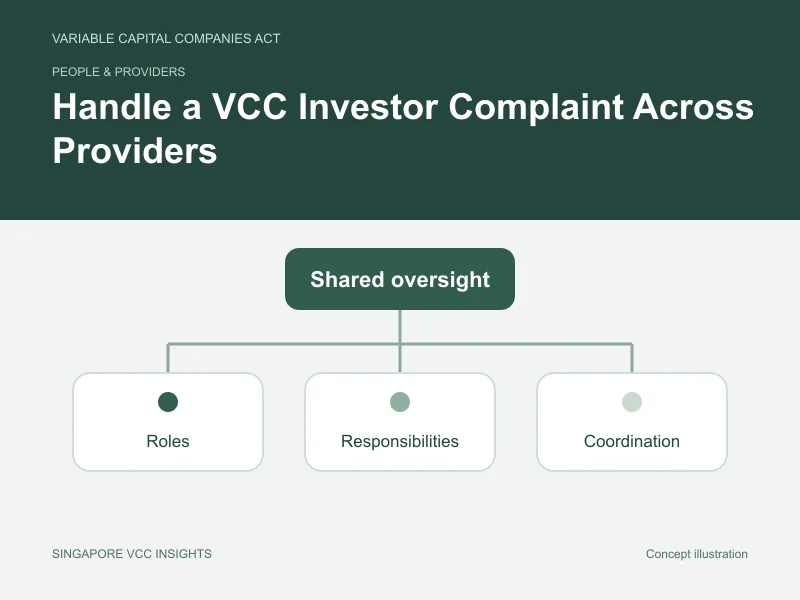
Open one VCC complaint case even when several providers are involved. Acknowledge receipt without prejudging the outcome, preserve the investor’s original words and all linked records, classify the issue, and assign factual work to the manager, administrator, distributor, bank or other responsible party. Keep one accountable owner and one approved response. Close only after the conclusion, remediation, investor communication and operational records agree.
At a glance
- Preserve the original complaint and communication channel before summarising it.
- Separate ownership of the case from ownership of each underlying fact.
- Classify urgent money, access, disclosure and misconduct concerns immediately.
- Use one approved chronology and evidence index across all providers.
- Verify remediation instead of closing on a promise or forwarded email.
Who this is for
- VCC complaints about investor servicing, dealing, payments, statements, disclosures, fees or provider conduct.
Important exclusions
- A promise that a dispute will be resolved, legal advice, or a statement that every VCC investor can use the same external dispute forum.
Create one case from the investor original
Capture the complaint in the investor’s own words, including the received time, channel, sender, affected VCC, sub-fund, class, transaction and requested outcome. Preserve attachments and message headers before copying content into a case system. MoneySense advises consumers to approach the financial institution first and explains later escalation routes, but a VCC should not assume every investor, product or provider relationship has identical external rights. The internal case must first identify the actual regulated and contractual parties.
Sources: MoneySense · Accounting and Corporate Regulatory Authority · Accounting and Corporate Regulatory Authority- Preserve the original message, call record, attachment, envelope or portal submission without rewriting the allegation.
- Confirm the investor, authorised representative, VCC, sub-fund, class and relevant account or transaction identifiers.
- Record the requested outcome separately from the facts that still require investigation.
- Acknowledge receipt through a verified contact route without admitting facts or promising a result.
- Assign a case owner who can coordinate all providers and control the final response.
Triage urgency and complaint type
Classify the matter before sending it to a provider queue. A pending unauthorised payment, compromised account, imminent dealing deadline, sanctions concern or ongoing misstatement may need immediate containment. A fee disagreement may require contract interpretation but no operational hold. Suspected fraud, misrepresentation or other misconduct requires a different escalation from a routine statement correction. MoneySense distinguishes commercial disputes from matters that may warrant reporting suspected wrongdoing, which is a useful boundary for internal triage without deciding the legal result.
Sources: MoneySense · Ministry of Finance · Accounting and Corporate Regulatory Authority- Value or access remains at riskContain the affected payment, instruction, credential or account change and preserve the last safe state.
- A record or calculation appears wrongFreeze the relevant version, obtain source data and run a reproducible reconciliation before responding.
- Disclosure or advice is challengedPreserve the exact materials, approvals, delivery evidence and parties involved in the communication.
- Misconduct is alleged or suspectedEscalate through the approved legal, compliance and regulatory route without confronting the subject casually.
- The issue is a commercial disagreementIdentify the controlling terms and decision owner while keeping the investor informed through the approved process.
Related guidance: service-provider incident response
Map provider roles without fragmenting ownership
A manager may own portfolio decisions, an administrator may own records and investor processing, a distributor may own sales communications, and a bank or custodian may own transaction evidence. Assign each provider a precise question, required records and response owner. The VCC case owner should reconcile the answers rather than forward competing explanations to the investor. ACRA describes the fund manager as responsible for managing the VCC’s investments and operations, which should be reflected in the escalation map even when substantial work is delegated.
Sources: Accounting and Corporate Regulatory Authority · Accounting and Corporate Regulatory Authority · Accounting and Corporate Regulatory Authority| Issue | Likely evidence holder | Question to answer | Control owner |
|---|---|---|---|
| Subscription or redemption | Administrator and bank | What was received, accepted, valued and paid? | Investor operations lead |
| Portfolio or mandate decision | Fund manager | What authority, analysis and approval supported the action? | Manager and VCC governance |
| Statement or fee calculation | Administrator and manager | Can the issued amount be reproduced from approved terms and books? | Fund accounting reviewer |
| Disclosure or distribution | Distributor and manager | Which approved material was delivered, when and by whom? | Compliance owner |
| Access or payment concern | Bank, administrator and security owner | Who acted, through which authority, and what remains at risk? | Incident decision owner |
Related guidance: investor operational due diligence checklist
Investigate from a common chronology
Build one chronology from independent timestamps: investor messages, portal events, administrator processing, bank value dates, manager approvals, document versions and provider tickets. Link every factual statement in the conclusion to evidence. Where accounts conflict, state the conflict and obtain the original system record rather than deciding by seniority. Keep privileged legal advice and sensitive personal data in their approved locations while the case index records only the controlled reference needed for governance.
Sources: Accounting and Corporate Regulatory Authority · Accounting and Corporate Regulatory Authority · MoneySense- Freeze the evidence populationIdentify the systems, messages, documents, recordings and logs that may change or be overwritten.
- Build the chronologyOrder events by reliable timestamp and distinguish occurrence, discovery, communication and correction times.
- Reproduce the disputed resultRecalculate the instruction, fee, statement or payment from approved source records and effective terms.
- Resolve contradictionsCompare provider accounts to primary evidence and document any remaining factual uncertainty explicitly.
- Approve the conclusionRoute the evidence-based finding and proposed remediation to the accountable VCC and provider authorities.
Related guidance: investor payout instruction change control
Respond, remediate and verify closure
The final response should address each material point in plain language, distinguish confirmed facts from conclusions, explain the remediation actually completed and identify any appropriate next route without overstating eligibility. If money, shares, records, access or disclosures were corrected, reconcile every affected system and document. Record delivery of the response through a verified channel. Trend the root cause separately so recurring provider, data or approval failures are corrected without exposing the investor’s private case more widely than needed.
Sources: MoneySense · Accounting and Corporate Regulatory Authority · Accounting and Corporate Regulatory AuthorityRelated guidance: investor communication approval guide
Frequently asked questions
Who should own a complaint involving several providers?
Assign one accountable VCC case owner while giving each provider defined fact and remediation tasks. The investor should not have to reconcile conflicting ticket responses from the manager, administrator, distributor or bank.
Should the VCC promise a response deadline?
Use only the timeframe required by the applicable relationship, policy and regulation, and confirm it before promising. If facts remain outstanding, give a controlled status update rather than inventing certainty or closing prematurely.
Can the administrator answer the investor directly?
It may handle communications within its mandate, but the final ownership and approval route should be clear. For cross-provider or sensitive matters, coordinate one approved response so the investor receives a consistent conclusion.
Does every investor complaint go to FIDReC?
No universal assumption should be made. Eligibility depends on the parties, product, investor and dispute. The VCC should identify the correct relationship and provide only an accurately verified escalation route.
What evidence proves remediation?
Use the records affected by the issue: corrected calculations, bank entries, share or investor ledgers, access reports, approved disclosures, delivery evidence and provider acknowledgements. A promise to fix is not the same as verified correction.
Official sources and further reading
- Resolving a Dispute With a Financial Institution (MoneySense)
- Choosing Directors and Key Officers for a VCC (Accounting and Corporate Regulatory Authority)
- Understanding VCC Features, Eligibility and Requirements (Accounting and Corporate Regulatory Authority)
- Overview of Managing a Variable Capital Company (Accounting and Corporate Regulatory Authority)
- Money Laundering and Terrorism Financing Risk Assessment of Legal Persons (Ministry of Finance)
Discuss a Singapore VCC structure
For help coordinating a Singapore VCC setup or corporate administration, contact Raffles Corporate Services.
General information only. This article is not legal, tax, regulatory or investment advice and does not imply affiliation with or endorsement by ACRA, MAS or IRAS.