Independent Singapore VCC guidance
Direct answer
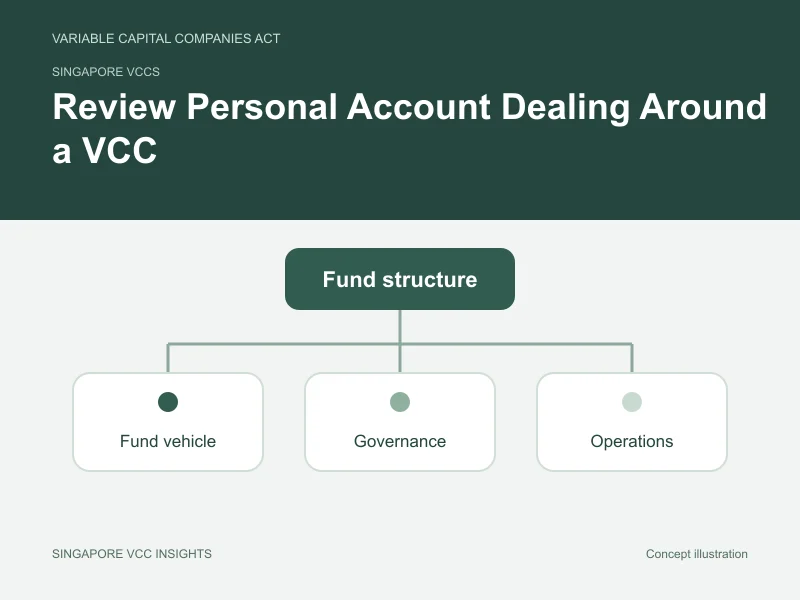
Review personal account dealing around a VCC by identifying the person and connected accounts, the security or issuer, information available to that person, the VCC trading chronology, pre-clearance evidence and any restriction in force. Do not decide from timing alone. Compare access, intent, approvals, fund impact and repeated patterns. Hold unresolved cases, preserve original records and route the conclusion through the manager’s conflicts and compliance authorities.
At a glance
- Define the people and connected accounts covered by the manager’s actual policy.
- Compare information access and fund activity using one reliable chronology.
- Use pre-clearance as evidence, not as an automatic defence.
- Escalate suspicious timing, incomplete declarations and repeated exceptions.
- Report VCC impact without spreading unnecessary personal information.
Who this is for
- Manager personnel, relevant connected accounts and VCC-related securities or instruments covered by the actual conflicts framework.
Important exclusions
- A legal conclusion about market misconduct, employment discipline or the coverage of a specific person without reviewing the governing policy and facts.
Define the person, account and instrument
Start with the manager’s actual policy scope. Identify the employee, director, representative, contractor or other person involved and every connected account that the policy treats as relevant. Record beneficial control, trading authority and who made the decision. Then identify the issuer, instrument, related securities and any derivative or fund interest that can create similar exposure. ACRA describes the VCC director and fund manager as different roles in the structure, while MAS risk material emphasises governance, conflicts and controls around investment activity. The review should preserve those responsibility boundaries.
Sources: Accounting and Corporate Regulatory Authority · Monetary Authority of Singapore · Accounting and Corporate Regulatory Authority- Identify the person, role, reporting line and access rights during the period under review.
- List personal, household, controlled and discretionary accounts covered by the manager’s approved dealing policy.
- Map the traded security to related issuers, instruments, derivatives and VCC positions that may create an equivalent conflict.
- Capture who initiated, approved and executed the transaction and whether another person held genuine discretion.
- Preserve declarations and account evidence without copying unnecessary private data into broad governance records.
Related guidance: side-letter governance control
Build one information and trading chronology
Bring the relevant events into one sequence: investment research access, committee papers, restricted-list changes, VCC orders, broker communications, pre-clearance, personal orders, fills and later amendments. Use system timestamps and source records where available. Do not assume that a personal order before a fund trade proves advance knowledge, or that an order after a fund trade is harmless. The purpose is to identify what the person knew, what authority they had, what the VCC was doing and whether the stated explanation fits the evidence.
Sources: Monetary Authority of Singapore · Accounting and Corporate Regulatory Authority| Event | Evidence | Control question | Escalation signal |
|---|---|---|---|
| Information access | Permissions, meeting records and document logs | What relevant information was available? | Access is broader than the declared role |
| Fund decision | Research, approval and order records | When did the VCC decide or act? | Personal activity clusters around fund decisions |
| Pre-clearance | Request, checks, response and conditions | Was approval based on complete facts? | Instrument or account was misdescribed |
| Personal execution | Broker statement and order events | Did the trade match the approved terms? | Timing, size or instrument changed |
| Post-trade review | Holdings reports and exception alerts | Was the result detected and explained? | Repeated late or missing disclosure |
Related guidance: cross-sub-fund conflicts register
Decide whether to clear, hold or investigate
Apply the approved policy to the verified facts. A clean pre-clearance record can support the decision, but it cannot cure omitted accounts, inaccurate instrument details, later access to sensitive information or a changed trade. Consider fund activity, information sensitivity, personal benefit, investor impact, pattern history and the credibility of the explanation. Where facts remain incomplete, preserve the position and restrict further dealing as authorised by policy while the appropriate compliance or legal authority determines the next step.
Sources: Monetary Authority of Singapore · Accounting and Corporate Regulatory Authority · Accounting and Corporate Regulatory Authority- Facts and approvals alignRecord the evidence, applicable policy route and reviewer conclusion, then complete ordinary monitoring without overstating assurance.
- The approval request was incompleteHold the conclusion, obtain the missing account, instrument or information-access evidence and reassess the original decision.
- Timing or access creates a concernPreserve records, restrict further activity where authorised and escalate through the protected investigation route.
- A repeated pattern appearsReview the wider population, supervision, access design and policy effectiveness rather than closing each event separately.
Related guidance: VCC board conflict decision framework
Remediate without weakening confidentiality
Correct holdings records, declarations, access permissions and monitoring rules through traceable processes. If VCC investors, orders or allocations were affected, route those consequences through the relevant fund controls without embedding personal investigative detail in every operating record. The VCC board may need an impact, control and closure summary, while the manager retains protected personnel and investigation material. Test whether revised alerts identify the original pattern and whether supervisors challenge late, missing or implausible declarations.
Sources: Monetary Authority of Singapore · Accounting and Corporate Regulatory Authority · Accounting and Corporate Regulatory Authority- PreserveLock the original requests, approvals, access logs, fund chronology and account evidence before any correction is made.
- ContainApply authorised restrictions to relevant accounts, information or activity while material facts remain unresolved.
- CorrectRepair declarations, holdings, access and VCC records through controlled entries that retain the earlier history.
- ImproveChange policy wording, account coverage, data feeds, alerts or supervision where the event exposed a repeatable gap.
- CloseApprove closure only after the investigation route, VCC impact actions and independent control testing are complete.
Related guidance: VCC board management information pack
Frequently asked questions
Which personal accounts should be included?
Use the manager’s approved policy and the facts. It may cover accounts owned, controlled or influenced by the person, as well as certain connected or household accounts. Do not assume that a different name on an account removes it from review when the person makes the decisions.
Does pre-clearance automatically resolve the concern?
No. Pre-clearance is one control record. Check whether the request accurately described the account, instrument, size and timing, whether relevant information or fund activity changed, and whether the executed trade stayed within any condition placed on the approval.
What if the personal trade happened before the VCC order?
Timing is important but not decisive by itself. Review when research began, who received it, when the fund decision formed, whether an order was expected and what the person knew. Use system evidence and a complete chronology before reaching a conclusion.
Should the VCC board see the employee’s full investigation file?
Usually the governance need is an accurate summary of fund impact, control weakness, decisions and closure. Keep sensitive personal or legally protected material within authorised channels, while giving the board enough verified information to discharge its oversight responsibilities.
How can repeat dealing problems be detected?
Aggregate exceptions by person, account, issuer, timing, approval route and VCC activity. Test missing or late declarations, repeated use of exceptions and unusual access. Trend monitoring is more useful than closing each event without comparing it to the wider population.
Official sources and further reading
- Risk Management Practices for Fund Management Companies (Monetary Authority of Singapore)
- Choosing Directors and Key Officers for a VCC (Accounting and Corporate Regulatory Authority)
- Overview of Managing a Variable Capital Company (Accounting and Corporate Regulatory Authority)
- Financial Institutions Directory: Fund Management (Monetary Authority of Singapore)
Discuss a Singapore VCC structure
For help coordinating a Singapore VCC setup or corporate administration, contact Raffles Corporate Services.
General information only. This article is not legal, tax, regulatory or investment advice and does not imply affiliation with or endorsement by ACRA, MAS or IRAS.