Singapore VCC insights
VCC Act 2018 — Section 29 sub-fund segregation — Step-by-step walkthrough
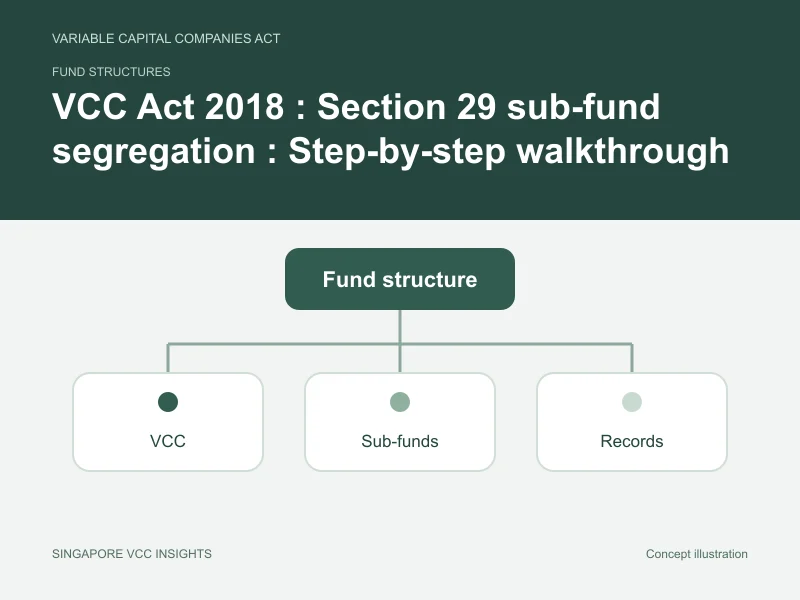
VCC Act 2018 Section 29 sub-fund segregation is the statutory rule that lets a Variable Capital Company create separate sub-funds whose assets and liabilities are ring-fenced from one another. Under the Variable Capital Companies Act 2018, the assets of one sub-fund cannot be used to meet the liabilities of another. This walkthrough explains how the segregation works and what it requires.
Raffles Corporate Services works with a panel of corporate and employment law firms; this article is general information, not legal advice.
What VCC Act 2018 Section 29 sub-fund segregation establishes
Section 29 of the Variable Capital Companies Act 2018 is the heart of the umbrella-VCC structure. It provides that the assets of a sub-fund are segregated and must be used only to discharge the liabilities of that sub-fund, and that the liabilities of one sub-fund are not the liabilities of any other or of the umbrella VCC itself. This statutory ring-fence is what makes a single VCC able to host multiple strategies without cross-contamination of risk.
Importantly, the segregation operates as a matter of Singapore law even though sub-funds are not separate legal persons. The umbrella VCC is the single legal entity that contracts; the sub-fund is a segregated portfolio within it. Section 17 of the Act establishes that legal personality, and our on-site walkthrough on VCC Act 2018 covers it in detail.
How the ring-fence works in practice
When a VCC enters a contract for a particular sub-fund, it must, so far as practicable, make the counterparty aware that it is acting for that sub-fund. Section 29 then ensures that the counterparty’s recourse is limited to that sub-fund’s assets. On a winding up, each sub-fund is wound up as if it were a separate legal person under the dedicated VCC insolvency regulations, which preserves the segregation even in distress.
This is the key advantage over a conventional company holding several portfolios, where creditors could in principle reach all the company’s assets. For fund managers comparing structures, our cross-site note on MAS streamlined fund manager framework 2026 explains the streamlined fund-manager framework that governs who may manage these vehicles.
Who uses sub-fund segregation
Umbrella VCCs with segregated sub-funds suit fund managers running multiple strategies, share classes or investor groups under one corporate roof, reducing set-up and maintenance cost while preserving legal separation. Each sub-fund maintains its own assets, register and accounts, but they share the umbrella’s directors, registered office and corporate secretary. For investors entering through a holding structure, our cross-site guide on Sole proprietorship vs LLP vs Pte Ltd covers the underlying incorporation choices.
Step-by-step to establish a segregated sub-fund
The process runs: incorporate or use an existing umbrella VCC, ensure the constitution permits sub-funds, register each sub-fund with ACRA (which issues a sub-fund registration), open segregated bank and custody accounts, maintain separate accounting records, and document on every contract which sub-fund is acting. Each sub-fund must be registered before it commences activities, and ACRA maintains a register of sub-funds.
Cost, timeline and numbers
Registering an additional sub-fund within an existing VCC typically costs S$1,000 to S$3,000 in professional fees plus the ACRA sub-fund registration fee, and can be completed in one to two weeks. The umbrella VCC must have at least one director ordinarily resident in Singapore and a Singapore-based fund manager. There is no statutory cap on the number of sub-funds, but each carries its own audit and administration cost.
Common mistakes
The classic error is failing to make counterparties aware that the VCC contracts for a specific sub-fund, which can blur the ring-fence. Others include commingling assets across sub-funds in shared accounts, not registering a sub-fund before it transacts, and assuming a sub-fund can sue or be sued in its own name, which it cannot because only the umbrella VCC has legal personality.
FAQs on VCC Act 2018 Section 29 sub-fund segregation
Are sub-funds separate legal entities? No. Under the VCC Act 2018 only the umbrella VCC has legal personality; sub-funds are segregated portfolios within it.
Can one sub-fund’s assets meet another’s liabilities? No. Section 29 ring-fences each sub-fund’s assets to its own liabilities.
Must each sub-fund be registered? Yes. Each sub-fund must be registered with ACRA before it commences activities.
How are sub-funds wound up? Each sub-fund is wound up as if it were a separate legal person under the VCC insolvency regulations, preserving the segregation.
Authoritative sources: Singapore Statutes Online. See also ACRA. See also the Monetary Authority of Singapore.
Need help with this? Call, SMS or WhatsApp +65 8501 7133, or email hello@rafflescorporateservices.com. Raffles Corporate Services works with a panel of corporate and employment law firms; this article is general information, not legal advice.